China urges US to revoke proposed telecom restrictions, warns of damage to bilateral ties
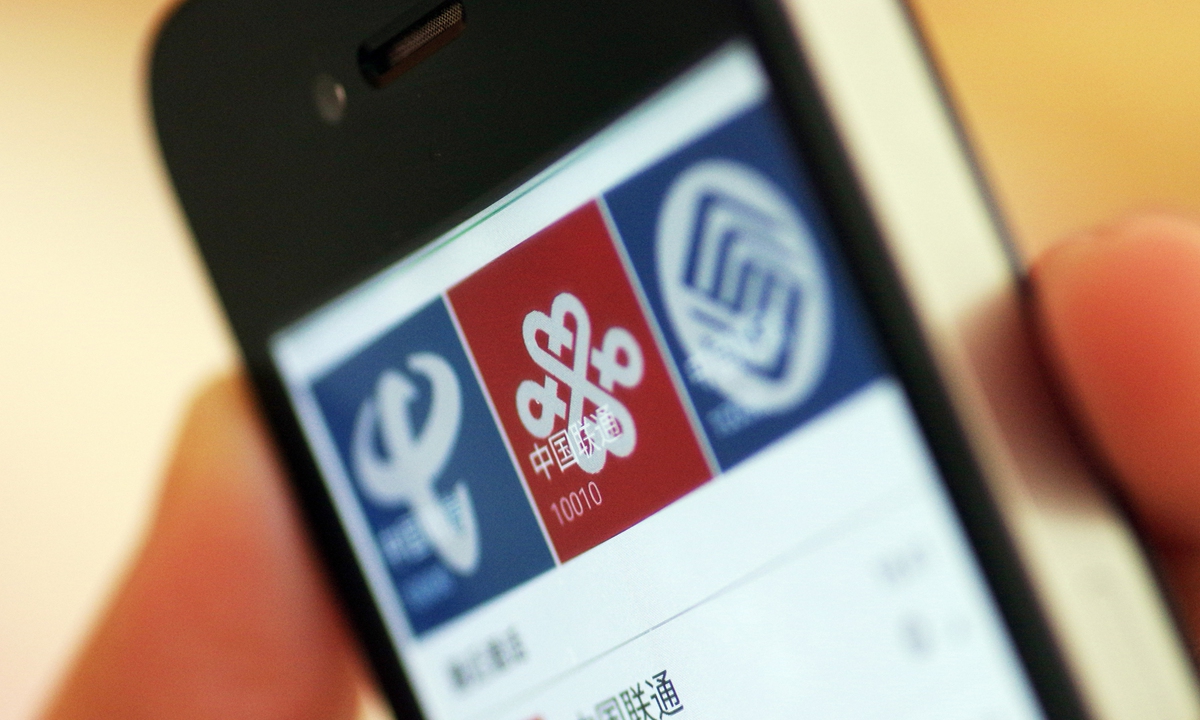
Logos of China's three major telecom operators China Telecom, China Unicom, and China Mobile Schematic photo: VCG
China's Ministry of Commerce (MOFCOM) on Sunday called on the US to revoke proposed restrictions on Chinese telecom operators' direct access to US phone numbers, saying the move violates the principles of non-discrimination and fair competition.
The response came after the US Federal Communications Commission (FCC) voted on Thursday to bar China Mobile, China Telecom, and China Unicom from directly obtaining US phone numbers for internet-based calls. The FCC had previously barred the three operators from providing international telecommunications services in the US, Reuters reported.
Chinese experts warned that the US move reflects Washington's growing tendency to overstretch the concept of national security and politicize normal economic and trade activities. While its direct financial impact on major Chinese telecom operators would be limited, the restrictions could raise costs for cross-border businesses, undermine market competition and technological cooperation, and erode mutual trust at a time when the two countries are seeking to stabilize bilateral economic and trade relations.
Unjustified restrictions
In a statement released on Sunday, MOFCOM said the US FCC abused its regulatory powers and overstretched the concept of national security while making groundless accusations against Chinese telecom companies and maliciously undermining their operations in the US, a commerce ministry spokesperson noted in response to a media query.
The FCC has recently continued to push to decouple and sever supply chains between China and the US in telecommunications, communications, testing, and certification, the spokesperson added.
This runs counter to the important consensus reached by the two heads of state and undermines the stability of China-US economic and trade relations, the spokesperson said.
China urges the US to immediately rescind the measures and return to the right way of resolving issues through consultations, the spokesperson said, noting that China will take necessary measures to firmly safeguard its own interests.
The FCC claimed that the restrictions were intended to address "national security" concerns and prevent scam-related robocalls.
Zhou Mi, a senior research fellow at the Chinese Academy of International Trade and Economic Cooperation, told the Global Times on Sunday that the US restrictions would interfere with normal market competition, erect discriminatory barriers against Chinese telecom operators, and undermine fair competition in the telecommunications industry.
If implemented, the measures would prevent affected Chinese operators from directly providing certain internet-based telephone services to US customers, restricting their ability to expand in the American market. But the consequences would extend beyond Chinese companies, Zhou said.
By restricting competition, the US risks hurting its own consumers, limiting their choices and putting greater pressure on service prices and quality, Zhou said. "Excluding market participants could weaken incentives for investment and innovation, ultimately hindering technological progress," he added.
Ma Jihua, a veteran telecom industry analyst, told the Global Times that the restrictions would have a negligible direct impact on the revenues of China's three major telecom operators, given their already limited business presence in the US.
The measure does not amount to a blanket ban on calls between the two countries but targets Chinese operators' direct access to US numbering resources, he explained.
However, Ma warned that the limited financial impact on Chinese operators did not mean the restrictions would come without costs for the US. Businesses relying on cross-border internet-based voice services, including exporters, e-commerce companies, and overseas offices, could face higher costs and longer service activation times if forced to obtain numbering services through US-based providers.
While ordinary US consumers were unlikely to face immediate disruption to international calls, higher operating and compliance costs could eventually be passed on to US businesses and then consumers, Ma said.
Ma also questioned the effectiveness of the restrictions in combating telecom fraud, noting that scammers do not rely solely on direct access to US telephone numbering resources. They could still make fraudulent calls through third-party providers, internet-based calling services, or caller ID spoofing. Simply restricting Chinese telecom operators' direct access to US numbers may therefore do little to curb such activities.
He further warned that the restrictions could force legitimate telecommunications services to rely on more third-party providers, making communication channels more complex. With more intermediaries involved, regulators could face greater difficulties tracing the origins of suspicious calls and identifying those responsible.
Consensus needs action
The latest US restrictions contrast with recent efforts by Beijing and Washington to stabilize bilateral relations and expand economic cooperation.
During the November 19 meeting in Shenzhen on the sidelines of the Asia-Pacific Economic Cooperation (APEC) Economic Leaders' Meeting, the two countries' heads of state agreed to develop an action plan for a constructive relationship of strategic stability, according to the Chinese Foreign Ministry.
At the meeting, China called for a longer list of cooperation and a shorter list of problems and stressed that differences that cannot be resolved for the time being should be managed in a constructive way, and escalation should be prevented.
The talks followed the first meeting of the bilateral trade council on November 13, when officials discussed tariffs and agricultural trade and agreed to maintain communication.
Earlier on October 29, the FCC had voted to bar Chinese laboratories from testing electronics for the US market.
According to Ma, the latest measures reflected an expansion of US restrictions beyond hardware and equipment to telecommunications numbering resources and computing power.
Such an approach could disrupt the global division of labor in telecommunications and raise costs for multinational businesses, Ma said. He warned that continued restrictions could encourage companies to develop alternative communications and computing systems, potentially weakening the global influence of US technology standards.
The restrictions could undermine the mutual trust needed to implement the leaders' consensus and complicate efforts to resolve existing disputes and address emerging technological challenges, Zhou said.
Some US politicians should demonstrate their commitment to cooperation through concrete actions rather than allowing unilateral restrictions to erode mutual trust, Chinese analysts stressed.
RELATED ARTICLES