China’s hidden robotics engine: How towel racks, vacuum motors, and car sensors became backbone of embodied AI
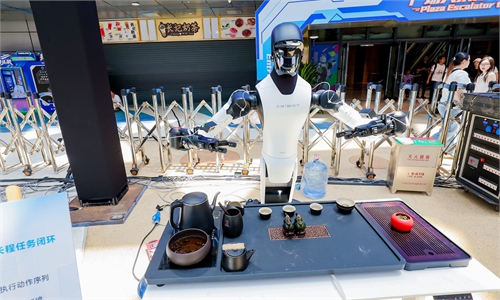
A booth at the 2026 World Intelligent Manufacturing Conference held in Nanjing, East China's Jiangsu Province on November 19, 2026 Photo: VCG
China's earnings season is usually filled with familiar stories of smartphones, electric vehicles, and consumer electronics. This quarter, something quieter but far more consequential is emerging in the footnotes: embodied intelligence.
The companies talking about robots are not all pure-play robotics firms. Many started by making heated towel rails, heating, ventilation, and air conditioning (HVAC) components, small-appliance motors, or smartphone parts. Their robot-related revenue remains tiny - often less than 1 percent of their sales. Yet those small numbers signal a profound migration.
Unlikely entrants
At a third-quarter results briefing on Wednesday, Shanghai Longcheer Technology Co, a major smartphone contract manufacturer, revealed that its data-collection equipment for embodied robots has entered mass production and is being delivered to customers. By the end of October, the business still accounted for no more than 1 percent of revenue.
One percent is easy to dismiss in a financial report. However, analysts pointed out that what it actually shows is harder to ignore: a company whose core competence is high-volume consumer-electronics manufacturing is now building the tools that train robots.
Around the same time, Jiangxi Avonflow HVAC Tech Co, best known for electric heated towel rails and HVAC products, announced that its subsidiary Yunxin Robotics have signed a precision structural-parts supply deal with a leading North American humanoid robot maker. The first batch of orders has been scheduled for production. The parts will go into critical load-bearing joints of the customer's next-generation humanoid robots.
These are not isolated experiments. They are the visible edge of a much broader pattern: China's existing manufacturing base is being repurposed for robotics at industrial scale, industry insiders noted.
Probably nowhere is the continuity clearer than in the motor workshops.
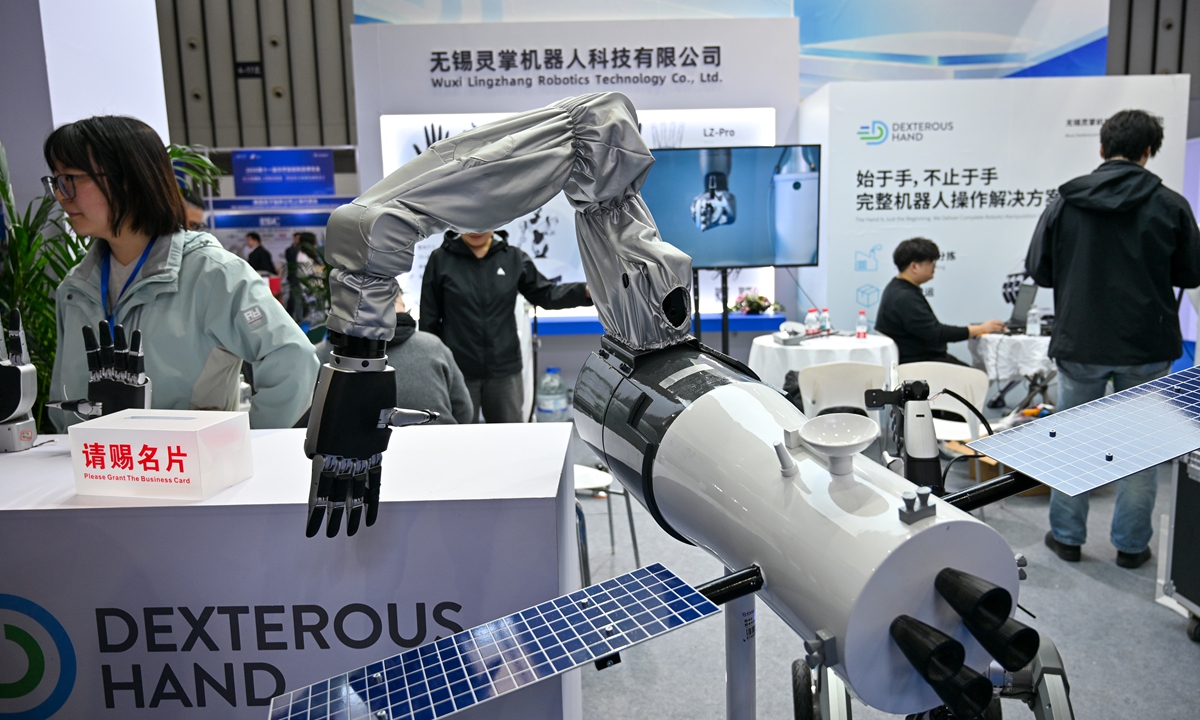
Ningbo Dechang Electrical Machinery Made Co began with vacuum-cleaner motors, moved into automotive electric power steering (EPS) motors, and is now producing joint motors for dexterous hands of robots. Some models have passed validation and have their initial designs finalized, with small-batch deliveries already underway, the company told investors recently.
New production lines
Jiangsu Leili Motor Co offers an even cleaner case study of industrial upgrading. Before its 2017 IPO, nearly 90 percent of revenue came from home-appliance motors, but its margins steadily eroded. The company then entered a new market by making medical micro-motors in 2019 and automotive motors around the same time. Automotive revenue grew from some 100 million yuan ($15 million) in 2017 to 940 million yuan in 2025.
In 2025, the company's robot components entered the supply chains of multiple domestic and international robot makers, module suppliers, and dexterous hand companies. In 2024, the company achieved mass production across its full range of hollow-cup motors, also known as ironless motors. A single tendon-driven dexterous hand needs 15 or 16 of these motors, a company executive said.
Now, from the motors of refrigerators and air conditioners, to the driving motors of automotive LiDAR systems, the voice coil motors in medical precision instruments, and the power cores of humanoid robots and quadruped robotic dogs, Leili's motor products can be found almost everywhere.
In the first half of 2026, Leili's robot-related parts revenue was only 17.84 million yuan - 0.77 percent of total sales - but it grew 115 percent year-on-year. The numbers remain small, but the trajectory has changed for the better.
A similar shift is taking place among suppliers of LiDAR sensors, often dubbed the "eyes" of intelligent cars.
RoboSense, long known as a supplier of automotive LiDAR sensors, saw its robot business explode. In the first quarter of 2026, it shipped 185,500 LiDAR units for robots - up 1,459 percent year-on-year - accounting for 56 percent of total volume and surpassing its advanced driver assistance systems business for the first time. The company expected more than 600,000 units for lawn-mowing robots alone in 2026, after just 200,000 in all of 2025, the Global Times learned from the company.
Hesai Technology, also a major LiDAR sensor provider, showed a similar shift. In the third quarter of 2026, robot-related revenue already exceeded half of the company's quarterly sales, with roughly 91,600 robot LiDAR units shipped.
"Experience in home appliances provided scale and cost discipline; experience in the automotive sector supplied reliability and consistency; robotics is the same manufacturing system pushed to still higher precision," Wang Peng, an associate researcher at the Beijing Academy of Social Sciences, told the Global Times.
An industry insider surnamed Zeng told the Global Times that China's manufacturing base for embodied intelligence was not built overnight for this moment. It is the accumulated capacity of two successive manufacturing cycles - home appliances and automobiles - finding a new outlet in 2026.
"The companies making towel rails and phone parts are not suddenly becoming robot visionaries. They are doing what Chinese manufacturing has always done best: taking an existing industrial capability and extending it, at scale and at rapidly falling cost, into the next high-growth domain," said Zeng.
Mass production
Repurposing production lines has measurably reduced costs in the robotic industry, enabling Chinese companies to supply cheaper components and support mass production of embodied robots worldwide.
For example, some dexterous hands that once sold for hundreds of thousands of yuan fell to 20,000-50,000 yuan in 2025. By 2026, some models priced at around 10,000 yuan are in volume production, with entry-level versions under 6,000 yuan.
Joint modules, harmonic reducers, and planetary roller screws - all crucial components of robot manufacturing - are following a similar downward price trend. A joint motor that cost 50,000-60,000 yuan in 2018 now costs only 500-600 yuan.
"That price collapse is not the work of any single company. It is the natural release of cost potential from a supply chain now optimized for consumer electronics and automotive precision manufacturing," said Wang.
The global numbers reflect the shift. In the first half of 2026, roughly 19,100 humanoid robots were shipped worldwide; Chinese manufacturers accounted for more than 97 percent of them. China's ability to produce at volume has not only lowered the price of complete robots; it has turned once-premium components such as dexterous hands and force sensors into standard equipment.
RELATED ARTICLES