Unitree sheds over 200b yuan in first trading week as analysts see rational repricing, upbeat in long-term prospects
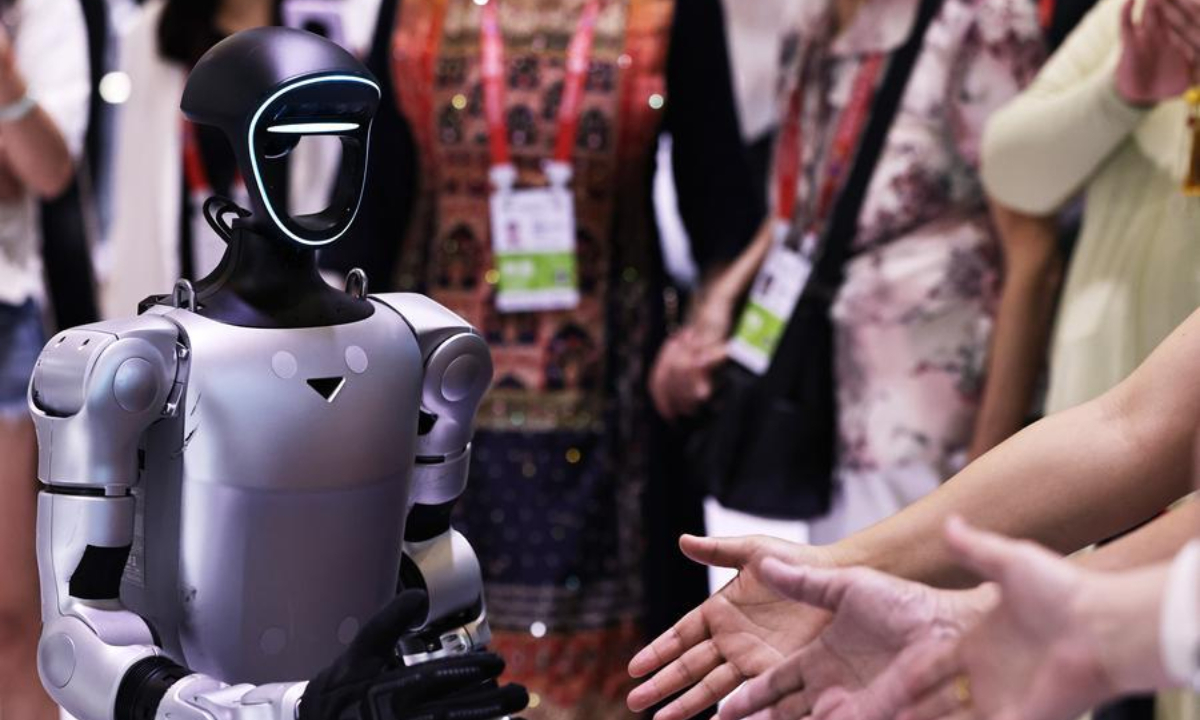
Visitors interact with a robot from Unitree Robotics during the sixth China International Consumer Products Expo (CICPE) in Haikou, south China's Hainan Province, April 14, 2026. (Xinhua/Gao Jing)
Just one week after its blockbuster Shanghai's STAR Market debut, Chinese humanoid robotmaker Unitree Robotics has lost more than 200 billion yuan ($28 billion) in market value from its opening-day peak, in a rapid repricing that analysts said is bringing expectations back toward the company's current fundamentals and the commercial reality of humanoid robotics.
Unitree closed on Wednesday at 591.53 yuan, down 1.87 percent, valuing the company at about 239.3 billion yuan. The stock has retreated 46.2 percent from its record high of 1,100 yuan, wiping 205.6 billion yuan off its peak market capitalization.
When trading opened on August 19, Unitree surged to 1,100 yuan, briefly valuing the company at 444.9 billion yuan. At that price, investors allotted one standard IPO lot of 500 shares were sitting on paper gains of nearly 475,000 yuan, setting a record for opening-day profits among registration-based IPOs in China.
The correction hardly erased the enthusiasm surrounding the listing. Unitree shares remained well above their IPO price of 150.80 yuan. The stock was trading at a static price-to-earnings ratio of about 877 times, according to media calculations, compared with a 38.56-times industry average.
Unitree's elevated initial valuation reflected both confidence in the long-term prospects of embodied intelligence and a degree of speculative enthusiasm, Hu Qimu, a professor at the Maritime Silk Road Institute of Huaqiao University, told the Global Times on Wednesday.
"As the market gradually cools and some investors lock in gains, a pullback is not unexpected," Hu said, describing the recent decline as part of a broader return toward more rational pricing.
Veteran industry analyst Liu Dingding agreed with that view. "Market enthusiasm was too high and pushed the company to a valuation that did not belong to its current stage of development," Liu told the Global Times, saying the correction broadly matched earlier expectations of many industry observers.
A tight tradable float also helped amplify the initial surge. Only about 30.09 million of Unitree's 404.46 million shares, or 7.44 percent, were available for trading at the outset, meaning strong investor demand was concentrated on a relatively small pool of stock and could more easily push up the share price in the short term, industry analysts said.
The gap between market enthusiasm and institutional valuations was also striking. Nomura initiated coverage with a "buy" rating but set a target price of 370 yuan, based on a 25-times forecast 2027 price-to-sales multiple, implying a valuation of roughly 150 billion yuan.
Nomura also highlighted Unitree's manufacturing strengths. The company develops and produces key components including motors, reducers, encoders and driver boards in-house, while externally sourced parts account for only 14 to 18 percent of costs. Its gross margin rose from about 44 percent in 2022 to about 60 percent in 2025.
The harder question is how quickly those advantages can become sustainable returns, as humanoid robots remain some distance from an ideal state of commercialization, observers noted.
"Compared with human labor, robots do not yet have a universal cost advantage," Hu said, adding that "product maturity, production-line upgrades and supporting infrastructure also determine whether robots can be deployed effectively."
Hu said that a return to more rational valuations could ultimately benefit the industry by refocusing attention on further cost reductions, deeper integration with the real economy and applications where robots can deliver genuine value.
Unitree rolled out four humanoid robot series - H1, G1, R1 and H2 - over roughly 26 months from August 2023 to October 2025, according to its prospectus and company disclosures. It has built a robotics product portfolio centered on "mobility, manipulation and interaction."
But the structure of demand shows why commercialization remains the central test. Reports citing Nomura said that research institutions accounted for more than 70 percent of Unitree's humanoid-robot revenue in the first nine months of 2025, while revenue from industrial and commercial applications remained relatively limited. The brokerage also flagged tighter US market access and intensifying competition as risks.
Competition is also intensifying. Industry data cited by Chinese media outlets showed AgiBot shipped about 8,400 humanoid robots in the first half of 2026, compared with around 5,900 for Unitree.
Liu nevertheless said that such volumes show that leading Chinese robotmakers are entering large-scale shipments and commercial validation. Capital can accelerate research and production, he said, but it ultimately needs to be anchored in real commercial value and sustainable operations.
Unitree may also be only the beginning of a broader listing wave. In Hong Kong alone, at least 46 robotics-related companies are in the IPO pipeline, accounting for more than 10 percent of all listing applicants, according to media reports. Leju Robotics and Deep Robotics are among those companies.
Hu remained upbeat about the sector's longer-term prospects, citing China's complete manufacturing supply chain and wide range of potential applications. But he stressed that commercialization will require greater selectivity: humanoids, quadrupeds, wheeled robots and robotic arms each have different cost and efficiency advantages. "The industry needs to look more rationally at which type of robot genuinely fits which application," Hu said.
RELATED ARTICLES