Unitree’s shares surge 460% on Shanghai market debut, validates China’s hard-tech path: expert
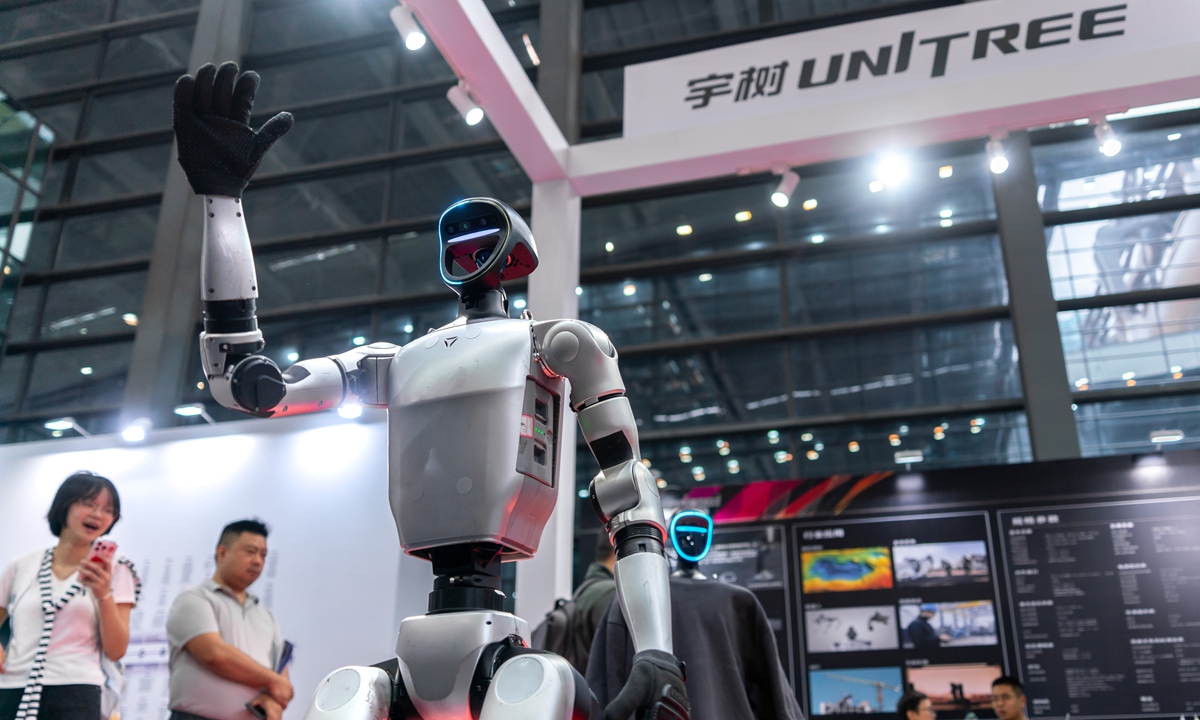
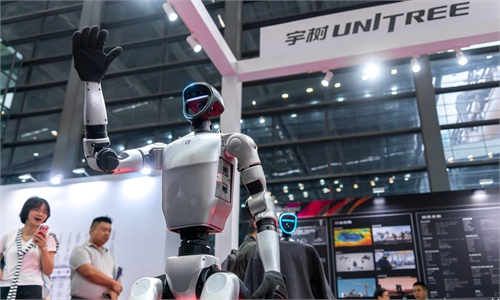
Unitree Robotics' humanoid robot is displayed at the 14th China Information Technology Expo in Shenzhen, South China's Guangdong Province, on April 10, 2026. Photo: VCG
Shares of Chinese humanoid robotmaker Unitree Robotics soared on their debut on Wednesday on the STAR Market of the Shanghai Stock Exchange. The shares surged 629.44 percent at the opening and closed 460.34 percent higher, giving the company a market capitalization of 341.77 billion yuan ($50.68 billion).
Unitree has become the first humanoid robot stock on the A-share market, signifying the transition of China's humanoid robotics industry from technological accumulation to large-scale commercialization. Moreover, the company's path to capitalization demonstrates that China's hard-tech route has proven viable, which will encourage more enterprises with original technology to enter the public markets, a Chinese expert said.
On the first day of trading, it opened at 1,100 yuan per share, with the total market capitalization once reaching 444.9 billion yuan. Calculated at the opening price, one successful allotment (500 shares) yielded a floating profit of 474,600 yuan.
Unitree issued 40.45 million shares in this offering, accounting for 10 percent of the total share capital after the issuance. The issue price of 150.80 yuan per share ranked second among STAR Market IPOs this year, with total proceeds reaching approximately 6.099 billion yuan, the company told the Global Times on Wednesday.
Online subscription enthusiasm was high. The number of valid subscription accounts for the offering reached 9.7846 million, making it the new stock with the most accounts participating in IPO subscriptions since the launch of the STAR Market, the company said.
In addition, the allotment rate fell below 0.02 percent — a historic low for the STAR Market — the price-earnings ratio far exceeded the industry average, and the valuation rose more than 4,000-fold over a decade. Every figure underscored just how extraordinary this IPO is, experts said.
"The capital market has demonstrated extreme enthusiasm for the embodied intelligence sector. As the first humanoid robot stock, it highlighted a frenzied influx of capital driven by scarcity premium and market sentiment," Chen Jing, a vice president of the Technology and Strategy Research Institute, told the Global Times on Wednesday.
Chen said that the capital market is bullish on Unitree, primarily due to the dual scarcity of its full industrial-chain autonomy and controllability, combined with its position as a global leader.
According to its prospectus, the company's humanoid robot shipments exceeded 5,500 units in 2025, achieving a global market share of 32.4 percent and ranking first worldwide. The self-developed and self-produced rate of core components exceeds 90 percent. From motors and reducers to controllers, all have achieved independent controllability, establishing a full-stack self-research technological barrier.
The company's revenue grew from 159 million yuan in 2023 to 1.699 billion yuan in 2025, with a compound annual growth rate of 226.78 percent. It turned from a loss of 18.02 million yuan to a profit of 591 million yuan over those years, making it one of the few companies in the embodied intelligence sector to achieve scaled profitability.
Chen said that Unitree's performance also demonstrated that the capital market's spotlight is shifting toward rising tech stars — those science and technology innovation enterprises that master core technologies and represent the direction of the future.
In June 2025, the China Securities Regulatory Commission officially launched the pre-review mechanism on the STAR Market. Benefiting from this, Unitree's IPO took only 104 days from application to registration approval, setting a new record.
In addition, the company's strategic placement attracted prominent investors, including Chinese artificial intelligence (AI) start-up DeepSeek, the National Council for Social Security Fund, investment arms linked to China National Petroleum Corp, China Southern Power Grid and China Telecom, as well as a Tencent-affiliated investment firm.
"Unitree's strategic placement lineup spans AI firms, internet giants, and national-level long-term capital. The participation of AI companies represents the integration trend between large-language models and embodied intelligence, while the entry of long-term funds like the social security fund reflects the state's strategic support for the hard-tech sector," Chen said.
This also marks the robotics industry's transition from pure technology validation to a stage of ecosystem co-construction. Capital is no longer merely chasing concepts, but is instead positioning for the future of "AI + robotics," Chen added.
The expert said that Unitree has provided an important pricing anchor for subsequent IPOs of robotics companies, which will also accelerate the transition of embodied intelligence from laboratory demonstrations to large-scale commercial application and drive the maturation of the upstream core components supply chain.
"Of course, whether a company thrives cannot rely solely on short-term enthusiasm. For the industry, the real long-term test is whether the capital feast can be transformed into technological breakthroughs and commercial implementation," Chen said.
Unitree identified several key risk factors in the prospectus, including the potential for slowing growth and fluctuations in operating performance, and the possibility that its research and development strategy may fall short of expectations.
"In the long run, Unitree's capitalization path has proven that China's hard-tech route is viable. Under the multiple tailwinds of favorable policies and capital, technology companies such as Unitree now have greater confidence to address their shortcomings and plan for the long term," Chen noted.
RELATED ARTICLES