Unitree STAR Market debut may reshape humanoid robot valuations
China’s hard-tech stocks gain momentum as global investors seek new growth drivers
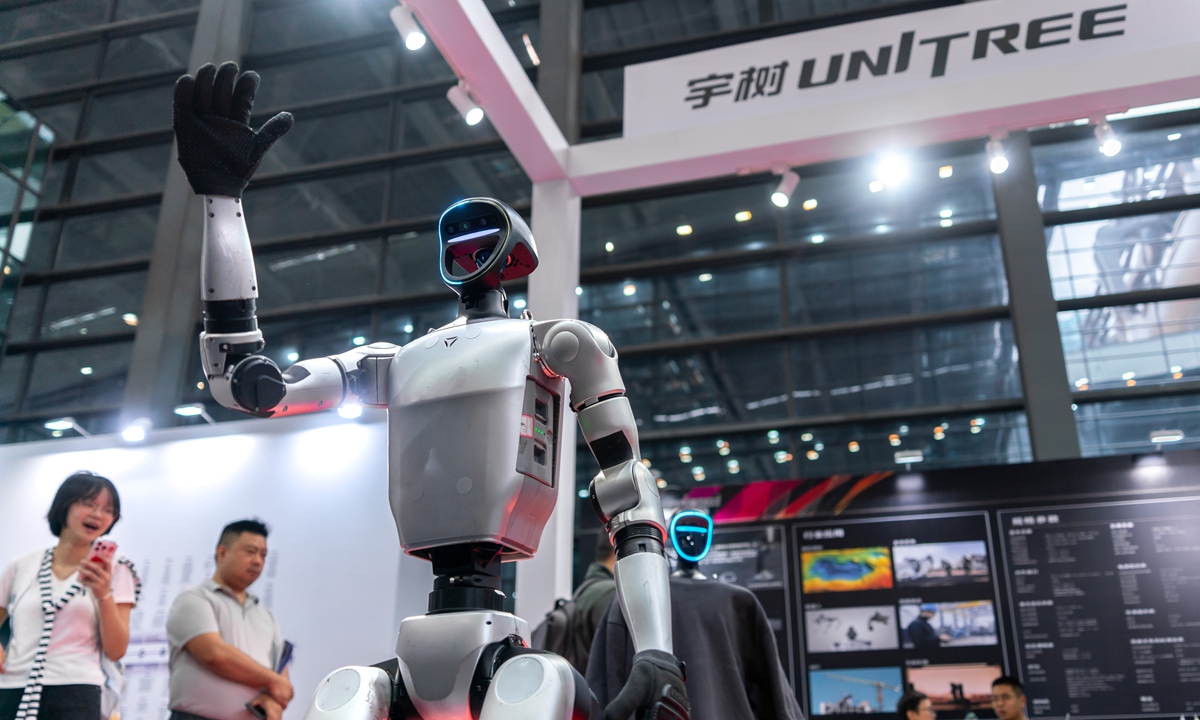
Unitree Robotics' humanoid robot is displayed at the 14th China Information Technology Expo in Shenzhen, South China's Guangdong Province, on April 10, 2026. Photo: VCG
Chinese humanoid robot maker Unitree Robotics is set to debut on the Shanghai Stock Exchange's STAR Market on Wednesday, putting one of China's most closely watched robotics companies under its first major public-market test as investor enthusiasm for hard-tech assets continues to rise.
The listing comes as the 2026 World Robot Conference opens in Beijing and amid a broader wave of Chinese robotics companies seeking access to capital markets. Analysts said Unitree's trading performance could become an important pricing reference for other humanoid robot makers, while also testing whether investor enthusiasm can translate into sustained confidence in the sector's commercialization prospects.
Capital rush
According to the prospectus, Unitree plans to issue no fewer than 40.45 million new shares and raise 4.20 billion yuan ($623 million). Proceeds from the IPO will fund four core projects: intelligent robot model research and development, robot prototype development, new intelligent robot product innovation, and the construction of an intelligent robot manufacturing base, with as much as 85 percent of the proceeds earmarked specifically for R&D.
Unitree's listing on the STAR Market signals that China's humanoid robot industry is moving beyond the early stages of technology validation and capital-driven expansion, Chen Jing, vice president of the Technology and Strategy Research Institute, told the Global Times. The listing of a leading player provides both a valuation benchmark and a financing template for the sector, while planned investment in manufacturing capacity suggests that top companies are already preparing for large-scale production, he said.
According to the announcement, Unitree Robotics priced its offering at 150.80 yuan per share, implying a price-to-earnings ratio of 219.23 times. Based on the offering price, the company's post-issuance market capitalization is estimated at about 60.99 billion yuan.
Unitree Robotics' IPO attracted about 9.78 million valid online subscription accounts, setting a record for a new share offering on the STAR Market. Its final online allotment rate was just 0.01809759 percent, the lowest in the market's history, making it the hardest STAR Market IPO on record for retail investors to secure an allocation in.
The company's strategic placement attracted a group of prominent investors, including Chinese AI startup DeepSeek, the National Council for Social Security Fund, investment arms linked to China National Petroleum Corp, China Southern Power Grid and China Telecom, as well as a Tencent-affiliated investment firm.
Among them, DeepSeek was allocated shares equivalent to 2.31 percent of the offering, subject to a 36-month lock-up period. Unitree said in the announcement that the strategic investment could deepen cooperation in large AI models and embodied intelligence, combining the two companies' technological strengths to improve robots' ability to understand and adapt to complex environments.
From a startup founded in 2016 with registered capital of just 100,000 yuan to a company backed by a roster of prominent investors, Unitree's fundraising journey reflects the broader shift in how the robotics industry has been viewed over the past decade, experts said.
Unitree's strong reception in the capital market has also been underpinned by its robust financial performance. According to its updated prospectus released on August 14, revenue surged from 159 million yuan in 2023 to 393 million yuan in 2024 and 1.70 billion yuan in 2025, representing a three-year compound annual growth rate of 226.78 percent.
The company swung from a net loss of 11.15 million yuan in 2023 to a net profit of 95.47 million yuan in 2024, which rose further to 278 million yuan in 2025. Its gross margin from core businesses, including humanoid robots, quadruped robots and robot components, increased from 44.22 percent in 2023 to 56.74 percent in 2024 and 60.13 percent in 2025.
Hard-tech stocks gain traction
Meanwhile, a number of Chinese robotics companies are preparing for Hong Kong listings, with media reports estimating that 30 to 50 firms could be in the pipeline.
As one of the first major humanoid robot makers to enter the public market, Unitree's post-listing performance could become an important valuation benchmark for peers still in the private market and companies preparing for IPOs, experts said.
Ma Jihua, a veteran technology industry analyst, told the Global Times that Unitree's listing provides the humanoid robot sector with a much-needed "pricing anchor."
"After Unitree's listing, comparable companies will increasingly be measured against concrete indicators such as valuations, shipments, revenue and profits," Ma said.
He noted that the sector is entering a new stage in which investor attention is shifting from concepts and technological narratives toward financial performance, commercialization and delivery capabilities.
Unitree is, however, not an isolated case. Its listing comes amid a broader repricing of Chinese hard-tech assets, with investors increasingly turning toward companies in semiconductors, AI and advanced robotics.
Chinese memory-chip giant CXMT has emerged as another closely watched example of growing investor interest in Chinese hard-tech companies. Just over two weeks after its STAR Market debut, the company's market capitalization surpassed Tencent's at August 13's close, making it China's most valuable listed company.
Overseas funds are also increasing exposure to Chinese semiconductor companies. As of Tuesday, CXMT accounted for 4.91 percent of the Roundhill Memory ETF, making it the fund's sixth-largest holding. Tema ETFs has also added CXMT to its memory-focused ETF, where the Chinese chipmaker accounted for 7.54 percent of holdings as of August 14, according to media reports.
Liu Shaoshan, director of the Embodied AI at the Shenzhen Institute of Artificial Intelligence and Robotics for Society, told the Global Times that the financing structure behind China's latest robotics boom is also changing. Compared with the autonomous-driving wave, which relied more heavily on traditional venture-capital firms, the current robotics boom has seen stronger participation from local state-backed funds, providing greater long-term capital support to hard-tech startups.
However, Liu cautioned that strong financing and high valuations alone will not determine which companies ultimately succeed. As more robotics firms seek listings, the key test will be whether they can generate sustainable revenue, achieve mass production and delivery, and turn technological advances into viable real-world applications.
Chen said the wave of Chinese hard-tech listings reflects a broader shift in investor focus from consumer-internet business models toward companies built on core technological breakthroughs. The rise of listed players in humanoid robotics, AI and semiconductors is also giving private-market investors clearer valuation benchmarks and exit channels, while pointing to a deeper shift in China's tech sector toward original innovation.
Chen said the next phase of technological competition will be shaped by tighter integration of software and hardware, stronger demand from industrial applications and a greater premium on original technologies. How effectively capital markets identify and price genuine technological value, he said, will be increasingly important to China's position in the next wave of global tech competition.
RELATED ARTICLES