China’s Unitree Robotics kicks off STAR Market IPO pricing; valuation may top 109b yuan
First embodied AI A-share listing; valuation may top 109b yuan
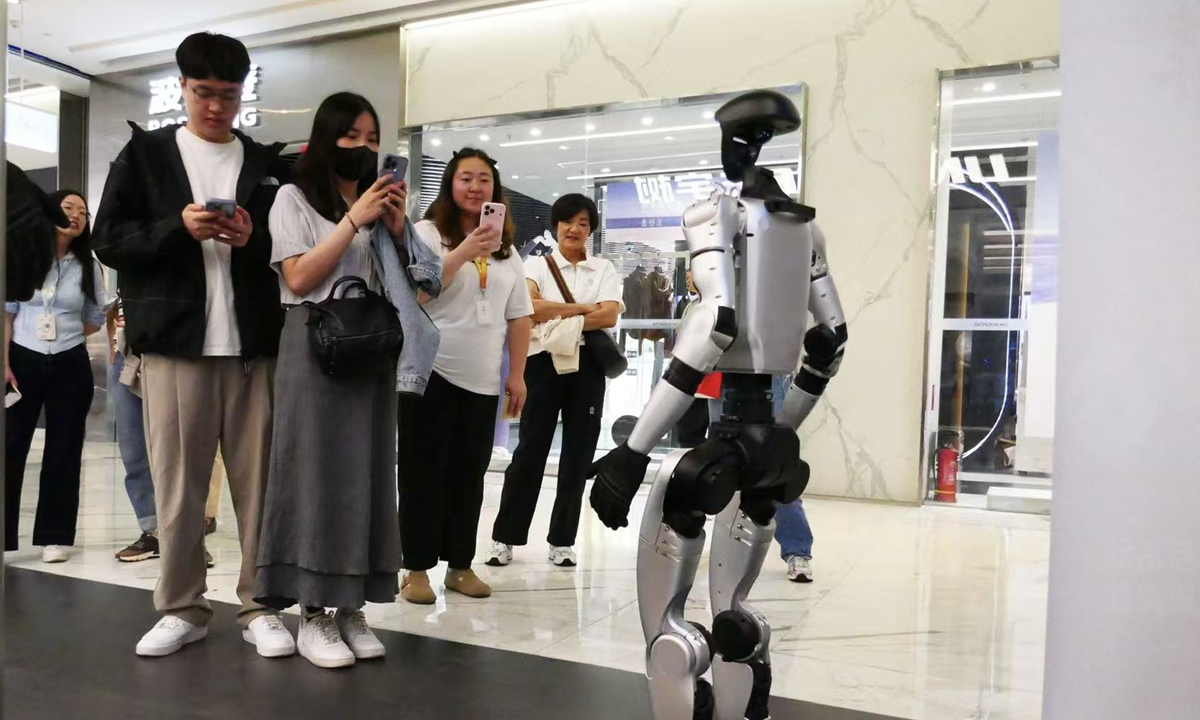
People take photos of the G1 humanoid robot at the Unitree offline store in Beijing on April 30, 2026. Photo: Tao Mingyang/GT
Chinese robot maker Unitree Robotics began preliminary price inquiries on Wednesday for its planned IPO on the Shanghai Stock Exchange's STAR Market. Investment banks estimate its post-listing valuation could exceed 40 billion yuan ($5.9 billion), while CCB International sees it being re-rated to 60 billion yuan to 100 billion yuan, with an optimistic target of 109 billion yuan.
The company's previously released prospectus stated that it plans to raise 4.2 billion yuan through the IPO. It plans to issue about 40.45 million new shares, representing 10 percent of the enlarged share capital after the offering, according to Unitree's prospectus published on SSE. The online and offline subscription date is scheduled for August 10.
Unitree said that proceeds from the IPO will mainly support four areas: 2.022 billion yuan for intelligent robot model research and development (R&D), accounting for nearly half of the total, 1.11 billion yuan for robot body development, 445 million yuan for R&D of new intelligent robot products, and 624 million yuan for building an intelligent robot manufacturing base.
Based on some institutions' estimated 40-billion-yuan post-IPO valuation and the STAR market's standard 500-share lot size, the issue price is preliminarily estimated at around 104 yuan per share. The final price will depend on market demand during the inquiry process, media reported.
The company's IPO fundraising amount is relatively small, but it will help boost the performance of the humanoid robot sector as a whole, Yang Delong, chief economist at Shenzhen-based First Seafront Fund, told the Global Times on Wednesday.
"The robotic sector is one of the six fields - also including semiconductor, computing power/algorithm, commercial spaceflight, solid-state batteries and biomedicine - that benefited from China's fast development of artificial intelligence (AI) technologies," said Yang.
In a report to investors, CITIC Securities, the lead underwriter for Unitree's IPO, estimated that the company's overall valuation could reach 50.6 billion to 55.9 billion yuan within 6 to 12 months after listing, equivalent to about 20 times expected annual sales and roughly 80 times expected earnings.
Institutional analysis also pointed out that Unitree Robotics' listing highlights the strength of China's robot supply chain. The domestic production rate of its supply chain reaches 90 percent, while all core components are fully self-developed.
The China Securities Regulatory Commission approved Unitree's registration application on July 2, clearing the way for it to become the first embodied-intelligence company listed on the A-share market.
The firm expected a revenue of 1.052 billion yuan to 1.128 billion yuan in the first half of 2026, representing a year-on-year growth of 35.62 percent to 45.41 percent, driven by rising demand in the embodied AI sector and expansion of its business, the company said.
From the perspective of product structure, Unitree Robotics' business mix has been gradually shifting in recent years. In 2023, quadruped robots accounted for 75.78 percent of its revenue, while humanoid robots contributed only 1.88 percent.
By 2025, revenue from humanoid robots reached 868 million yuan, representing 51.78 percent of total revenue and becoming the company's largest revenue segment.
According to its IPO prospectus, Unitree shipped more than 5,500 humanoid robots in 2025, ranking No.1 globally.
The advancing IPOs of hard-tech firms signal growing capital market support for technology innovators, enabling them to strengthen R&D, scale operations, and speed up product commercialization, which will in turn fuel further innovation and industrial development, Liu Dingding, a veteran tech industry analyst, told the Global Times.
Prior to Unitree's IPO on the A-share market as the first embodied-intelligence company, UBTech Robotics went public on the main board of the Hong Kong Stock Exchange in December 2023, which was widely hailed as the first IPO of humanoid robots.
A bunch of Chinese hard-tech firms are accelerating their listing process. The IPO filings of Leju Robotics has been accepted by the ChiNext board of the Shenzhen Stock Exchange and that of DEEP Robotics has been accepted by SSE's STAR market.
But Yang also noted that "at present, this industry is still in its early stage of development. There is a high probability that the sector has not yet entered the true growth phase. This is something that investors needs to pay attention to."
Unitree Robotics' co-founder Chen Li said on July 3 that at present, "robots have not been widely applied. The main reason for this is that large models for embodied intelligence have not yet matured."
The core sign that embodied AI has reached its "ChatGPT moment" is simple: two 80 percent - robots can complete about 80 percent of tasks via voice or text commands in 80 percent of unfamiliar scenarios. By 2030, embodied AI robots will spark a new consumer wave and sharply raise social productivity and labor capabilities, said Chen.
RELATED ARTICLES