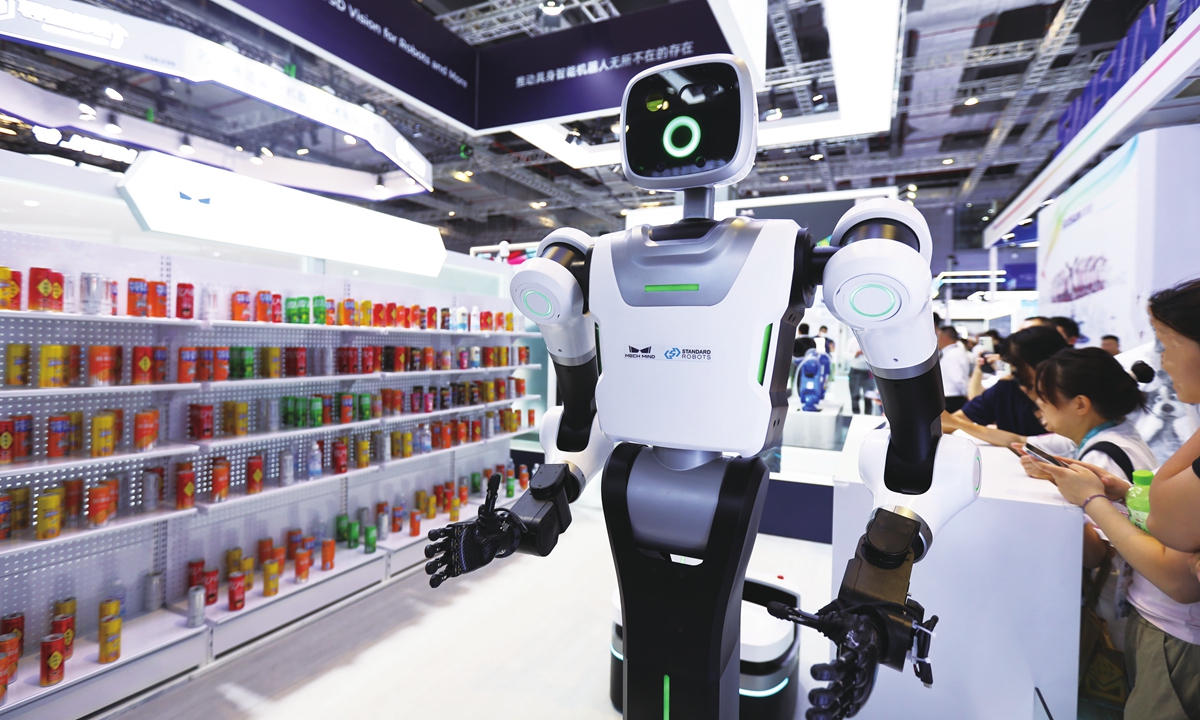
A humanoid robot seeks to retrieve items from a shelf at an industry fair in Shanghai on September 24, 2025. File photo: VCG
Driven by constant tech breakthroughs and growing market adoption, humanoid robots in China are undergoing a notable wave of price cuts this year.
Once high-threshold products costing hundreds of thousands of yuan, some robot models have now entered the 10,000-yuan range ($1,450). The industry's focus has shifted from whether robots could be built to how quickly they will be snapped up by consumers, experts said.
Behind the falling prices is the steady expansion of real-world applications. From designing, manufacturing to being put on display in exhibition halls, humanoid robots are increasingly moving into our daily life.
During the May Day holidays, Unitree Robotics opened a store in a shopping mall in Beijing's downtown Wangfujing Shopping Street, drawing large crowds. Many visitors tried operating the robots, asked staff about product details, and some placed orders on site. Some models are reportedly available for immediate pickup.
"The store only released promotional posters in advance, but the foot traffic and attention on the opening day exceeded expectations," store representative Sun Baoyan told the Global Times.
Changes on the consumer side are evident. Buyers are growing more price-conscious, with robots affordability and practicality becoming key priorities. Robot enthusiast Ding Liandong said that robot dogs used to cost between 60,000 yuan and 80,000 yuan a few years ago, and now, some entry-level robot models have dropped to just over 10,000 yuan, "making them affordable for ordinary families."
"Lower prices have made the products more acceptable to Chinese consumers," Ding told the Global Times. As humanoid robot pricing increasingly aligns with functionality, the market is beginning to segment by demand and price range.
Economies of scale
In 2025, China had more than 140 humanoid robot manufacturers nationwide, with shipments reaching 14,400 units, which accounted for 84.7 percent of the global total production, according to a report by the People's Daily. The country's humanoid robot market size reached 1.55 billion yuan last year, and the world's top six humanoid robot makers by shipments were Chinese companies, the report said.
The main driver behind incessantly falling prices is the release of scale effect.
In the past, the high cost of humanoid robot was largely due to very low production volume that can hardly cover R&D expenses. As the yearly production has risen from a few thousand units to tens of thousands, the average cost plunged rapidly.
"As total production scales up, R&D and manufacturing costs are spread out, and the robots' selling prices dive," Wang Peng, an associate research fellow at the Beijing Academy of Social Sciences, told the Global Times.
And, the shift is not happening in isolation, but the result of coordination across the entire industrial chain. Tens of thousands of Chinese companies, big or small, are now involved in robotics. Falling costs for core components are driving down the selling price of complete robot systems. "Every segment of the supply chain helps reduce the cost," Wang noted.
At the 2026 Shanghai International Embodied Intelligence and Humanoid Robotics Industry Chain Exhibition, multiple manufacturers showcased standardized product lines tailored for different scenarios, with prices ranging from 10,000 yuan to 100,000 yuan.
Launchybot, for example, showcased more than 20 dexterous-hand products at the Shanghai exhibition, with entry-level prices set at below 10,000 yuan. The company said that its products have evolved toward being "more practical, more durable and lower-cost," while large-scale industrial production and a new mass-production center are expected to strengthen its cost advantage.
The concept of "industrial-grade" robotics is reshaping product development. Instead of simply chasing technical specifications, companies are placing greater emphasis on durability and scalability. "Industrial-grade means robots can operate reliably over the long term, rather than remain laboratory showcases," Geng Yi, planning director of Launchybot, told the Global Times.
To ensure stable output, controllable costs and consistently high quality across each products, Geng said that Launchybot plans to launch a manufacturing center in Hangzhou, East China's Zhejiang Province, with an annual production capacity of 10,000 units. In addition, Launchybot has established a fully self-developed supply chain, covering proprietary technologies including patents and software, as well as core components such as motors and flexible sensors, further reinforcing its goal of setting a benchmark for cost-performance in the industry.
To put it into perspective, falling prices carry structural significance. "This marks the transition of robots from specialized tools to mass-market consumer products," Liu Dingding, a veteran industrial observer told the Global Times.
China took a significant step toward regulating its rapidly growing humanoid robotics sector on March 2, with the release of the country's first national standard system covering the entire industrial chain and lifecycle of humanoid robots and embodied artificial intelligence, the Xinhua News Agency reported.
The standard system comprises six key components: basic commonality, brain-like and intelligent computing, limbs and components, complete machines and systems, application, and safety and ethics, Xinhua reported.
Rising market adoption
Founded in 2005, Luoyang Hongyuan Bearing Technology Co in Central China's Henan Province began expanding into the robot bearing sector in 2010, witnessing both the rapid adoption of industrial robots and the fast development of China's manufacturing industry.
Humanoid robot bearings require products to be thinner and smaller, while maintaining extremely high standards thin-wall rigidity, Wu Qiaoling, general manager of the company, told the Global Times. After about 17 years of technological iteration, Hongyuan Bearing now holds about 90 percent of China's robot reducer bearing market and exports products to Japan. Its clients include major industry players such as AgiBot, Unitree Robotics and UBTECH, while its products have also been applied in the championship-winning robot model - "Lightening" by Chinese smartphone maker HONOR - in a recent humanoid robot half-marathon event.
"Falling robot prices are an inevitable sign of industrial maturity and will help accelerate large-scale adoption and commercialization of robots," said Wu, noting that China's comprehensive industrial supply chain remains a key advantage, with highly efficient local supplier coordination, lower R&D and production costs, and faster response capability — advantages that overseas competitors find difficult to replicate.
As robots enter different price brackets, demand is becoming increasingly segmented, with high-end models serving industry, mid-range products targeting commercial and educational use, and lower-cost robots reaching households, Wang said.
Industry observers said that the phased, price-based expansion is better aligned with tech maturity and helps build a more sustainable market. At offline stores in Beijing, many visitors viewed robots as potential companions or household assistants.
"The humanoid robot is impressive, especially the movement and speed," Giacomo Galli, a tourist from Italy, told the Global Times, adding that such robots could one day help accompany elderly people.
Over the longer term, households remain a major market, with robots expected to take on tasks such as housework and elderly care as AI capabilities improve.
A middle school teacher in Beijing told the Global Times that rental costs for robotic dogs have dropped sharply, from more than 10,000 yuan in the past to around 2,000 yuan today.
The analysts added that lower rental costs could accelerate the adoption of robots in education, giving students earlier access to cutting-edge technologies. IDC said that China's educational companion robots market will exceed $1 billion in 2026. It forecasted that, by the end of 2026, Chinese service and consumer robot makers will account for 85 percent of global shipments.