China’s robot rental orders surge at year-end
Industry expects 2026 market to hit $1.4 billion
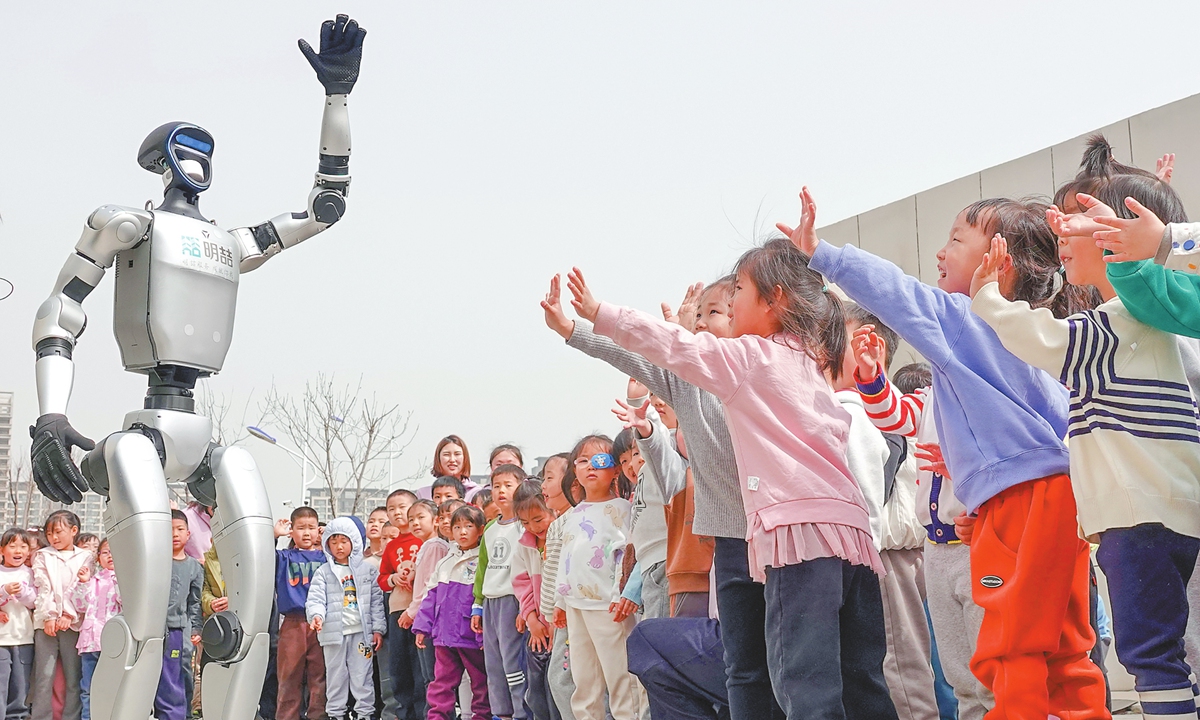
A humanoid robot waves to children at a kindergarten in the Yantai High-tech Zone, East China's Shandong Province, on March 24, 2025. Photo: VCG
"If you're renting robots for a company annual gala in early 2026, I suggest booking as soon as possible - otherwise, they'll be snapped up during peak season," a sales manager from a Shanghai-based robot rental firm told the Global Times, adding that the company's 30 humanoid robots and robotic dogs are nearly fully booked from January through mid-February, which is before the Spring Festival, due to corporate events.
Industry insiders predict that the robot rental market will break through 1 billion yuan ($142.7 million) this year, potentially reaching 10 billion yuan next year as platform-based operations advance.
Experts and industry participants view the robot rental market as still in its early stages, but the next two years will be a critical window for explosive growth. Many regard 2025 as the first year of commercial humanoid robots.
As year-end corporate events and commercial performances surge, China's robot rental market is experiencing explosive growth. At the same time, rental rates are dropping, from more than 10,000 yuan per day to 200 yuan at the lowest.
According to CCTV News, basic embodied intelligent robots on some rental platforms now start at slightly more than 200 yuan per day, while advanced models capable of intelligent interaction and complex performances range from 2,000 yuan to 5,000 yuan per day. Robotic dogs generally rent for 200 yuan to 500 yuan per day.
The rising rental demand for robots resulted in the launch of China's first open robot leasing platform BOTSHARE last week, offering integrated solutions through the Robot-as-a-Service (RaaS) model.
Starting in Shanghai, the platform plans to expand to 200 cities next year, serving more than 400,000 customers, while connecting with more than 10 robot manufacturers, 200 premium service leasing partners, and more than 3,000 content creators, aiming to define the new era of RaaS, Jiang Qingsong, partner at Agibot (also known as Zhiyuan Robotics) and chairman of BOTSHARE, told the Global Times in a note.
"Driven by demand, BOTSHARE brings together users, rental providers, content developers and manufacturers to amplify the industry's overall value and bridge the last mile for humanoid robots to reach the mass market," said Jiang at a launch ceremony for the platform.
On BOTSHARE's mini-program on WeChat, the cheapest popular rental option is a robotic dog of Agibot at 200 yuan per day. Promotional banners advertise New Year's subsidies, with delivery expected within 48 hours.
Jiang estimated that the rental market will surpass 1 billion this year and reach 10 billion yuan next year.
"The current hotspots of robot rentals focus on commercial scenarios with strong 'emotional value,' mainly for performances and exhibitions. The market is nascent, with annual demand at around 800 million yuan, driven by trial interest amid limited supply," Zhang Yi, CEO and chief analyst at consultancy iiMedia Research, told the Global Times.
Over the next two years, the industry will enter a phase of platform integration and mass production, with applications expanding from performances to functional sectors such as retail, security, industrial pilots, and cultural tourism. The overall market is expected to grow rapidly for next two to three years, reaching an annual scale of tens of billions of yuan, said Zhang.
Wang Xingxing, founder and CEO of Unitree Robotics, recently stated that the robot market, including rentals, has seen significant changes this year and remains very active. He said that humanoid robots will continue participating in performances and events, with 2025 likely just the beginning.
For example, six humanoid robots recently took the stage at Chinese-American singer-songwriter Wang Leehom's concert in Chengdu, Southwest China's Sichuan Province, performing alongside the singer and drawing widespread attention, including praise from US tech billionaire Elon Musk, who retweeted a related video on X, and wrote "impressive."
Beyond corporate events and performances, falling rental costs are enabling robots to enter factories, warehouses, and scenic spots as practical assistants, industry insiders pointed out.
For example, hot pot chain Haidilao has become BOTSHARE's first major client, with leased robots set to enter select stores before the Spring Festival in 2026 to write calligraphy, perform viral dances and interact with customers, according to a report by people.com.cn.
"The sector is transitioning from short-term entertainment hype to deep enterprise-level needs," Song Xiangqing, a vice president of the Commerce Economy Association of China, told the Global Times on Sunday, describing the long-term robot rental market as shifting from mere equipment leasing to renting intelligence as a service.
Zhang likened the future path of robot rentals to China's drone industry, where breakout growth came not just from agriculture or industry, but also from widespread urban drone light show rentals. The key is integrated "equipment + solution" delivery.
"Similarly, robot rentals will succeed by offering complete 'robot + service/solution' packages, unlocking significant commercialization potential," said Zhang.
Song also noted that as the market moves from fragmented to platform operations, simple hardware rental no longer creates barriers. Integrating large-language models and industry knowledge bases extends value beyond hardware to data-driven decision services, which is key to evolving from equipment lessors to intelligent service operators.
RELATED ARTICLES