China’s ‘national team’ injects 60 billion yuan to support A-shares as regulators move to counter global market shock
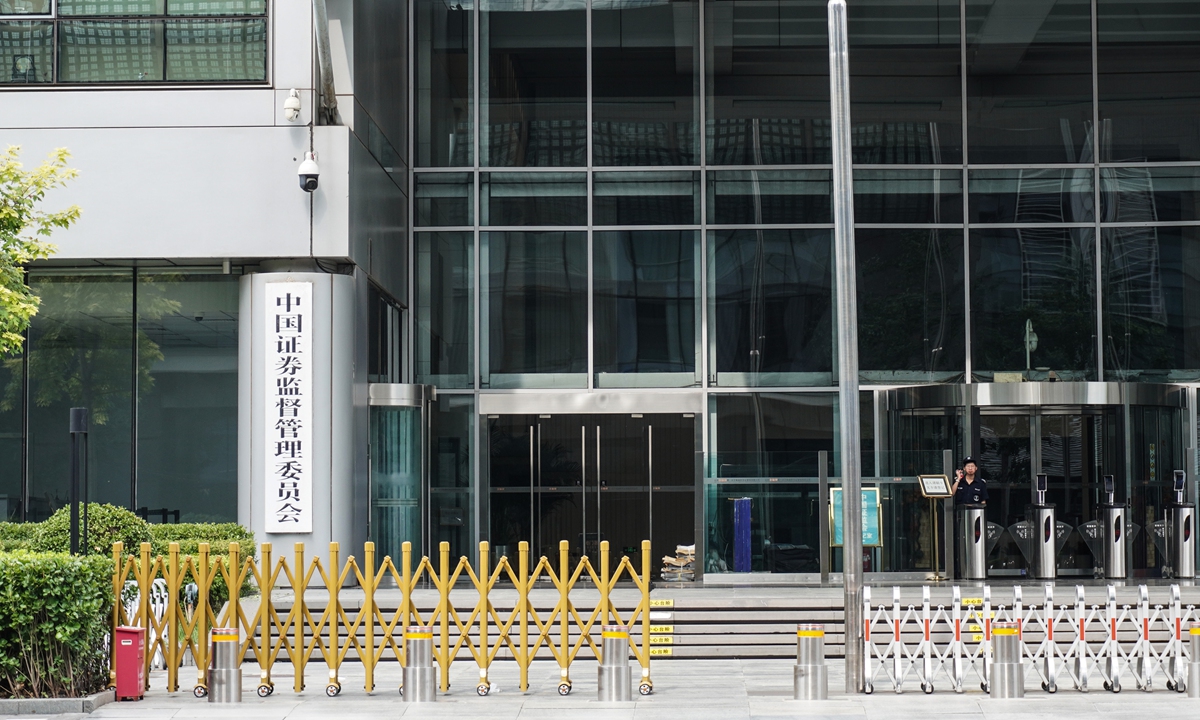
The building of the China Securities Regulatory Commission in Beijing. Photo: VCG
As the volatility of global capital markets has spilled over into China's A-share market, China Securities Regulatory Commission (CSRC) held an investor symposium to send a clear signal of market stabilization. Meanwhile, the "national team," including two centrally administered state-owned enterprises (SOEs), deployed about 60 billion yuan ($8.9 billion) through stock buyback re-lending facilities to help support China's stock market.
Analysts said the CSRC has a precedent of organizing symposiums with market participants during previous critical periods in the stock market. This latest action is widely regarded as a clear and positive signal to stabilize the market. Central SOEs are utilizing the stock buyback re-lending tool, created in October 2024, to stabilize the market. This signaled the systematic implementation and full-force activation of a national financial mechanism.
As one of the latest moves, CSRC on Monday held an investor symposium in Beijing. CSRC Chairman Wu Qing said the regulator will do its best to prevent market risks, strengthen market supervision, promote high-quality development of the capital market, and safeguard stable market operation.
Wu pointed out that investors are the backbone and the most important participants in the capital market. The CSRC will do its part to improve the transparency and authenticity of listed companies to deliver better returns for investors, demand institutions operate in a standardized manner and upgrade investor services, and continuously improve a long-term mechanism for investor protection.
While regulators communicated with the market, the "national team" acted with real money. Two central SOEs focusing on investment - China Reform Holdings Corporation Ltd and China Chengtong Holdings Group Ltd - announced support measures on Sunday.
China Reform Holdings said its subsidiary had used over 50 billion yuan in special re-lending facilities for share buybacks and stake increases, alongside its own funds, aiming to safeguard market stability.
It remains confident in the development prospects of China's capital market and firmly supports the technological innovation and high-quality development of central SOEs, the company said.
On the same day, China Chengtong Group revealed that it had purchased nearly 10 billion yuan of shares in central SOEs, technology companies and exchange-traded funds (ETFs). The company noted that it firmly believes in the prospects of China's economy and capital market, and is fully committed to maintaining the stable operation of the capital market.
Meanwhile, in the past week, ETFs across the market recorded net inflows of 22.91 billion yuan.
Solid support offsets fluctuations
The coordinated actions came as the A-share market has faced fluctuations since late June, driven by external global tech deleveraging and internal profit-taking after a strong rally in technology stocks, Yang Delong, chief economist at Shenzhen-based First Seafront Fund, told the Global Times on Monday.
Chinese stocks closed mixed on Monday, with the benchmark Shanghai Composite Index up 0.85 percent to 3,796.28 points. The Shenzhen Component Index closed 0.71 percent lower at 13,610.23 points. The combined turnover of stocks covered by Shanghai Composite and Shenzhen Component stood at 2.70 trillion yuan, up from 2.65 trillion yuan on Friday, the previous trading day.
The STAR 50 Index, which tracks the 50 largest stocks listed on China's sci-tech innovation board, closed 0.19 percent higher at 1,718.69 points on Monday.
This was a slight improvement from Friday's market performance.
Analysts attributed the adjustment to a combination of external and internal factors. Globally, deleveraging in technology assets triggered cross-market contagion from South Korea and the US, compounded by recurring geopolitical risks in the Middle East.
The KODEX SK Hynix Single Stock Leverage ETF, which seeks to deliver twice the daily performance of SK Hynix shares, has plummeted around 70 percent from its all-time high set in June and is down approximately 50 percent since its launch in May, according to LSEG data.
Domestically, rapid gains in tech stocks - the STAR 50 Index rose more than 70 percent from early April to early July - led to concentrated profit-taking and technical corrections, analysts said.
Brokerages' recent reports generally agreed that the stock market adjustment stems primarily from short-term liquidity shocks and cross-border spillovers rather than any fundamental shift in China's economic or industrial logic.
In the first half of 2026, GDP reached 69.6 trillion yuan, up 4.7 percent year-on-year, with the strongest quarterly GDP increment in five years, according to statistics from the National Bureau of Statistics.
High-tech manufacturing grew robustly, with value-added increasing 13.3 percent. Industries such as integrated circuit manufacturing related to artificial intelligence (AI) and intelligent vehicle equipment manufacturing have all maintained a high growth rate of over 30 percent.
In the first half of the year, China's integrated circuit export value surged 96.1 percent year-on-year, highlighting strong momentum in high-end manufacturing, statistics from the customs showed.
"China's economic resilience and technological development continue to provide strong underlying support," said Yang.
Yang said the underlying logic of technological self-reliance remains intact. Despite short-term valuation adjustments, the AI industry trend has not reversed, which will support relevant stocks in the long-term.
Analysts also pointed out that resilience in China's economy will provide solid support to its financial market.
"We anticipate that, driven by moderately stronger pro-growth policies stimulating domestic demand and the dissipation of certain short-term negative factors, GDP growth will rebound to around 4.6 percent in the third quarter," Wang Qing, chief macroeconomic analyst at Golden Credit Rating International, told the Global Times.
Growth is expected to accelerate further in the fourth quarter, leading the full-year economy to follow a "V-shaped" trajectory. In the second half of the year, new momentum - represented by high-tech manufacturing - will continue to maintain relatively strong growth, said Wang.
Long-term confidence
International investors are increasingly recognizing the defensive qualities of Chinese assets.
Morgan Stanley noted rising interest from global investors during recent roadshows, expecting gradual capital reallocation into Chinese stocks.
Standard Chartered upgraded Chinese equities to overweight, citing valuation advantages and technology leadership, according to research notes sent to the Global Times.
Goldman Sachs also maintains an overweight stance on A-shares, particularly favoring AI and overseas expansion themes. The firm highlighted a valuation gap, with China's AI potential estimated at 50 to 100 percent above current prices.
It also suggested clients shift their funds from South Korean AI stocks to similar stocks in China, according to media reports.
Data supported this sentiment among international financial institutions. More than 570 foreign institutions have conducted over 3,900 surveys of A-share companies so far in 2026. As of May, overseas investors held over 4 trillion yuan in circulating A-share market value, according to data from Wind, a domestic financial data provider.
Analysts noted that China's solid economic fundamentals, continuous technological advancement, and policy commitment to high-quality development remain the strongest anchors for A-share valuations. As global capital seeks diversified and resilient assets, Chinese equities are increasingly viewed as a core component of international portfolios.
RELATED ARTICLES