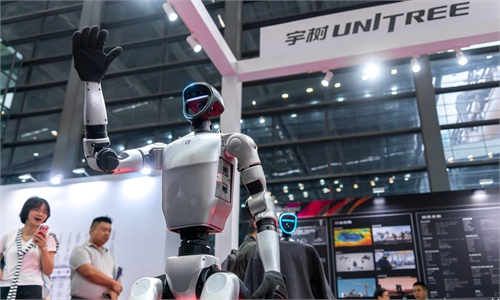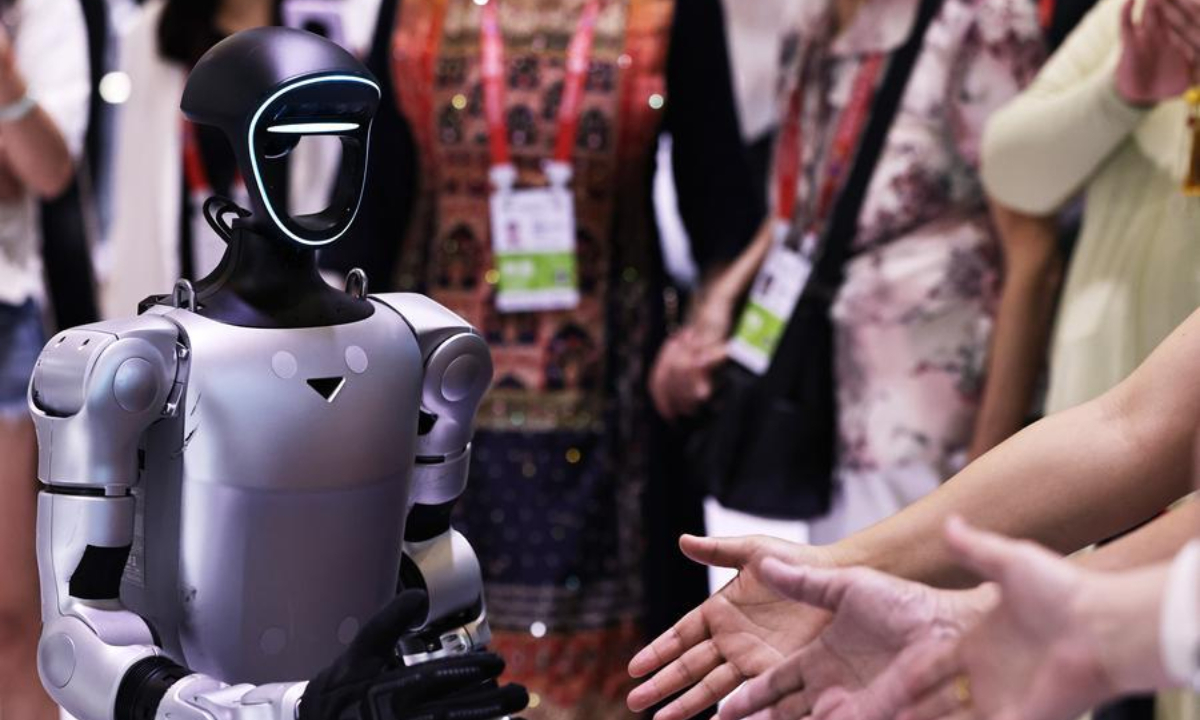
Visitors interact with a robot from Unitree Robotics during the sixth China International Consumer Products Expo (CICPE) in Haikou, south China's Hainan Province, April 14, 2026. (Xinhua/Gao Jing)
Shares of Unitree Robotics, known as "the first humanoid robot stock" in China, continued their decline on Monday. By the close of trading, the drop had narrowed to 10.31 percent, with the stock closing at 603 yuan per share.
Although this still represents a gain of approximately 303 percent from the issue price of 150.8 yuan, it marks a cumulative decline of more than 44 percent from the opening price of 1,100 yuan on the first trading day. The company's total market capitalization has fallen below 250 billion yuan, evaporating nearly 100 billion yuan from its peak on day of its debut closing.
Why did Unitree lose 100 billion yuan in market value in just three days? Chen Jing, a vice president of the Technology and Strategy Research Institute, told the Global Times on Monday that the decline in the company's share price is a normal market correction.
"This is a classic case of value returning after the excessive speculation that typically follows a hot IPO. Market sentiment has shifted from over-optimism to a more rational assessment," Chen said.
The company's final online subscription success rate was only 0.01809759 percent — less than two in 10,000. For comparison, the previously popular memory-chip IPO of CXMT had a success rate of 0.47 percent, making Unitree's allocation roughly 26 times more difficult.
"As the initial post-IPO speculative frenzy gradually subsides and the capital market returns to rationality, the real shortcomings commonly faced by humanoid robot companies — such as weak commercial deployment and limited adaptability of application scenarios — have been exposed," Pan Helin, a member of the Expert Committee for the Ministry of Industry and Information Technology, told the Global Times on Monday.
Chen said that the key reason for the sharp drop is a revision of fundamental expectations. As Unitree founder Wang Xingxing said during the 2026 World Robot Conference, although robots can currently perform some tasks, their overall efficiency still lags behind that of humans, and the "ChatGPT moment" for embodied intelligence remains two to 10 years away.
However, the issue price itself falls within a reasonable range. In the future, the capital markets will adjust the company's valuation according to whether its technological barriers are genuine, whether application scenarios can move from demonstrations to real-world deployment, and whether the company can build an ecosystem and drive the broader industrial chain, analysts said.
Behind Unitree, a large pipeline of robotics companies is waiting to list. According to media reports, more than 20 embodied-intelligence companies, including Deep Robotics and Leju Robotics, have already announced clear listing plans.
Yang Delong, chief economist at Shenzhen-based First Seafront Fund, told the Global Times that the market is still dominated by technology stocks, and technological innovation remains the main investment theme for the future.
"The humanoid robot sector represents the physical carrier of the AI era, and AI technology offers medium- to long-term investment opportunities rather than short-term trading themes," Yang noted.
Chen said that over the longer term, market investment logic will demand that companies possess rigid demand scenarios. Enterprises that demonstrate breakthrough capabilities and clear commercial pathways will continue to attract greater resource allocation.
RELATED ARTICLES