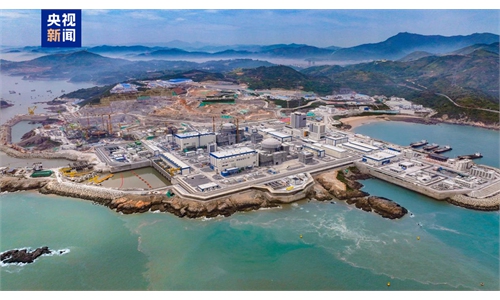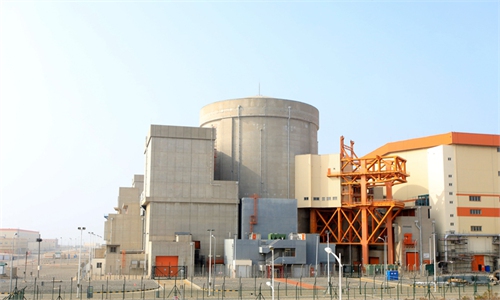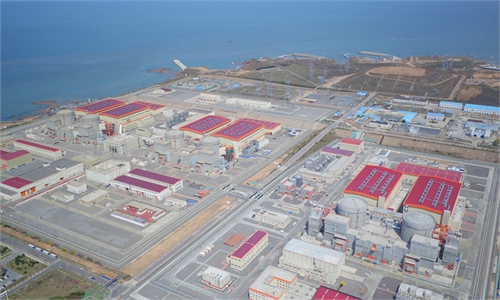
Workers lift the containment top ring onto the top of a reactor building at the Xuwei nuclear energy heating and power plant in Lianyungang, East China's Jiangsu Province.
Haiyan county in East China's Zhejiang Province, home to southern China's first nuclear heating demonstration project, has officially started its winter heating season recently, with services expanding from residential communities and industrial enterprises to hotels.
This year, another 15 households requested new installations or replacements of nuclear heating systems, bringing the proportion of households using centralized heating in the community to more than 25 percent.
Nuclear heating uses residual heat from local nuclear reactors, with water serving as the medium to transfer heat through heat exchange stations and enclosed pipelines to residential buildings.
The county's nuclear heating network now covers more than 700,000 square meters, benefiting more than 4,000 households as well as industrial enterprises and public buildings. The system reduces carbon dioxide emissions by about 10,000 tons annually, while heating costs are about 30 percent lower than for gas-fired heating.
To further strengthen heating capacity, an expansion project next to the primary heating station at the Qinshan Nuclear Power Plant is under construction and could begin operations as early as December this year. The new facilities will operate alongside the existing heating station, providing sufficient capacity to meet heating demand across 1.5 million square meters, significantly boosting the county's heating capacity and enabling further expansion into new applications.
The continued expansion of nuclear heating services in Haiyan reflects China's efforts to extend the use of nuclear energy beyond electricity generation to urban heating and other applications, Lin Boqiang, director of the China Center for Energy Economics Research at Xiamen University, told the Global Times on Sunday.
By making better use of thermal energy generated by nuclear power plants, nuclear heating can improve overall energy efficiency, reduce carbon emissions and lower heating costs, offering a new approach to diversifying clean energy applications, said Lin.
In East China's Shandong Province, China's first commercial nuclear heating demonstration project, known as Warm Nuclear No.1, officially began its eighth heating season at midnight on November 15. This winter, its heating coverage has expanded from 13.5 million square meters to 14 million square meters, supplying clean heating to 400,000 residents in Haiyang and Rushan, according to the Yantai Daily.
The continued expansion of nuclear heating projects in China could provide a model for more cities, particularly in coastal regions where many of the country's nuclear power plants are located, Lin said. However, wider adoption will depend on local heating demand, the cost of building heat transmission networks and the availability of supporting infrastructure, the expert noted.
Global Times
RELATED ARTICLES