First Hualong One nuclear power unit in Yangtze River Delta enters commercial operation
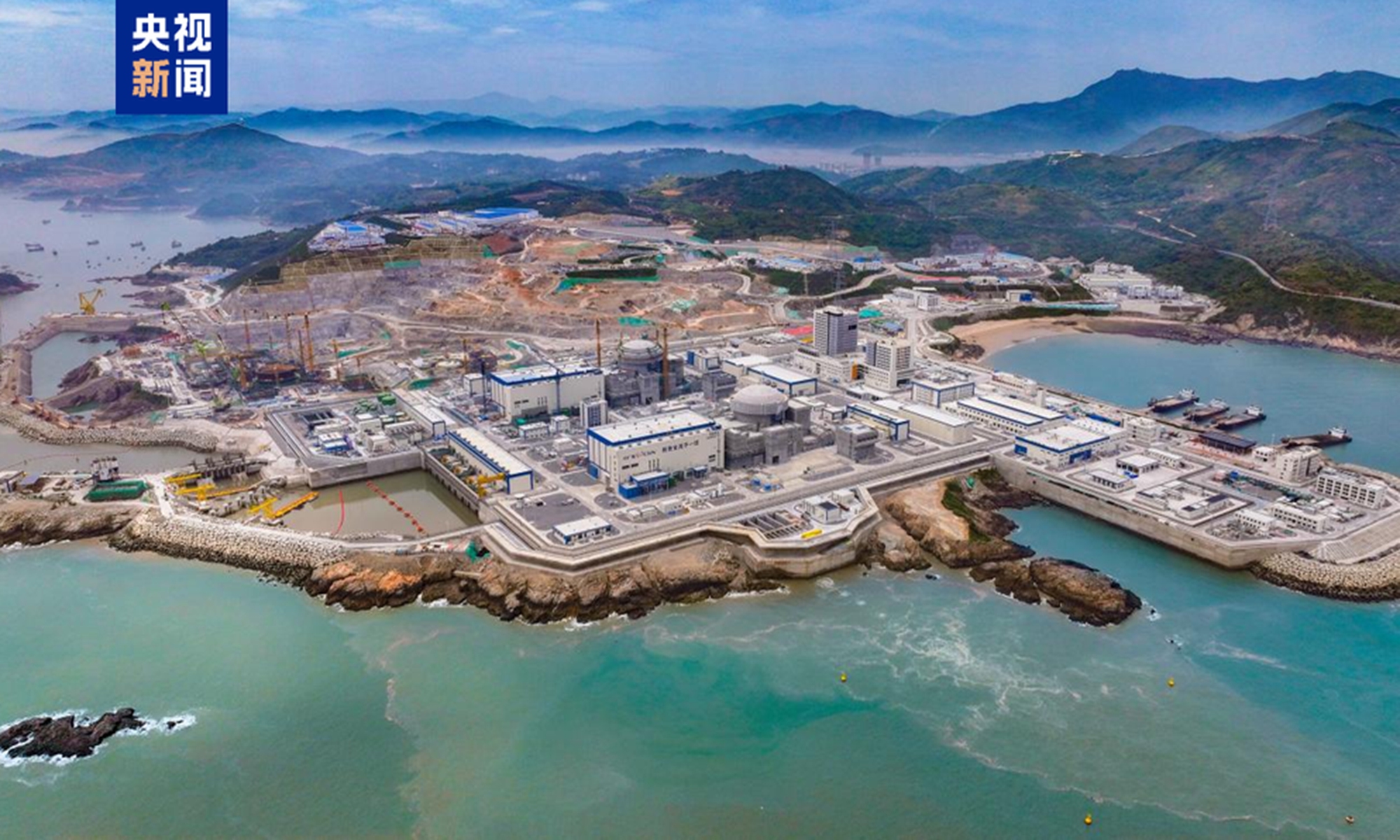
China's first Hualong One nuclear power unit in the Yangtze River Delta region and the first nuclear power project with private capital involvement officially meets the conditions for commercial operation and is put into use on April 29, 2026. Photo: Screenshot from China Media Group
Following the completion of the 168-hour trial operation on Wednesday, China's first Hualong One nuclear power unit in the Yangtze River Delta region and the first nuclear power project with private capital involvement officially met the conditions for commercial operation and was put into use, China Media Group (CMG) reported.
According to the report, the Unit 1 of the Zhejiang San'ao nuclear power project of China General Nuclear Power Group is expected to generate more than 9 billion kilowatt-hours of electricity per year, which can meet the annual electricity demand for production and daily life of over 1 million residents.
Amid profound adjustments in the global energy landscape and the rapid growth in artificial intelligence (AI) computing power demand, the Yangtze River Delta - as one of the national computing power hub nodes under the "East Data, West Computing" project - is a region with some of the strongest computing power demand and the most complete industrial supporting system in China. It has an urgent and sustained need for stable, clean, and efficient power, the report said.
The San'ao Nuclear Power Project plans to construct six Hualong One nuclear power units in three phases. Currently, four units have been approved, and the overall construction is progressing steadily as planned. Once all six units are completed, the project is expected to generate more than 54 billion kilowatt-hours of electricity annually. It will also save over 16.35 million tons of standard coal equivalent each year and reduce carbon dioxide emissions by nearly 50 million tons, according to the CMG.
"In addition to providing stable and clean energy to the region, it is also China's first nuclear power project with private investment. This sets an example for private capital to play a greater role in the construction of major national energy infrastructure," Lin Boqiang, director of the China Center for Energy Economics Research at Xiamen University, told the Global Times on Wednesday.
On April 17, the China Nuclear Energy Association released a blue book on China's nuclear energy development, in which it said that the country currently has 60 commercial nuclear power units in operation and 36 units under construction. The scale of nuclear power units under construction accounts for more than half of the global total. In addition, 16 units have been approved and are awaiting construction. China's nuclear power installed capacity continues to grow, reaching 125 million kilowatts, ranking first in the world.
This year, China has started construction on two new nuclear power units and is set to bring seven units into commercial operation, with the scale of nuclear power under construction continuing to lead the world.
The blue book said that Hualong One, China's independently developed third-generation nuclear technology, has now entered a new stage of construction in batches. The latest data showed that the total number of Hualong One units in operation and approved for construction, both at home and abroad, exceeds 40, making it the third-generation nuclear reactor type with the largest number of commercial deployments worldwide.
The blue book noted that China's nuclear energy industry has entered a phase of accelerated development. During the 15th Five-Year Plan period (2026-2030), the growing demand for energy and electricity driven by socioeconomic development, along with the country's dual carbon goals, will provide strong momentum and ample space for nuclear power growth.
China's operating nuclear installed capacity is expected to surpass that of the US before 2030, making it the world's largest. This will provide solid support for building a new-type power system and implementing the strategy of becoming an energy powerhouse, according to the blue book.
Lin noted that China's nuclear energy development has progressed from initially introducing foreign technology to achieving independent design, construction, and operation today. It is now capable of producing some of the world's most advanced nuclear power units, which fully demonstrates the significant progress of China's nuclear technology.
At the same time, this development also reflects the country's strong determination to promote low-carbon energy transition, Lin said. "For safeguarding national energy security, nuclear power holds profound strategic significance. It thus provides strong support for building a stable, secure, and clean modern power system in China," Lin noted.
RELATED ARTICLES