Unitree Robotics shares surge 20% as humanoid robot companies rally on policy support, investor optimism
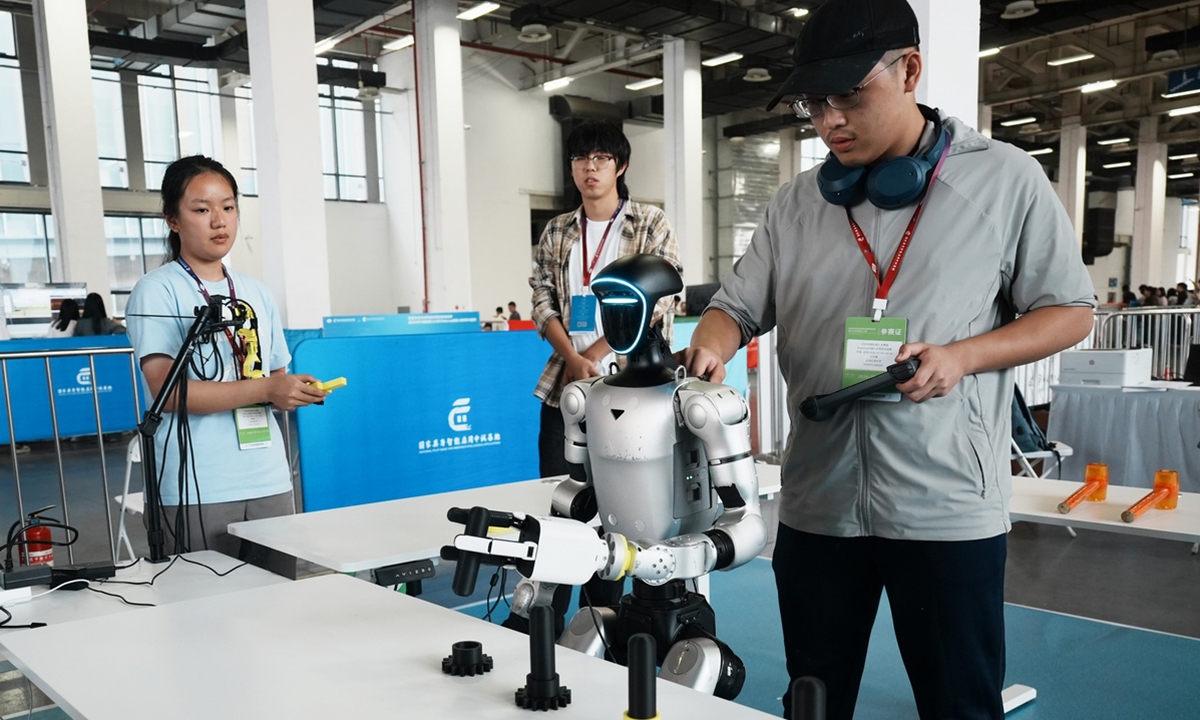
A student remotely controls a Unitree G1 humanoid robot to grasp an object at the inaugural Global Embodied Intelligence Application Innovation Challenge and the 2026 China Robot Competition, which were held in Hangzhou, East China's Zhejiang Province on October 18, 2026. The event drew 2,000 teams and nearly 5,000 university participants, showcasing innovations and skills in embodied intelligence applications. Photo: VCG
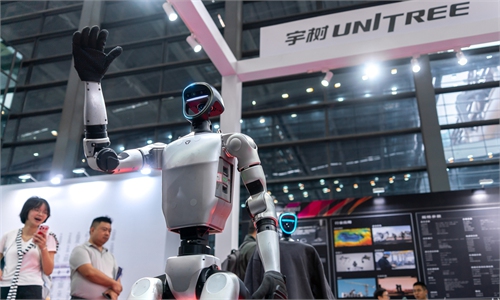
Chinese humanoid robotics startup Unitree Robotics surged by the daily limit of 20 percent on Monday, pushing its share price back above 700-yuan ($99) and its market capitalization to 286.36 billion yuan, as robotics-related stocks rallied amid growing industry optimism, while major Chinese A-share indexes staged a broad rebound.
Shares of Unitree Robotics closed at 708 yuan, while several other humanoid robotics-related companies, including Shanghai-listed Shangwei New Materials and Shenzhen-listed Hanwei Electronics, also hit their daily trading limits. Shares of companies involved in robot components, motion control and automation equipment posted strong gains, reflecting growing investor interest across the robotics supply chain.
The rally came as Chinese mainland stocks recovered from an early sell-off. After opening lower, major indexes regained ground, with market sentiment improving significantly in afternoon trading on Monday.
By the close, the benchmark Shanghai Composite Index rose 0.15 percent to 3,538.95 points, while the Shenzhen Component Index climbed 1.93 percent. The tech-heavy ChiNext index gained 3.08 percent and the STAR Composite Index advanced 2.62 percent.
The strong performance of humanoid robot shares followed a series of positive developments in the industry, including government measures supporting the adoption of intelligent technologies and broader efforts to strengthen investor confidence.
On Monday, four Chinese government departments, including the National Development and Reform Commission (NDRC), jointly released an implementation plan aimed at improving elderly care and childcare services.
The plan encourages the development of AI agents, service robots, smart wearable devices and exoskeletons tailored to elderly care, while supporting their deployment in nursing homes and community-based care facilities. The measures are expected to create more application scenarios for intelligent robotics and expand potential market demand.
The policy announcement came a day after Chinese securities regulators unveiled a package of measures aimed at improving market liquidity to stop a sell-off in the A-share market.
The measures include lowering the minimum margin requirement for securities financing from 100 percent to 80 percent, effective November 30, proposing a market-maker mechanism for the ChiNext board and introducing additional fee reductions at the Shanghai and Shenzhen stock exchanges.
Industry developments have also reinforced expectations for the commercial deployment of humanoid robots.
Tesla CEO Elon Musk said during a video interview at the TomorrowX Summit on November 18 that the company's Optimus humanoid robot could become capable of performing household chores, including taking out the trash, washing dishes and putting them away, within the next 12-18 months.
Meanwhile, Unitree Robotics founder Wang Xingxing said during the recent Asia-Pacific Economic Cooperation (APEC) CEO Summit in Shenzhen that improving robots' ability to adapt to different environments and perform unfamiliar tasks without additional training remained one of the industry's biggest challenges.
However, Wang said technological breakthroughs this year had brought the industry closer to a turning point, raising expectations that humanoid robots could eventually enter ordinary households and perform practical tasks.
Ma Jihua, a veteran telecom industry analyst, said the rally in humanoid robot shares reflected growing market confidence in the industry's commercialization prospects, driven by technological advances. Progress in AI, intelligent perception and motion control was improving robots' ability to perform complex tasks, while China's mature manufacturing capabilities and extensive supply chains provided a solid foundation for scaling up production and reducing costs.
Ma noted that policy support could accelerate commercialization by expanding real-world applications. The latest measures encouraging the use of intelligent robots in elderly care, for example, could generate new demand while helping manufacturers improve product reliability and performance. China's vast domestic market, combined with its strengths in AI and industrial automation, could enhance the global competitiveness of Chinese robotics companies, he said.
However, Ma cautioned that the recent surge in robotics stocks was partly driven by market sentiment and short-term speculative trading. Despite rapid technological advances, humanoid robots still faced challenges involving reliability, adaptability and production costs. The industry's long-term growth would ultimately depend on whether manufacturers could translate technological breakthroughs into affordable, reliable products capable of performing practical tasks at scale, rather than relying on short-term investor enthusiasm, he said.
RELATED ARTICLES