Foreign money is buying Chinese assets, betting on higher industrial profit, more innovation results

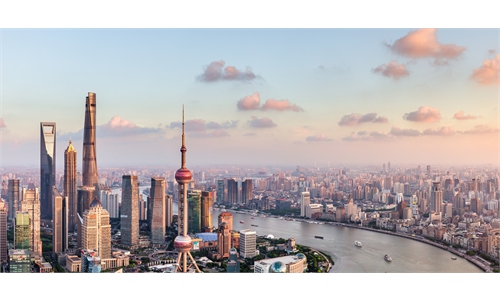
Aerial view of Shanghai's Xuhui district File photo: VCG
J.P. Morgan Asset Management's China unit listed its first active exchange-traded fund (ETF) on the Shanghai Stock Exchange (SSE) on Monday, as one of the latest actions by foreign companies betting on Chinese assets. Analysts said foreign capital is buying because earnings and innovation signals from China's industrial base become clearer, more predictable and easier to invest in.
The firm's shareholder committed $75 million of proprietary capital. This is the largest such commitment made by a fund company, shareholder or affiliate in the active equity space since 2023, the Shanghai Securities News reported on Monday.
Li Bo, the fund manager of JPMorgan's new active ETF, attributed this investment to China's economic shift - from scale expansion to innovation-driven growth viewed over a longer run, according to a media report.
"China's future incremental growth will come increasingly from technological breakthroughs and industrial upgrading. The application of technologies such as AI, automation and advanced manufacturing will help raise production efficiency, strengthen corporate profitability and drive more sustainable growth. Against this backdrop, investment opportunities are no longer broad-based; they are concentrated in areas driven by sustained innovation - the long-term soil in which the growth style can thrive," said Li.
Passive ETFs aim to track an underlying index, which can be a stock market, a group of regional or global stock markets, or an industry sector. Active ETFs do not track any underlying index but seek to achieve a stated investment objective by investing in a portfolio of stocks, bonds, and/or other assets such as money market instruments.
While the $75 million commitment is large, the bigger point is the message it carries: one of the world's largest asset managers is putting its own capital behind the view that Chinese stocks will be powered by corporate earnings and innovation, Yang Delong, chief economist at Shenzhen-based First Seafront Fund, told the Global Times.
That view is being reinforced across the institutional landscape. On October 23, Citigroup received approval from the China Securities Regulatory Commission to establish Citigroup Securities (China), a wholly-owned brokerage with registered capital of 1.2 billion yuan ($180.1 million).
A Citigroup executive earlier this month described China as its second-largest international market outside the US, adding that a large number of high-quality enterprises have emerged in China, with innovative enterprises in the new economy area being the most representative. Securing this license is of great significance for Citigroup to expand its customer base.
In cross-border asset management, Neuberger Berman obtained Qualified Domestic Institutional Investor (QDII) status on November 6, becoming only the second newly established wholly foreign-owned mutual fund manager to receive the qualification after BlackRock in September.
Supporting the allocation case is a clear improvement in the quality of underlying earnings. In the first three quarters of 2026, A-share listed companies reported a 5.7 percent year-on-year rise in revenue and an 8.2 percent increase in net profit - both outpacing nominal GDP growth.
Meanwhile, China's research and development (R&D) intensity reached 2.80 percent of GDP in 2025, surpassing the OECD average for the first time, with enterprises accounting for more than three-quarters of total R&D spending.
That R&D investment resulted in high added value in high-tech manufacturing enterprises above designated size, which grew 17.6 percent year-on-year in October, marking the highest growth rate in any month in the past five years, according to data from the National Bureau of Statistics..
Foreign investment in China's high-tech and innovation sector also continued to increase. In October, the actual use of foreign capital in high-tech industries reached 252.8 billion yuan, up 31.3 percent year-on-year, accounting for 41.7 percent of total foreign capital use.
"A strength for China's credit profile is its integral role in global supply chains and its advancements in new industries, particularly electric vehicles and renewables. We expect these strengths to be sustained given China's well-developed manufacturing ecosystem and its ongoing investments in advanced industries and increasing industrial resilience through technological and supply chain self-reliance as indicated in the 15th Five-Year Plan (2026-30)," Jeremy Zook, lead analyst for China at US-based Fitch Ratings, said in a note sent to the Global Times.
Oxford Economics Asia said in a report released on Friday that it expected above-consensus growth in China next year, driven by investment.
"We expect GDP to grow by an above-consensus 4.6 percent next year, as an acceleration in state-led investment provides additional support to industrial activity. China's push into strategic infrastructure and high-tech industries is set to sustain investment and trade," according to the report sent to the Global Times.
"In the past, foreign investors mainly anchored their decisions on China's overall economic growth rate and the risk premium attached to the market. Now a new consensus is forming: the key pricing anchor is moving toward the quality of corporate earnings and companies' ability to turn innovation into real profits - especially those driven by high-tech and advanced manufacturing in the real economy," said Yang.
RELATED ARTICLES