China approves Citi's wholly foreign-owned securities firm amid efforts to boost market entry and streamline foreign capital
By Chen Qingrui and Published: Oct 25, 2026 07:43 PM


Aerial view of Shanghai's Xuhui district File photo: VCG
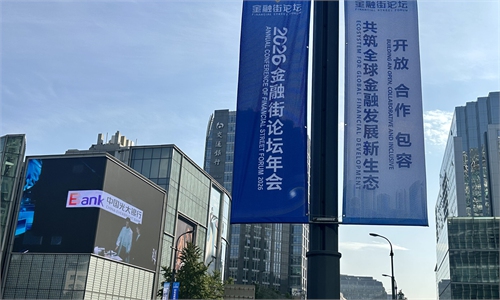
China's approval for Citigroup to establish a wholly foreign-owned securities company marks another step in the country's financial opening-up, as international institutions expand their onshore businesses and seek to connect domestic capital markets with global investors. The move comes as Chinese financial regulators reaffirm their commitment to further opening up the financial sector at the 2026 Financial Street Forum in Beijing, while recent data show growing foreign investment in high-tech industries despite a decline in overall foreign capital inflows.
The China Securities Regulatory Commission (CSRC) approved the establishment of Citigroup Securities (China) Company Limited on Friday. The planned company will be registered in Shanghai with registered capital of 1.2 billion yuan ($179.88 million). It will be wholly owned by Citigroup Global Markets Holdings Inc., and its approved business scope will include securities brokerage, securities investment advisory, securities underwriting and sponsorship, and proprietary trading, according to the regulator's official approval.
The approval makes Citi the seventh wholly foreign-owned securities firm approved to operate in China, following J.P. Morgan, Goldman Sachs, Standard Chartered, BNP Paribas, UBS and Mizuho, according to Xinhua. Citi's application process began in late 2021, the Financial Times reported.
The move allows the US financial group to expand its onshore capital markets services, complementing its existing international operations. It also reflects a broader shift in China's financial opening-up, as foreign institutions move from participating in the domestic market through partnerships to establishing wholly owned businesses and expanding their local capabilities, Chinese experts noted.
Deepen local operations
Foreign institutions initially entered China's financial market mainly through joint ventures, combining Chinese partners' local market knowledge with foreign shareholders' international experience and quantitative analysis capabilities, experts said.
The transition from joint ventures to wholly foreign-owned operations carries significant implications for foreign financial institutions seeking to deepen their presence in China, Zhou Mi, a senior researcher at the Chinese Academy of International Trade and Economic Cooperation, told the Global Times on Sunday. He noted that this transition allows companies to apply their expertise more directly to local market needs, streamline decision-making and better align business strategies with China's economic development.
In addition, foreign financial institutions' success in China depends not only on their ownership structure but also on their ability to understand local market needs, align their business objectives with China's economic and social development, and strengthen compliance with domestic regulatory requirements, Zhou said.
Foreign banks are also expanding their roles in China's domestic financial market beyond traditional banking services. Standard Chartered Bank (China) recently became the first foreign bank to provide custody services for a publicly offered QDII fund, according to the bank's statement.
The service covers a fund launched by Guotai Haitong Securities Asset Management, enabling the foreign bank to support domestic investors' overseas asset allocation. The net assets of QDII funds exceeded 1 trillion yuan for the first time in January 2026, up more than 50 percent year-on-year, according to data cited by Standard Chartered.
Standard Chartered told the Global Times in a statement that with the launch of this service, Standard Chartered China has extended to publicly offered QDII funds its distinctive one-stop service model. Such products require coordination between domestic and overseas custodians, as well as settlement, investment supervision, accounting and regulatory reporting across multiple time zones, markets and currencies.
The bank said it would continue to leverage its global network and cross-border service capabilities to provide high-value-added, customized fund custody services to institutional clients at home and abroad, and will deepen its presence in China's wealth management market.
In another move to deepen its local presence, Standard Chartered established a China chief investment office in Shanghai in September. The bank said the office would be led by a local research team and regularly publish views on Chinese assets and asset allocation strategies, combining its global macroeconomic perspective with local market analysis.
Expanding opportunities
The expansion of foreign financial institutions' businesses comes alongside continued efforts to improve market access and cross-border investment channels.
At the 2026 Financial Street Forum in Beijing from October 19 to 22, People's Bank of China Governor Pan Gongsheng outlined plans to pilot measures allowing eight Chinese and foreign RMB clearing banks in offshore markets to conduct proprietary RMB trading in China's interbank FX market in line with international practices. He also outlined measures to improve bond market connectivity and expand liquidity support for financial institutions.
CSRC Chairman Wu Qing said the regulator would further improve the convenience of investment operations under the Qualified Foreign Institutional Investors (QFII) scheme, encourage foreign institutions to make full use of their parent companies' expertise to expand product offerings and participate in innovative businesses, while supporting more foreign institutions in investing and operating in China. He also highlighted efforts to improve cross-border investment and financing facilitation.
These measures build on reforms that have progressively removed barriers to foreign participation in China's financial sector, including the removal of foreign ownership caps on securities, fund management and futures companies. The focus is increasingly on making market access more effective by improving investment channels, broadening the range of products and strengthening links between domestic and overseas markets.
Recent investment data, however, point to a mixed picture. China utilized 548.81 billion yuan in foreign investment during the first nine months of 2026, down 4.3 percent year-on-year, while inflows in September alone rose 2.5 percent year-on-year. A total of 47,800 foreign-invested enterprises were established during the nine-month period, according to the Ministry of Commerce.
Notably, utilized foreign investment in high-tech industries rose 33.8 percent year-on-year during the same period, accounting for 41.6 percent of the national total. Investment in research, development and design services increased 59.2 percent year-on-year, ministry data showed.
For foreign financial institutions, China's large market and expanding investment opportunities offer room to develop services in securities, wealth management, custody and cross-border financing, Chinese experts noted. However, they still need to translate formal market access into sustainable local business by understanding domestic clients, adapting products to local needs and competing on service quality.
RELATED ARTICLES