With its own climate governance arrears unpaid, how can Western media expect China to ‘pick up the tab’?: Global Times editorial
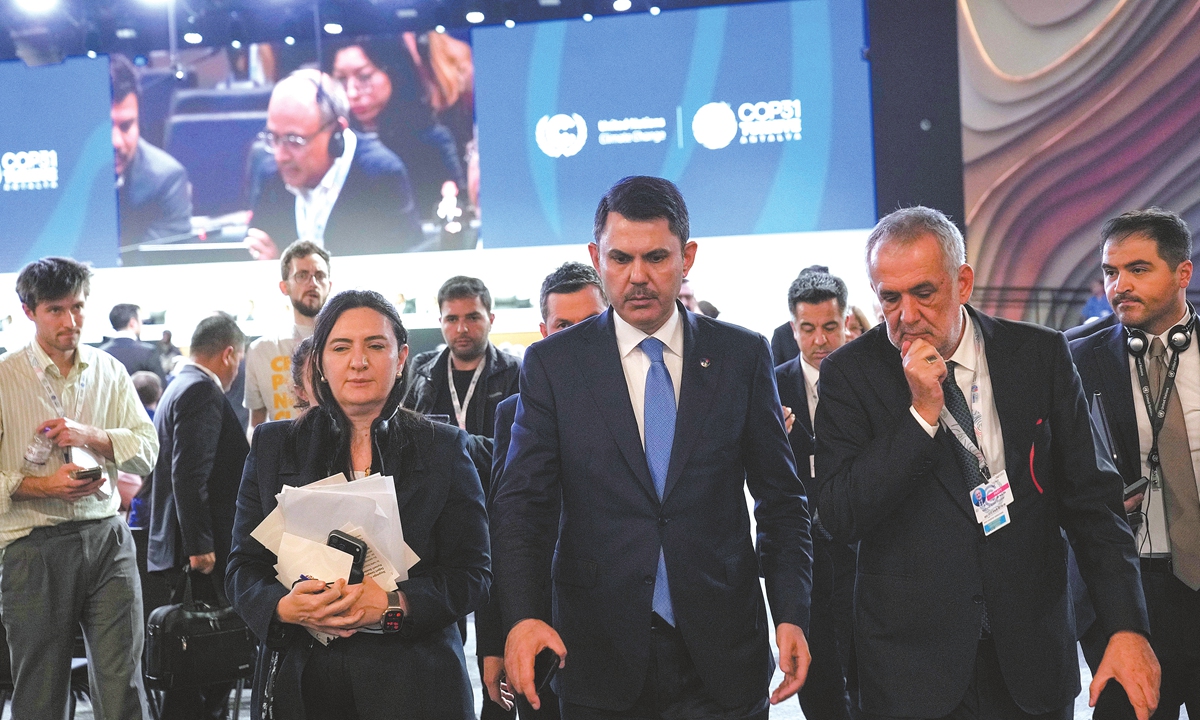
COP31 President Murat Kurum (center) leaves a closing plenary session at the COP31 UN Climate Summit in Antalya, Turkey, on November 22, 2026. The 31st COP31 failed to reach a consensus on the Antalya Pact. Photo: VCG
When negotiations break down, China is blamed for being "unwilling to take the lead"; yet when China provides green production capacity to the world, some media outlets sensationalize the "China shock" and "overcapacity" narratives. Either way, China is always made to take the blame. If the West truly welcomes greater contributions from China to global emissions reduction, it should first work to remove the various discriminatory policies targeting China's new energy exports.The repeatedly extended United Nations (UN) Climate Change Conference (COP31), in Antalya, Turkey, ended in a breakdown of negotiations. This marks the first time since 2009 that a UN climate conference has "ended without agreement," and it was also the longest-running session since the first conference in 1995. Before the conference closed, Reuters, citing the US government's absence, questioned why China was unwilling to be the world's next climate leader. In this framing, obligations developed countries should honor are twisted as something they can sit back and wait for China to "pick up the tab" - an absurd inversion of accountability.
The primary reason for the breakdown in negotiations at this conference was that the final draft failed to include clear provisions regarding the transition away from fossil fuels. Parties such as the European Union (EU) refused to accept the text because the final draft made no mention of fossil fuels.
With nearly 200 parties harboring divergent priorities, reaching a consensus inherently requires all sides to make compromises on specific provisions. Attributing the failure of the negotiations to China's "unwillingness to take the lead" not only overlooks the concessions China made to seek consensus but also fails to explain the differences among parties regarding the transition away from fossil fuels.
Not to mention that developed countries represented by Europe have come under heavy criticism during the negotiations for obstructing progress on multiple fronts, including adaptation finance and just transition. The EU's climate chief even publicly stated before the meeting that talks on "new climate finance commitments" were "dead in the water," ruling out any new commitments to large-scale climate pledges.
This stance sparked dissatisfaction among many countries. Some European media outlets chose to overlook this. Instead, by citing the so-called "reluctance of China to take the lead," they sought to discredit China's efforts in addressing climate change. One cannot help but wonder whether this move is intended to evade their own historical responsibilities.
Reaching a consensus requires the joint efforts of all nations, and there has long been a clear division of responsibilities regarding taking the lead in emissions reductions and providing funding. The Paris Agreement reaffirmed the principle of common but differentiated responsibilities, clearly stipulating that developed countries should continue to take the lead in reducing emissions and have an obligation to provide financial assistance for mitigation and adaptation measures in developing countries.
Insufficient funding will delay climate adaptation projects - such as flood control and water supply - and weaken developing countries' ability to withstand climate disasters. Leveling such accusations against China does not absolve developed countries of their financial obligations.
For a transition affordable to all nations, adequate financial support must be in place, and emission reduction technologies must also be accessible at manageable costs. China's push in Antalya to discuss trade barriers was aimed precisely at this latter point. Ahead of the conference, the EU urged major emitters, including China, to step up their emission reductions, yet electric vehicles (EVs) originating in China still face additional anti-subsidy duties when entering the EU market.
This contradictory approach is also reflected in the biases of Western narratives. When negotiations break down, China is blamed for being "unwilling to take the lead"; yet when China provides green production capacity to the world, the media sensationalizes the "China shock" and "overcapacity." Either way, China is always made to take the blame.
If the West truly welcomes greater contributions from China to global emissions reduction, it should first work to remove the various discriminatory policies targeting China's new energy exports.
According to estimates by the International Energy Agency (IEA), even when emissions from both vehicle manufacturing and use are taken into account, a medium-sized battery-electric vehicle still produces fewer emissions on average than a comparable gasoline-powered vehicle. The same applies to solar photovoltaics. As solar panels become cheaper, projects previously shelved due to high costs become economically viable, allowing local communities to replace coal- or gas-fired power with solar energy sooner.
The emissions reductions occur in the countries where these products are used, and helping accelerate that transition is precisely China's contribution. Imposing tariffs on Chinese products that could help reduce domestic emissions, while simultaneously urging China to do more to combat climate change, will only make it harder for those countries to achieve their own emissions reduction targets.
China's enormous contributions to global climate governance in recent years are evident to all. According to IEA estimates that account for emissions from electricity generation and fuel supply, the stock of EVs was responsible for avoiding net emissions of 190 Mt CO2‑equivalent (CO2-eq) in 2025 compared with equivalent gasoline-powered vehicles, with more than half of those reductions attributable to EV deployment in China.
Last year, China provided developing countries with $132 billion in clean technologies and investment, nearly matching the total climate finance provided by all developed nations in 2024. According to estimates by overseas research institutions, this year alone, China's exports of clean energy equipment are expected to reduce emissions overseas by approximately 450 million metric tons of carbon dioxide.
These achievements are "unparalleled globally." During this year's climate conference, the Chinese delegation participated in negotiations and consultations on 165 agenda items and held more than 50 bilateral meetings at the ministerial level, making tremendous efforts to encourage all parties to work toward common ground.
Ahead of the next round of negotiations, developed countries should translate their financial commitments into funding for concrete projects, continue to take the lead in reducing emissions at home, and give green products a fair opportunity to compete. China has already transformed many once-expensive low-carbon technologies into affordable products accessible to more countries and households, and has demonstrated that a development pathway combining wind and solar power, energy storage, and EVs is both technically and economically viable, representing one of its greatest contributions to the global low-carbon transition. It is abundantly clear that addressing climate change requires a collective effort by countries around the world.
RELATED ARTICLES