As ‘AI bubble’ debate heats up, What’s the impact on China ?: Global Times editorial
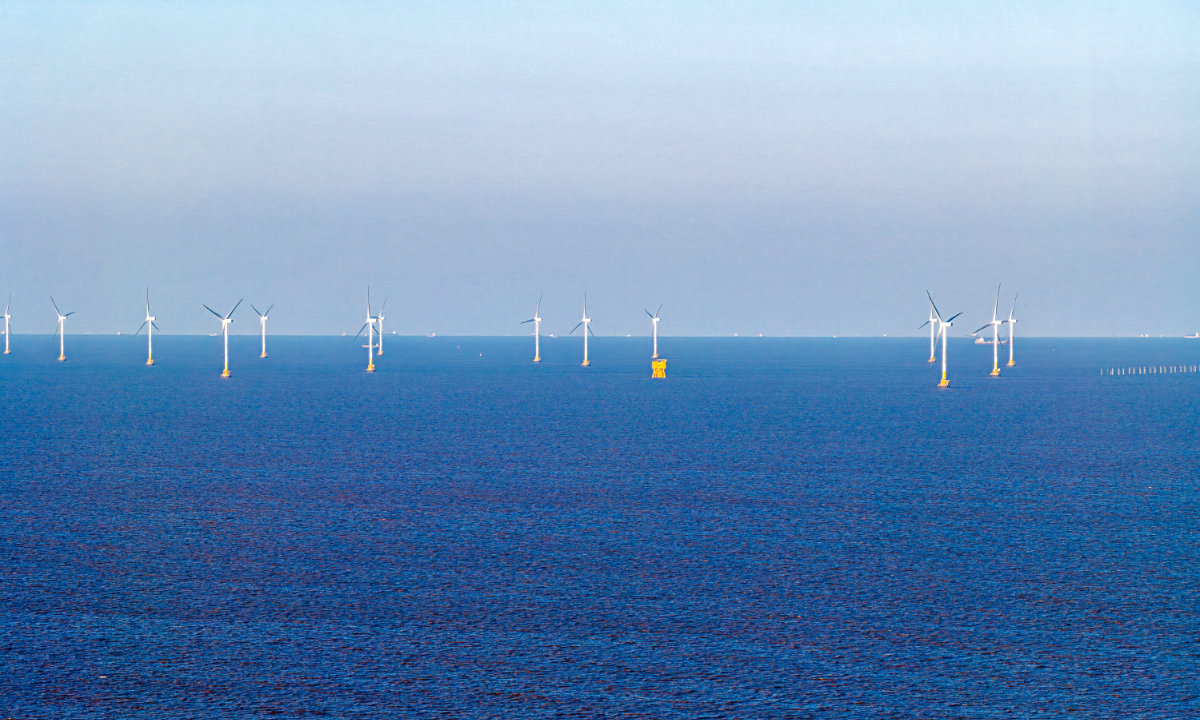
An offshore data center powered directly by wind energy is seen in waters east of the Lingang Special Area in Shanghai on May 29, 2026. The facility is the world's first undersea data center connected directly to offshore wind power. Photo: VCG
Editor's Note:
China's economy is steadily advancing along the path of high-quality development, even as domestic and international circumstances become increasingly complex. Some Western media outlets, whether due to misunderstanding or bias, have repeatedly questioned or even distorted China's economic development. Accordingly, the Global Times is launching the "Q&A on China's Economy" column to present facts and clarify perceptions.
The debate over whether the artificial intelligence (AI) market is in a bubble has intensified. Several consulting firms have warned that a "super bubble" is forming in global AI stocks. Turing Award laureate Yann LeCun has also argued that the current model of using capital subsidies to attract users is unsustainable, and that the AI industry could face "a big bubble explosion." Against this backdrop, more voices are claiming that "Chinese AI will not escape the same logic."
Simply put, an "AI bubble" refers to a situation in which investment and market expectations far exceed actual returns. Once the investment frenzy cools and returns fall short of expectations, the consequences can include sharp stock-price declines, corporate failures, and capital flight. From a global perspective, the increasingly vocal warnings from multiple institutions about an AI bubble are not without foundation. Although the US has star applications such as ChatGPT, Gemini, and Claude, tech giants have generally overestimated users' willingness to pay while deliberately downplaying computing costs and subdued conversion expectations. Grand narratives alone can no longer support high valuations.
Much of the market value of Microsoft, Nvidia, and other giants is underpinned by long-term AI narratives. Reports indicate that OpenAI's annualized revenue stood at about $50 billion as of September this year, yet the company was valued at $1.25 trillion in its latest funding round in November. To some extent, driven by expectations of high valuations and other factors, US AI giants have effectively launched an "arms race" in technical parameters. Quite a few observers believe that the current AI bubble may already be approaching - or even surpassing - the dot-com bubble of the turn of the millennium.
At the same time, we should not overlook the other side of the story: the actual application of AI in the real economy. Data from the UK's Office for National Statistics showed that the share of British businesses with 10 or more employees using AI rose from 12 percent in 2023 to 35 percent in 2026. AI technology has gained a substantial foothold in manufacturing, information and communications, financial services, and other sectors of the real economy. A joint industry white paper by Frost & Sullivan and the Toubao Research Institute projected that the global AI market will exceed $2.6 trillion by 2030. These figures show that AI is not merely conceptual hype without practical value. The process of translating AI into productivity gains is genuinely underway; it is just that the market's earlier expectations of how quickly this would happen far outpaced what the industry could realistically deliver.
Viewed in the context of past global technological revolutions, the adoption of almost every major general-purpose technology has gone through similar cycles of capital boom and bust. The global railway construction boom in the mid-19th century and the internet boom around 2000 both saw periods of excessive capital inflows and inflated valuations for numerous projects. Yet after the tide receded, the infrastructure and strong companies that survived ultimately became core drivers of the next wave of economic growth.
The current adjustment in the AI sector is essentially a normal process of separating genuine value from hype as the technology moves toward real-world application. It helps eliminate projects built solely on hype and lacking practical application scenarios, creating more room for technologies and companies that can genuinely reduce costs, improve efficiency, and deliver tangible value for industry.
Returning to the realities of China's AI industry, we should not simply assume that a global AI bubble bursting would inevitably put China under similar pressure. The real strength underpinning Chinese AI industry lies not in the hype surrounding one or two large-language models, but in its complete industrial system and strong engineering capabilities. Models, chips, power grids, robots, and manufacturing scenarios are closely interconnected, forming a deep industrial foundation that supports the underlying technological infrastructure. This progress does not depend on science-fiction-like narratives; instead, AI is gradually becoming embedded in technological innovation and changes in production.
Moreover, the overall computing costs in China's AI industry are significantly lower than those in Europe, the US, or South Korea. The market share of domestic AI chips continues to rise, and China's data-center delivery and expansion efficiency lead the world. Leveraging the world's most comprehensive manufacturing ecosystem, the broadest range of data scenarios and strong policy guidance in tackling key technological challenges, China is developing a self-sustaining AI ecosystem. Even under external restrictions, this ecosystem can continue to evolve and achieve real-world deployment - advantages that other major economies do not possess.
The US experience also reminds us to guard against the capital market hijacking industrial development through a narrow "computing power-valuation" logic. AI competition has already shifted from a race over technical parameters to a comprehensive contest involving cost, energy, data, application scenarios, and governance capabilities. If capital flows only into chips, optical modules, and computing-power leasing while neglecting industry-specific models, industrial software, intelligent manufacturing, medical research, and public services, it risks leading to redundant investment and capacity. China should not simply copy Silicon Valley's path of "high financing, high subsidies, and high valuations." Instead, the focus of competition should be on output per unit of computing power, cost reductions and efficiency gains for enterprises, and improvements in social productivity.
It would not be surprising if the AI sector sees valuation corrections or some companies are forced out of the market. However, this will not reverse the broader trend of intelligent transformation across the global economy. For industry professionals, the most important task right now is to focus on strengthening the ability to translate technology into practical applications and identify where AI can deliver irreplaceable value in response to the real needs of the economy. For the capital markets, a gradual return to more rational valuation frameworks will actually provide a more stable environment for AI companies with genuine long-term value.
As a key driving force behind a new round of technological revolution and industrial transformation, the long-term value of AI will not disappear because of temporary adjustments in the capital markets. After a period of rational calibration, the industry as a whole will be better positioned to develop more steadily and go further.
RELATED ARTICLES