US union’s push for tougher Chinese car ban can’t ease EV ‘growing pains’: expert
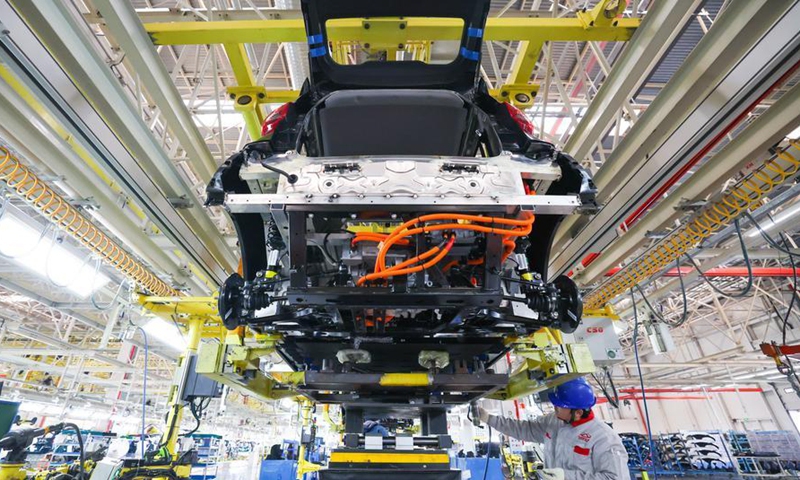
A worker assembles a new-energy vehicle at the workshop of a Chinese automaker in Shijiazhuang, North China's Hebei Province, on January 8, 2026. Photo: Xinhua
A major US labor union has urged Congress to quickly pass a tougher ban on Chinese vehicles before lawmakers adjourn in the coming weeks, Reuters reported on Monday, a push that a Chinese industry analyst said would do little to improve US automakers' production efficiency, boost profitability in the electric vehicle (EV) sector or accelerate the industry's transition toward electrification.
The 1.3 million-member International Brotherhood of Teamsters union on Monday urged Congress to quickly pass a tougher US government ban on Chinese vehicles. Senators and congressional aides are still in talks with House lawmakers and aides, seeking to reach a deal to win approval of a permanent law banning Chinese vehicles, according to Reuters.
In January 2025, the Biden administration announced a rule prohibiting automakers with certain links to China or Russia from selling new connected passenger vehicles equipped with specified hardware or software in the US, including those manufactured domestically, starting from model year 2027, according to the US Department of Commerce.
Building on restrictions on Chinese vehicles introduced under the Biden administration, the proposed legislation seeks to broaden or strengthen such restrictions through federal law. If enacted, it could further limit the policy flexibility of future US administrations to lift or ease these restrictions, Sun Xiaohong, former secretary-general of the automotive branch of the China Chamber of Commerce for Import and Export of Machinery and Electronic Products, told the Global Times on Tuesday.
Sun said that the difficulties facing US automakers stem from a combination of technological, industrial and market factors, and high battery costs, insufficient economies of scale and relatively slow EV adoption in the US have made it difficult for traditional automakers to strike a balance between investment in new technologies and financial returns.
"Addressing these challenges requires sustained investment in research and development, supply chain optimization and stronger consumer demand, rather than further restrictions on foreign competitors," the analyst said.
Financial disclosures from certain major US automakers have already shown that profitability remains a challenge for their EV businesses, despite existing US restrictions on Chinese vehicles.
Industry conglomerate Ford previously said that its EV division lost $4.8 billion in 2025 and was expected to lose $4 billion to $4.5 billion in 2026, according to media reports.
The disparity in battery prices between China and North America further illustrates the scale of the challenge.
According to the International Energy Agency's (IEA) Global EV Outlook 2026, battery pack prices in China were 30 percent lower than in North America in 2025, compared with a gap of 20 percent in 2022. The agency attributed the global decline in battery prices to factors including improvements in manufacturing efficiency, advances in battery technologies and intensifying market competition.
Developments in the global automotive market suggest that insulating US carmakers from Chinese competition at home will not shield them from increasingly intense competition overseas.
Global EV sales grew by 20 percent in 2025 to exceed 20 million. EVs accounted for nearly 55 percent of new car sales in China and 28 percent in Europe, while the share in the US remained below 10 percent, according to the IEA.
For the US auto industry, the key lies not only in protecting its existing market share but also in improving its manufacturing capabilities and developing cost advantages to compete in a rapidly evolving global market, while relying solely on market access restrictions will do little to narrow the competitive gap, Sun said.
Chinese automakers have accumulated extensive experience in battery technology, large-scale production and the development of EV supply chains. Sun said that under an appropriate regulatory framework, bilateral cooperation in these areas could help US automakers reduce production costs and accelerate their transition toward electrification, ultimately benefiting American consumers.
RELATED ARTICLES