US bill targeting Chinese-linked automakers slammed as ‘protectionist move’ that would harm global supply chains and US consumers
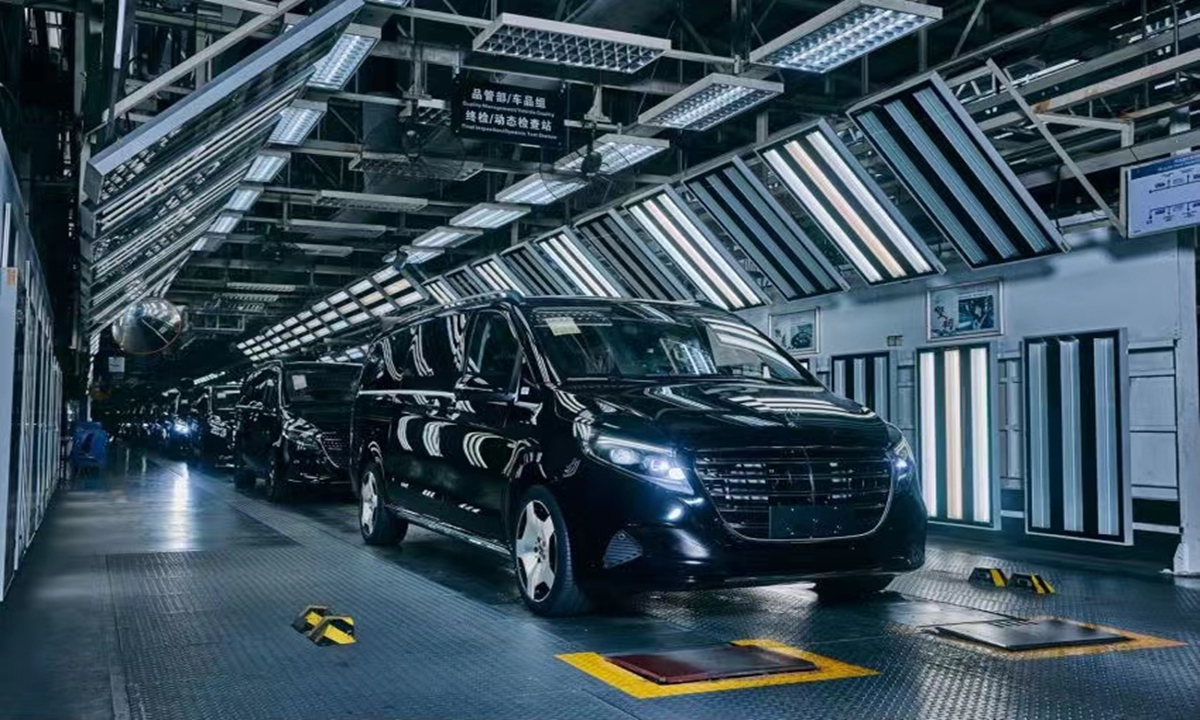
A view of a Mercedes-Benz factory in East China’s Fujian Province. Photo: Courtesy of Mercedes-Benz
The US Senate Commerce Committee on Wednesday local time reportedly advanced the “Connected Vehicle Security Act of 2026,” a bipartisan bill that tightens restrictions on Chinese-connected vehicles and technology entering the American market. The legislation would bar some established foreign automakers, such as Germany’s Mercedes-Benz, from selling vehicles in the US due to Chinese investment links, Reuters reported.
Chinese experts said the legislation reflects mounting protectionist pressure in the US auto industry, harms the global automotive supply chain, and will ultimately be paid for by ordinary American consumers. They argued that the US move is a classic protectionist tactic rather than a genuine national security measure, pointing out that if data security were truly the concern, Washington should establish transparent, uniform, and verifiable technical standards for all companies instead of singling them out based on nationality or ownership.
The new act would bar Chinese-linked vehicles equipped with wireless technology from being imported or sold in the US starting in January 2027. The bill covers vehicles linked to Russia, Iran, and North Korea as well, news site Quartz reported, citing Reuters.
According to Reuters, the proposed measure aims to prevent certain foreign automakers from selling connected vehicles in the US if more than 15 percent of the company is owned by Chinese entities. Mercedes-Benz, with roughly 20 percent Chinese-linked investment ownership, could be affected and has been given until 2030 to comply, with the possibility of applying for waivers.
The bill, introduced by Republican Senator Bernie Moreno of Ohio and Democratic Senator Elissa Slotkin of Michigan, claims to protect American drivers from risks such as surveillance, espionage and cyber threats by blocking Chinese-origin vehicles, software and key components, per Financial Times reports.
He Weiwen, a senior fellow at the Center for China and Globalization, told the Global Times on Thursday that the bill is part of a broader US effort to slow the expansion of competitive Chinese automakers and their supply chains. Chinese companies have developed strong advantages in batteries, smart vehicle systems, supply chain integration and cost control, while US automakers continue to lag in electrification and software development, he noted.
“In this situation, some US politicians are choosing not to improve domestic competitiveness, but to reduce the pressure by limiting rivals’ access to the market,” He said. “The result would likely be higher costs for automakers, fewer choices for consumers and weaker competition in the US market.”
Experts also warned that the legislation would disrupt the efficiency of the global automotive supply chain and interfere with the international operations of multinational carmakers.
Zhou Mi, a senior research fellow at the Chinese Academy of International Trade and Economic Cooperation, told the Global Times on Thursday that frequent use of “national security” framing in trade policy undermines America’s credibility and creates uncertainty for global businesses.
Mercedes-Benz, which employs more than 10,000 people in the US and operates assembly plants in Alabama and South Carolina, has highlighted its significant American footprint. Zhou said this underscores the dilemma facing multinational automakers deeply integrated into the US economy yet vulnerable to politically driven policies.
The bill reflects growing protectionist pressure in the US auto industry, and the costs would ultimately fall on ordinary American consumers through higher prices and reduced choices, industry analysts stressed.
Commenting on the US’ investigation into China-made vehicles that use "connected" car technology, a Ministry of Commerce spokesperson said on March 4, 2024 that the US’ attempt to set up non-tariff barriers is a typical protectionist practice, which will disrupt and distort the global auto industry and supply chains, and harm the interests of American consumers, the Xinhua News Agency reported.
Foreign Ministry Spokesperson Guo Jiakun said at a press briefing on January 14, 2025 that the US under the pretext of so-called national security made the decision without any factual basis to prohibit Chinese connected vehicle hardware and software systems, as well as completed connected vehicles, from being used in the US. Such a practice disrupts economic and commercial cooperation between companies, violates the principle of market economy and fair competition, and is typical protectionism and economic coercion.
“China firmly opposes this. We urge the US to stop its wrongdoings of overstretching the concept of national security, and stop going after Chinese companies. China will take necessary measures to firmly defend its lawful rights and interests,” Guo said.
RELATED ARTICLES