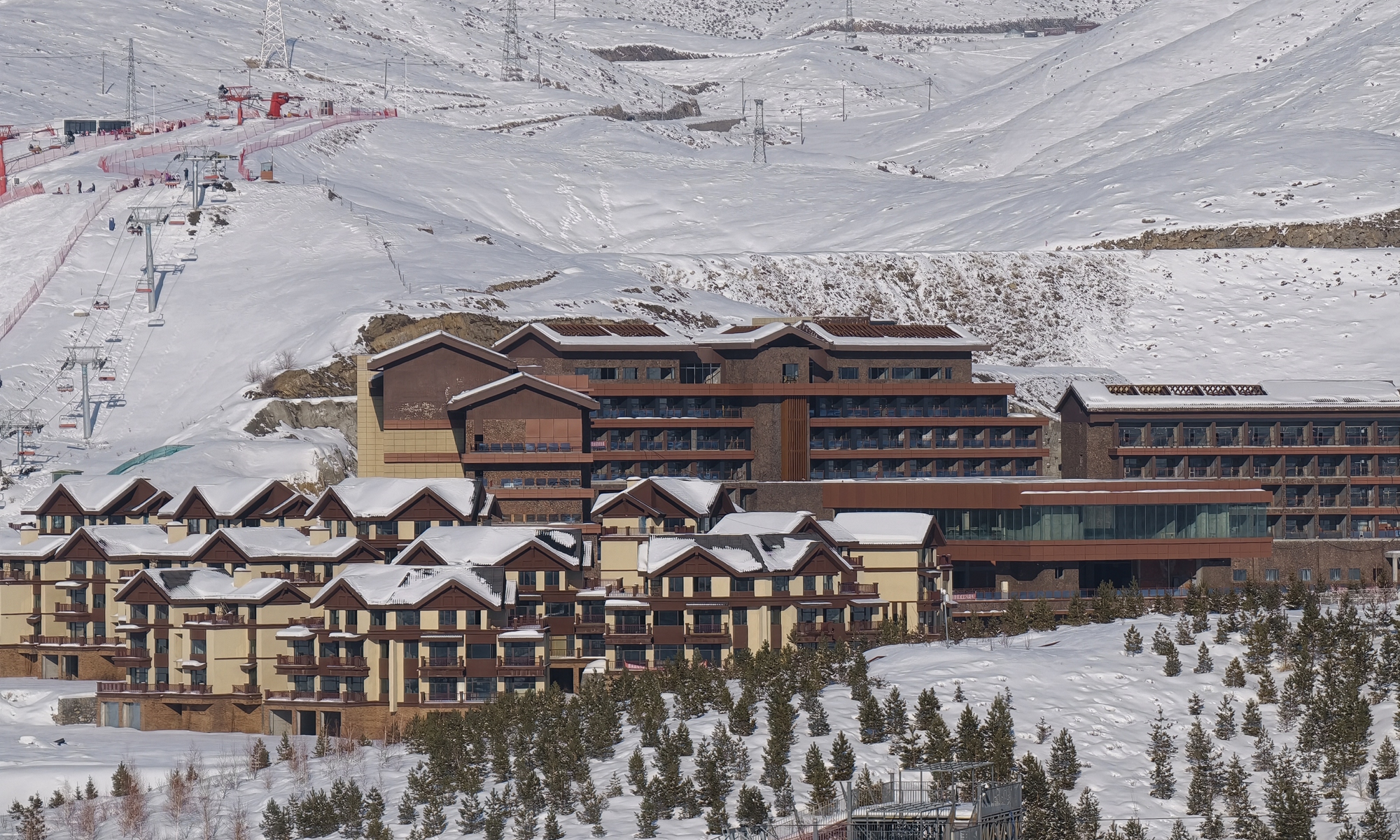
A view of the Jiangjunshan ski resort in Altay, Northwest China's Xinjiang Uygur Autonomous Region on February 24, 2026 Photo: VCG
As the snow season arrives, skiers heading to Altay in Northwest China's Xinjiang Uygur Autonomous Region have noticed something new: international hotel brands such as Conrad, Hilton, and Four Points by Sheraton have opened near the ski resorts, offering more diverse accommodation options.It is not only Altay. From popular tourist destinations like Ili, Bole, and Kashgar to business hubs such as Urumqi, international hotel groups have been racing to enter the Xinjiang market over the past two years. According to statistics, the three leading international hotel groups — Marriott, InterContinental Hotels Group (IHG), and Hilton — already operate more than 50 hotels in Xinjiang.
Why are international hotel groups so optimistic about Xinjiang? Two examples help explain.
In Hemu village in Altay, unique powder snow has fueled a skiing boom in winter, while the forest cabins attract visitors throughout spring, summer, and autumn. Hilton group has brought its Conrad and Hilton brands here, and IHG's Hotel Indigo brand is also set to open.
The booming tourism industry is delivering a steady and growing stream of guests for the hotel sector. From 2023 to 2025, the number of tourists visiting Xinjiang rose from 265 million to 323 million, making it one of the brightest growth engines for domestic tourism in China. At the same time, the chain penetration rate of hotels in Xinjiang remains well below the national average, leaving a vast blue ocean of opportunity.
Higher-end hotels typically require longer investment payback periods. International hotel groups, which primarily operate premium brands, are looking beyond the current boom to long-term potential. Their confidence is anchored in Xinjiang's ambitious goals: building a trillion-yuan cultural and tourism industrial cluster and aiming to receive more than 400 million tourists annually by 2030.
Now consider Urumqi. Construction of the free trade pilot zone is gathering pace, and the International Land Port is being developed into a new multimodal transport hub linking Asia and Europe. Marriott, IHG, and Hilton have already opened more than a dozen hotels in the city, while Marriott has also signed deals to bring in its Westin, Ritz-Carlton, and Aloft brands.
In the revenue structure of high-end hotels, non-room income — from meeting spaces, banquets, wellness, and leisure facilities — accounts for a substantial share, and business travelers are a key source of that revenue. Where do these business guests come from? The data provide a clear answer: during the 14th Five-Year Plan period (2021-25), Xinjiang's total foreign trade volume successively surpassed the 200-billion, 300-billion, 400-billion, and 500-billion yuan thresholds. In the first three quarters of this year alone, it reached 437.89 billion yuan ($65.7 billion), up 11.3 percent year-on-year.
Caravans once thronged along the Ancient Silk Road. Today, the Belt and Road Initiative has turned Xinjiang into a pivotal hub. The ancient relay stations and inns of the Silk Road echo in modern times as international hotel brands now settle in Xinjiang.
Why bet on Xinjiang? Guests are guaranteed, and business prospects are promising. The environment is improving, making operations more comfortable. Magnificent Xinjiang holds limitless opportunities.
This was compiled and translated by Global Times reporter Liu Yang based on an article published by the People's Daily on September 24, 2026.
RELATED ARTICLES