IN-DEPTH / IN-DEPTH
From White Rabbit candy to AI glasses, ‘China haul’ trend shows international visitors’ changing shopping lists and everyday discoveries
New list of souvenirs
By Published: Nov 24, 2026 11:36 PM

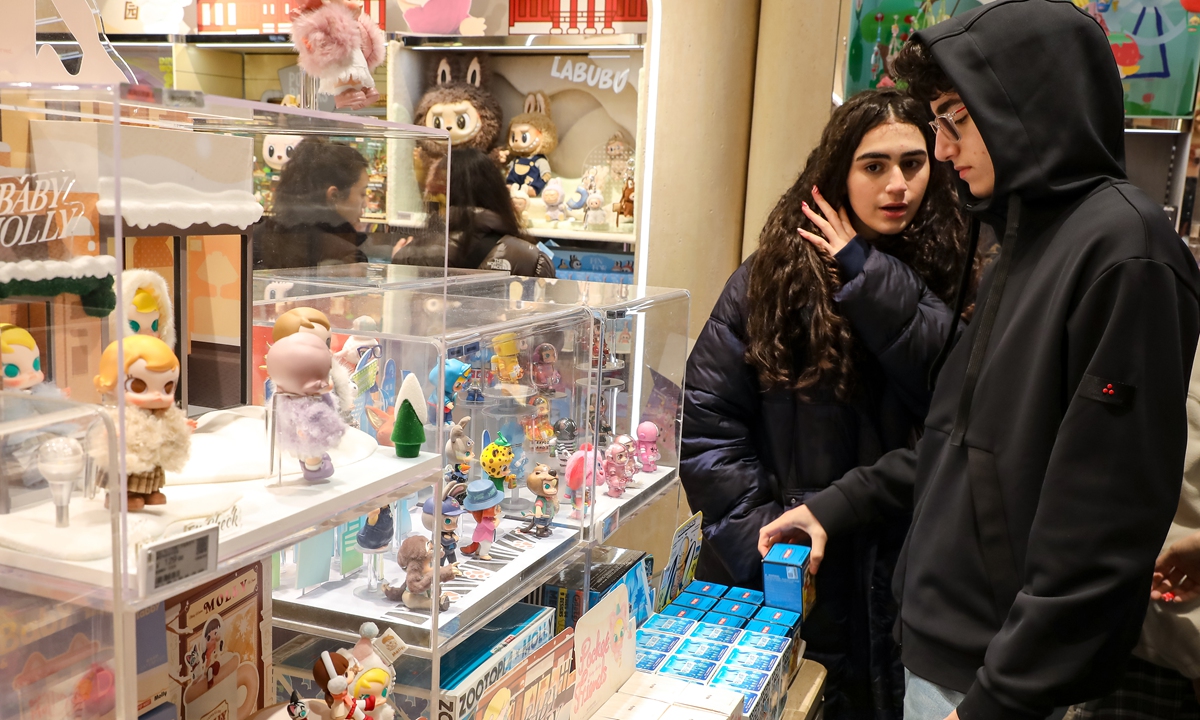
Foreign tourists buy Pop Mart products at a mall in Shanghai on December 20, 2025. Photo: VCG
At a tea shop in Guangzhou, South China's Guangdong Province, Matteo Picano tried several varieties before settling on Tieguanyin oolong tea from East China's Fujian Province and a bag of high mountain tea.
Tea wasn't the only thing on his shopping list. His girlfriend, who is from Northeast China, had introduced him to blind boxes. The two stopped at a blind box store in every city they visited. Among the figures and keychains they bought was a little bird from the Twinkle series. Some of the designs he found in China were unavailable in Italy, the 29-year-old engineer from Rome told the Global Times.
The little bird became as much a souvenir of China for Picano as the oolong tea. It came from a part of contemporary Chinese pop culture he discovered through the people around him, and exploring it gave him something else to look for on his trip.
For some people, that introduction to Chinese culture begins online. Earlier this year, TikTok and Instagram users joked that they were in a "very Chinese time" of their lives as they tried habits such as drinking hot water and wearing slippers at home. The trend also went by "Chinamaxxing."
In the latest "China haul" videos, international visitors show what they bought on a trip to China and talk about why they picked it. Viewers have asked for links to products ranging from action cameras to silk and ceramics.
Some of the shopping took place during the Asia-Pacific Economic Cooperation (APEC) Leaders' Week in Shenzhen. At a stall in the Huaqiangbei electronics market, Mexico's health secretary, David Kershenobich Stalnikowitz, asked what a leg massager could do, compared prices and bought one for 350 yuan (about $53), The Beijing News reported.
As these travelers come to know more of China's everyday life, their idea of what is worth bringing home is changing, too.
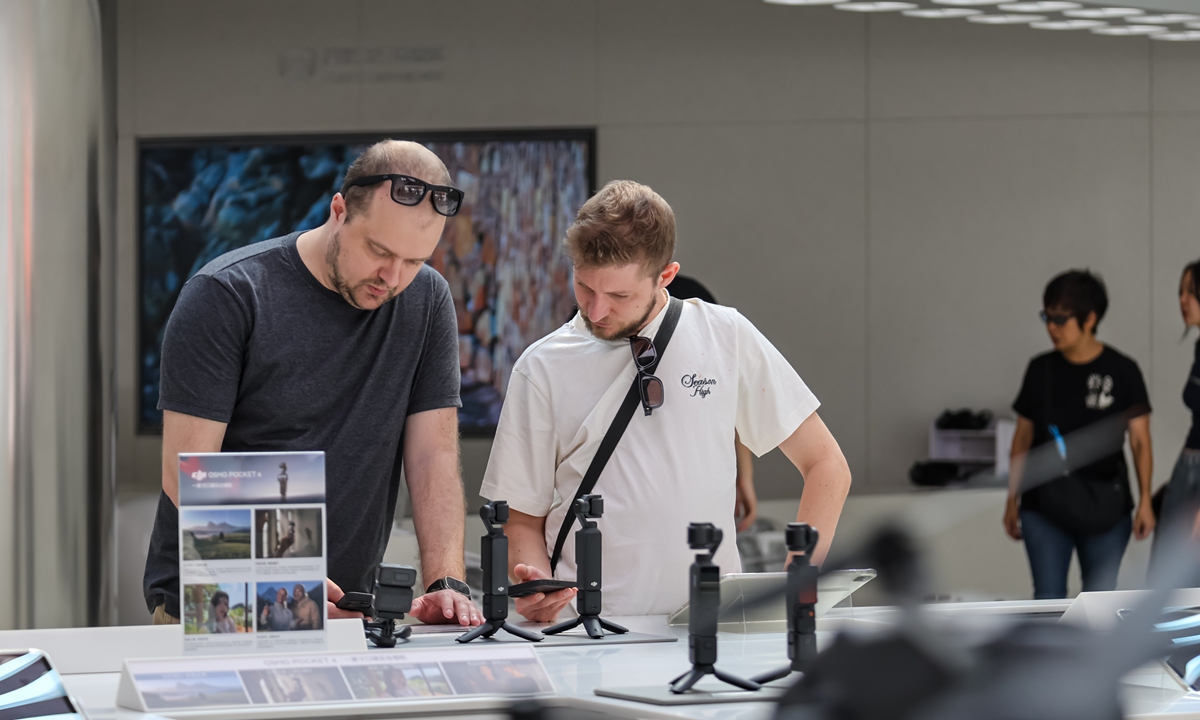
Foreign visitors try out DJI Pocket devices in Shenzhen on April 21, 2026. Photo: VCG
What visitors are looking for
In Xi'an, Northwest China's Shaanxi Province, Matteo bought a ceramic bottle shaped like a traditional wine gourd. He had seen vessels like it in Chinese films and television series and had grown curious about them. He also picked up a steel bottle with a filter for brewing tea, something he could use with the leaves he had bought on the trip.
Picano's interest in history and languages had led him to study Chinese at the Confucius Institute in Rome. Traveling gave him a chance to find out what people in China were watching, buying and collecting.
At a comics and video game convention in Guangzhou, he bought trading cards based on the animated film Ne Zha 2. He liked the "cutesy but quirky" look of the Pop Mart figures he found along the way, a combination he said was hard to find in European brands.
One of Picano's own shopping tips came from a classroom in Rome. His teacher, Tao, had recommended the jasmine ice cream from Beijing's Wuyutai Tea Shop. When he reached the capital, the first local thing he tried was the ice cream his teacher had told him about.
For some visitors, a particular purchase can determine which city comes first. Andrea Triboldi, another Italian traveler, said that he chose Shenzhen as his first stop because he wanted to see the technology on offer.
He had put more than 20 products on his list before leaving for China. His 11-year-old son had his eye on a DJI drone, reported the Xinhua News Agency. At one of the company's flagship stores in Shenzhen, an employee said that international visitors particularly enjoyed trying out the drones in test flights.
During November's APEC Leaders' Week, many shoppers headed to Shenzhen's Huaqiangbei electronics market to look for AI glasses, which had gained attention on social media. An eyewear vendor said the glasses' translation feature was a particular draw for overseas shoppers.
Local officials have also responded to that interest. In October, the Shenzhen municipal government's website published an English-language shopping list for Huaqiangbei based on purchases overseas visitors had made earlier this year. It featured eight gadgets, including pocket cameras, translation earbuds and AI glasses.
At the October launch, shoppers could buy all eight gadgets together for 5,141 yuan. Bought separately at their listed prices, the gadgets would have cost 6,200 yuan in total, according to the Futian district government's website.
The list was Huaqiangbei's response to a demand that visitors themselves had helped define.
As travelers become more familiar with the technology coming out of China, and after doing some research, some are arriving with a clear idea what they are looking for.

Matteo Picano wears traditional Chinese costume in Xi'an, Shaanxi Province. Photo: Courtesy of Picano
What becomes part of everyday life
In Marseille, Marie rarely had a hot drink away from home. In Beijing, she watched classmates and friends carry thermoses, and soon after, she started carrying one, too. She filled it with tea or just hot water. Now she has cups in so many sizes and colors, she said, "they are slowly turning into a collection."
Marie, a graduate student at Peking University who uses the Chinese name Dai Mingxin, has lived in Beijing since 2017. Soon after arriving, she bought an Honor phone. She was surprised by what she could get for the price.
Chinese brands are often her first choice when she shops for clothes, bags or home appliances. "I tend to care more about getting the best quality for the price I'm willing to pay," she told the Global Times.
Marie finds some of the "Chinamaxxing" videos exaggerated, though she recognizes the excitement of finding a new way to do something. She still gets that feeling in China.
For visitors on a short stay, a first encounter with a local routine can happen at the hotel. Some tourists had learned to use e-commerce platforms Taobao and Meituan to have purchases and meals delivered to their rooms. Some ordered takeout just to see a hotel robot deliver it.
Sometimes the appeal of a purchase becomes clear once it is in regular use. Marie said an electronic neck massager is the sort of gadget people in France might try out of curiosity at a store display. Marie bought an electronic neck massager after seeing the devices around China.
When asked what she would recommend taking home, she named the massager first, saying it "does wonders after a long plane trip home."
For Mok Jin Jin's family in Malaysia, the feature that made a Chinese-made blender especially useful was a single button. Mok told Xinhua that her mother often uses it to make drinks for the family. She particularly likes being able to press a button and let the blender clean itself.
Marie has also seen some of the brands she knows from China turn up in Marseille. Pop Mart, the toy chain Picano made time for in city after city on his first trip to China, now has a shop on Rue Saint-Ferréol in her hometown.
Other products reached her family in a suitcase. Marie brought Chinese makeup back to France for her mother, who liked the packaging and the quality. Over time, her mother found products she wanted to buy again. Now, whenever she visits her daughter in Beijing, she stocks up on makeup and skincare.
Who puts it on the list
Years before travelers began posting their "China hauls," Lao Gan Ma was already a kitchen staple for Jen Phanomrat, co-host of Food52's Either Side Eaters podcast. She remembered when she could only find it in Asian grocery stores. By the time of the podcast, it was already on the shelves in her local convenience store. Her co-host, Katie Quinn, used to buy it regularly in London. The version with black soybeans was Phanomrat's favorite, and Quinn liked the umami the beans brought to the chili oil.
On TikTok, an introduction to a Chinese product can begin with something as ordinary as making a hot drink. Chinese American creator Sherry Zhu shows viewers how she steeps goji berries in a thermos and talks about wearing slippers indoors. Some viewers of videos about Chinese habits asked where they could buy a pair of Chinese house slippers. Others turned to Zhu for advice about what to do for Chinese New Year. "Cousin Sherry," some called her in the comments.
Chang Jiang, a professor at Shenzhen University's School of Media and Communication, said that a fuller picture of China was emerging overseas through the accounts of travelers and ordinary social media users. Those accounts give viewers details they can act on, according to Chinese Social Sciences Today. In an August YouTube video, for example, creator Elliot Page and Dylan unpacked clothes and shoes they had bought in Guangzhou and Shenzhen, discussing how the fabrics felt and how the jackets fitted. A viewer considering a similar purchase could see what the clothes looked like on someone who had actually tried them.
Sometimes the detail that gets passed around is a candy wrapper. On August 5, an X user shared photos of White Rabbit milk candy and its red, white and blue wrapper laid flat, calling it an "absolute masterstroke of graphic design." The post had drawn more than 5 million views.
In November, RADII, an English-language website covering contemporary Chinese culture, featured White Rabbit in a guide to snacks worth trying on a trip to China. It pointed readers to red bean and coffee versions of the milk candy and recommended Snack Kingdom in Changsha, Central China's Hunan Province. The store's range has drawn visitors from countries including Russia and Tanzania. A Russian tourist said few snack shops back home offered that much choice. A Tanzanian visitor said the store was also a place to have fun and described the Chinese snacks she tried as less sweet than those she knew at home.
Observers see the "China haul" trend as a sign of changing tastes among international visitors. Chinese technology and design are giving travelers more reasons to shop, and browsing stores and markets has become part of the trip for some. What seals a purchase can be something as simple as the fit of a jacket, how well a pair of earbuds translates a conversation or the chance to try a familiar candy in a new flavor.
For Picano, that growing familiarity showed up in what he bought to take back home to Rome. He bought the oolong tea, a little bird from the toy line his girlfriend had introduced him to and a bottle he could use to brew the tea.
Zhu Xuanlin contributed to this story.
RELATED ARTICLES