Making Black Friday sales worth the wait takes more than clever pricing algorithms
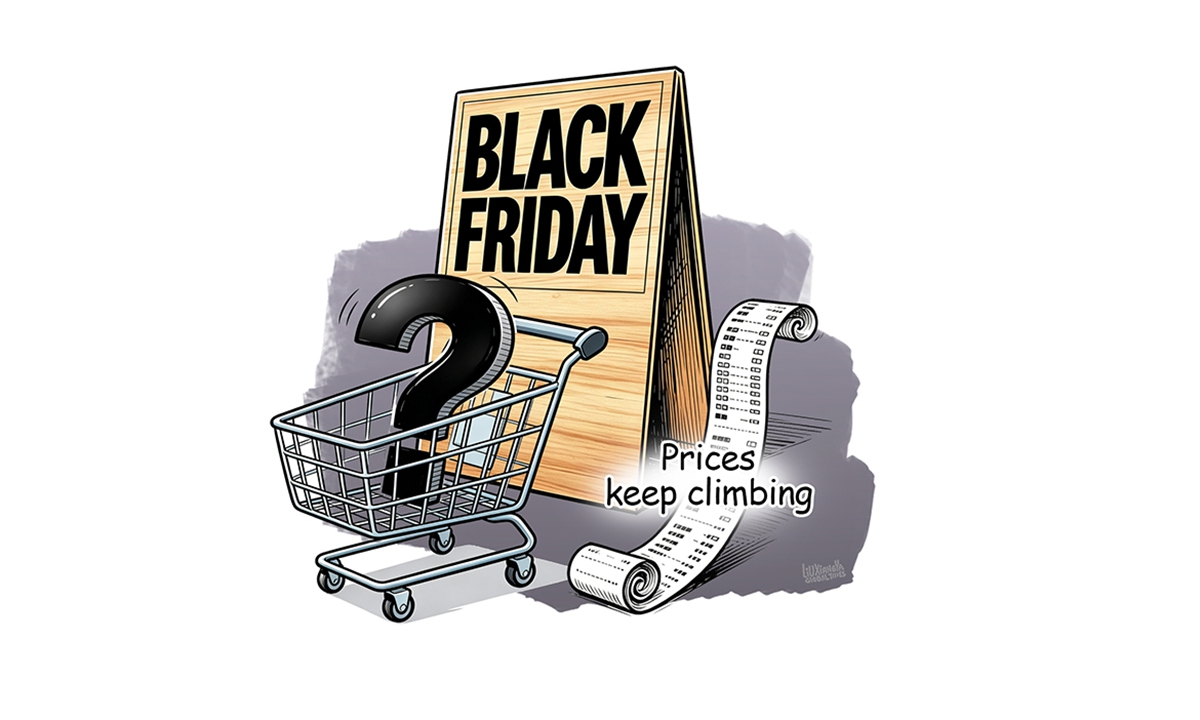
Illustration: Liu Xiangya/GT
Black Friday is becoming a more calculated affair. Some US retailers are turning to artificial intelligence (AI) to determine how much they need to cut prices to attract shoppers. However, for consumers facing rising living costs, the appeal of the annual shopping frenzy still rests on something much simpler: genuine bargains.
A billion-dollar beauty brand was initially planning to offer a 40 percent discount on a skincare product this Black Friday when an AI pricing tool suggested that a 30 percent would suffice. Another brand was advised to scale back a buy-one-get-one promotion from 50 percent to 40 percent off, Reuters reported.
By analyzing sales data, inventory levels and competitors' prices, among other factors, AI pricing tools help brands determine whether they can reduce discounts without dampening demand, allowing them to better protect profit margins.
Consumers are doing their own arithmetic. A survey released by the US National Retail Federation on November 19 showed that 82 percent of consumers are taking steps to manage holiday shopping costs, with 25 percent opting for less expensive gifts and 24 percent cutting spending elsewhere.
For consumers on tight budgets, the prospect of substantial savings is what makes Black Friday worth waiting for. That has been central to its appeal for decades. If genuine bargains become harder to find, festive displays and clever marketing alone may not be enough to keep shoppers coming back.
That matters all the more this year, as geopolitical conflicts have driven up energy costs worldwide and tariffs have added to import costs in markets such as the US and Canada. The Mastercard Economics Institute estimates that higher prices will account for nearly half of this year's projected 5.5 percent growth in US holiday retail sales, excluding gasoline and automobiles.
But retailers' ability to offer genuine bargains depends on more than their willingness to cut prices. More efficient global supply chains create headroom for such discounts by lowering goods delivery costs, though retailers may choose to retain those savings as profit rather than pass them on to shoppers.
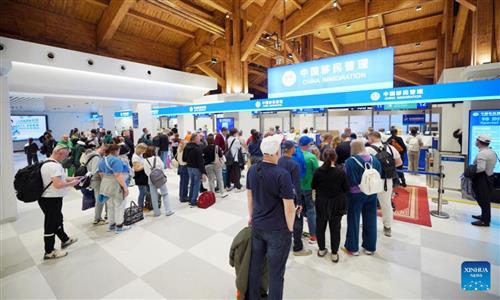
In the Huaqiangbei electronics market in Shenzhen, South China's Guangdong Province, daily visits by foreigners have exceeded 10,000 since mid-October, driven by the Canton Fair and overseas buyers stocking up for the year-end shopping season in Europe and the US, CCTV reported on November 5.
Among the products attracting attention are AI glasses. CCTV Finance reported earlier this month that a popular model featuring video recording, language translation and AI-powered object recognition was selling for just 450 yuan ($67). China's mature electronics supply chains and manufacturing efficiency are making such technology increasingly affordable.
For overseas retailers, access to such products means they can refresh their inventories and give shoppers something new to look for during the holiday season, rather than relying solely on deep discounts to drive sales.
Beyond China, manufacturing capacity is also expanding in Southeast Asia and India, covering clothing, footwear and consumer electronics. These economies are emerging alternative sources of affordable goods for Black Friday shoppers. For retailers, a growing pool of competitive suppliers is a clear commercial advantage.
The growth of cross-border e-commerce is bringing these manufacturing centers closer to overseas consumers. It has opened up new sales channels for suppliers that once depended heavily on traditional distribution networks. How easily goods can move across borders is therefore increasingly relevant to the prices and choices available to shoppers.
Tariff uncertainty, however, is making it harder for retailers to plan their purchases. As early as June, Reuters quoted shipping executives as saying that US retailers had placed orders with Chinese suppliers four to six weeks earlier than usual to build up stocks for Black Friday and Christmas ahead of expected tariff increases.
The costs are also being felt by consumers. Researchers writing on the Federal Reserve Bank of New York's website in October estimated that tariffs had added 2.9 percentage points to inflation in the consumer goods they studied as of February 2026. Without tariffs, those prices would have fallen slightly.
Trade barriers, such as higher tariffs, leave retailers with less room to offer discounts and erode consumers' purchasing power. Much of the savings made possible by advances in manufacturing and logistics risks being swallowed up by additional trade costs.
A better way to serve both businesses and consumers is to allow manufacturers from different countries to compete for orders on a level playing field.
Black Friday can become smarter, more diverse and more enjoyable. But the ultimate measure of that progress should be how much of the value created by technological and industrial advances ends up in the hands of consumers.
The author is a reporter with the Global Times. bizopinion@globaltimes.com.cn
RELATED ARTICLES