GT Voice: India's construction equipment localization drive should not be trapped in an anti-China narrative
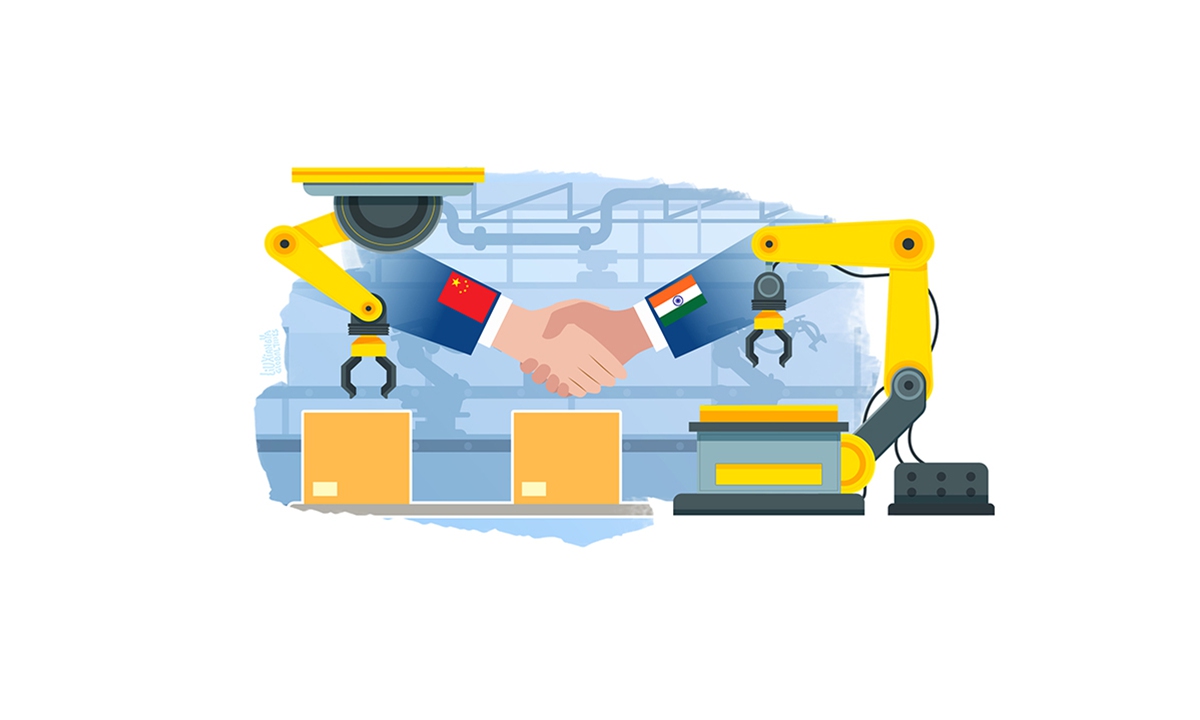
China-India industrial cooperation potential Illustration: Liu Xiangya/GT
India's Union Cabinet has approved an eight-year industrial support program with a total outlay of 110 billion rupees ($1.19 billion). The initiative aims to improve the country's manufacturing of construction and infrastructure equipment (CIE) and its components, as well as establish a dedicated CIE testing facility, thereby enhancing self-reliance and positioning India as a key player in the global CIE market.
However, some Indian media outlets have linked this industrial support policy to claimed concerns over the supply of Chinese equipment. The Economic Times said that the move comes amid "China's restrictions on exports of certain heavy equipment, including tunnel boring machines." India's business news channel CNBC TV18 interpreted the plan as "part of the government's broader push to build domestic manufacturing capacity and reduce reliance on foreign suppliers." It added that India largely depends on China for these machines, which are used in infrastructure projects in hilly, high-altitude and border areas.
India's development of its construction equipment industry has its own economic logic, and there is no need to link a normal process of industrialization to a "de-China" or an "anti-China" narrative. According to some media reports, approval of the plan followed nearly two years of discussions between the construction equipment industry and the government on financial incentives to boost domestic manufacturing. This shows that the industry's underlying economic rationale long predates recent supply concerns.
As a developing economy undergoing rapid industrialization and urbanization, India's desire to build a domestic construction equipment industry is not hard to understand. As construction of roads, railways, ports and other infrastructure continues, demand for construction equipment in India keeps growing.
India is the world's third-largest market for CIE, after China and the US. Indian government figures put the market at about 975 billion rupees ($11 billion) in fiscal year 2024-25. Fueled by rapid growth in infrastructure and housing, it is projected to more than double to roughly 2.28 trillion rupees by fiscal 2029-30. This vast market demand provides a practical foundation for nurturing indigenous manufacturing capacity. China has no reason to see India's industrial progress as a threat.
What truly warrants caution is that some Indian manufacturers are trying to secure more market space for local production by imposing tariffs and tightening local sourcing requirements.
High-end construction equipment is technology-, capital- and supply-chain-intensive. Its production involves precision machinery, hydraulic systems, core components, industrial controls and many other components. Erecting trade barriers while India's supporting industrial base is still immature may drive up equipment procurement and production costs, potentially slowing the country's ambitious infrastructure build-out. The concerns expressed by multinational manufacturers operating in India deserve to be taken seriously.
How to turn vast domestic market demand into a competitive edge for local manufacturing is a challenge shared by many developing countries still undergoing industrialization. China's CIE also went through a stage when its technological foundations were weak and it relied heavily on imported core components. The path it took to upgrade could offer useful lessons for India.
Looking back at the development of China's CIE, opening-up and cooperation, on the one hand, and independent innovation, on the other, have always been two mutually reinforcing main threads.
In the 1980s, Chinese construction equipment companies introduced advanced foreign technologies on a large scale. Take Chinese leading construction equipment maker company LiuGong as an example. The company introduced technology from US-based Caterpillar in 1987 and formed a joint venture with Germany's ZF Friedrichshafen AG in 1995. It then steadily strengthened its research and development (R&D) efforts and gradually built an industrial system covering complete machines, core components and services. In recent years, Chinese construction equipment companies have made breakthroughs in electrification, intelligent technologies and other fields.
This development path shows that international cooperation does not necessarily lead to technological dependence, and that opening markets does not mean giving up independent innovation. The key lies in whether international technologies and industrial resources can be effectively combined with a country's own R&D capabilities, market demand and engineering practice, so that external resources become endogenous drivers of development.
As the global construction equipment industry accelerates its shift toward intelligent and green technologies, China and India still have broad room for cooperation in equipment manufacturing, component supply, technology R&D and other areas. Some Indian manufacturers need to realize that China's mature construction equipment industrial chain is not an obstacle to India's localization drive, but rather an important resource that can help India shorten its industrial upgrading cycle and improve manufacturing efficiency.
How to cultivate independent innovation capacities through opening-up and cooperation is an important question for India's construction equipment industry as it moves toward global competition.
For India, the yardstick for manufacturing success should not be merely how much its import dependence has fallen, but whether its companies can build sustainable technological advantages and competitiveness in the international market. Self-reliance does not mean self-isolation, and localization should not become synonymous with protectionism.
RELATED ARTICLES