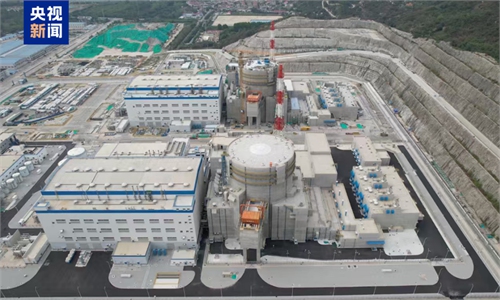
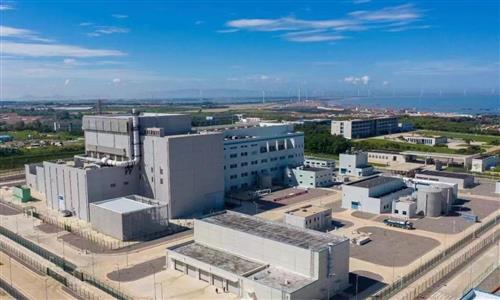
Construction begins on Phase II of Taishan nuclear power project, set to generate over 9 billion kWh annually
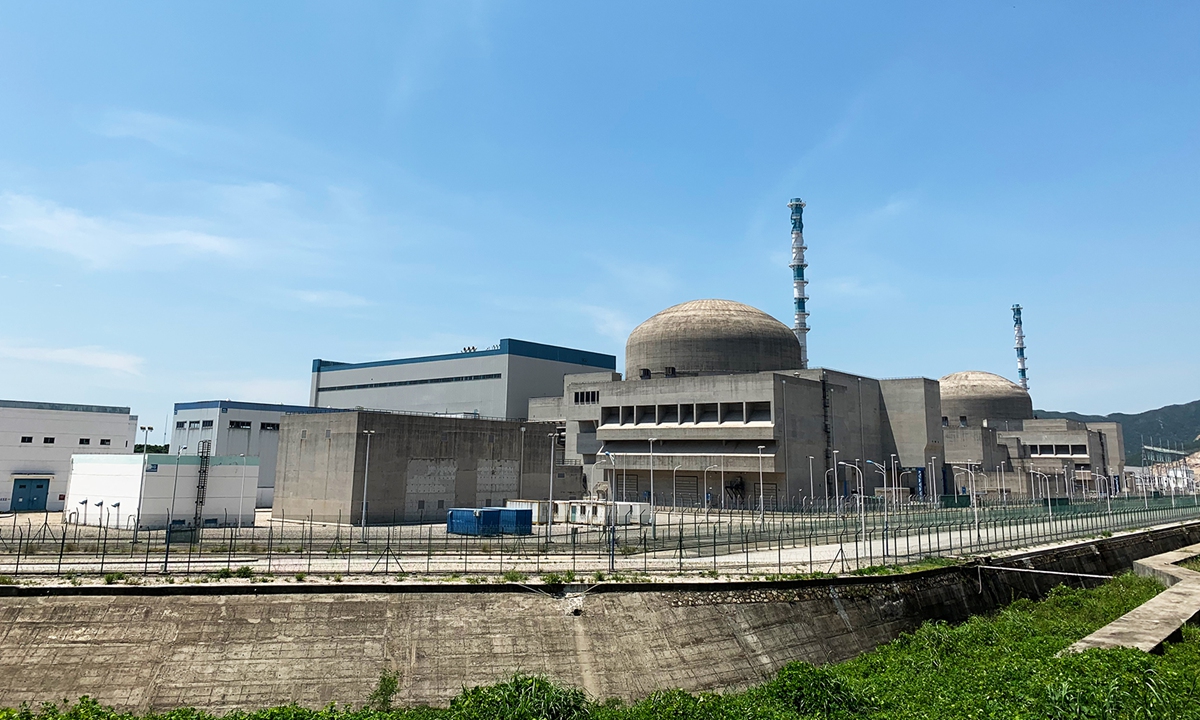
Taishan nuclear power plant
Workers began pouring concrete for the Unit 3 nuclear island at the China General Nuclear Power Corporation's (CGN) Taishan Nuclear Power Plant Base in South China's Guangdong Province on Wednesday, marking the start of Phase II main construction. The unit will use Hualong One, China's independently developed third-generation nuclear power technology.When operational, it is expected to generate more than 9 billion kilowatt-hours of electricity annually, enough to meet the yearly electricity needs of about 1 million people and boost clean power supply to the Guangdong-Hong Kong-Macao Greater Bay Area, according to state broadcaster CCTV.
Unit 3 received state approval on April 27, 2025. Its nuclear island foundation requires about 8,823 cubic meters of concrete, with the pouring expected to take 55 hours of continuous work.
The operation requires close coordination to manage the concrete supply, transportation, pumping and on-site construction, the Beijing-based Science and Technology Daily reported.
To improve efficiency, the project team has introduced automated processing lines and welding robots. It has also adopted a modular approach that combines the parallel construction of foundation walls with prefabricated walls for reinforcement. This helps reduce wait times between construction stages and the risk that reinforcement will be missed during installation, according to the Science and Technology Daily report.
Liu Dan, chairman of CGN Taishan Second Nuclear Power Co, said the project will draw on CGN's experience in the large-scale construction of the Hualong One unit. It will deploy a smart construction site system and an integrated progress coordination platform to share data across design, procurement, construction and commissioning, advancing the digital management of the project.
Deng Bowen, a cost engineer at a state-owned infrastructure construction company, told the Global Times that the cost of a major infrastructure project should be assessed over its entire service life, rather than only by its initial construction expenses.
"Some design choices may require additional investment during construction but can bring savings when the facility is in operation," Deng said.
"The design affects not only construction costs, but also the energy needed to run pumps, water replenishment and long-term operating expenses. These factors need to be considered together at the very beginning," he noted.
The cooling system planned for Phase II offers one example. The project will adopt water-collecting, natural-draft cooling towers. Using natural airflow, the towers will dissipate waste heat from the conventional island's thermal cycle and allow cooling water to be recirculated. The design is expected to help reduce the impact of heated water discharges on the surrounding marine environment, the Science and Technology Daily reported.
The Taishan nuclear power project will comprise six million-kilowatt-class units across three phases. The two units in Phase I were fully completed and put into operation on September 7, 2019. With construction of Phase II now underway, the project is expected to further increase regional clean electricity supply and support Guangdong's transition to greener energy, as well as the development of low-carbon industries in the Greater Bay Area, according to the Science and Technology Daily.
RELATED ARTICLES