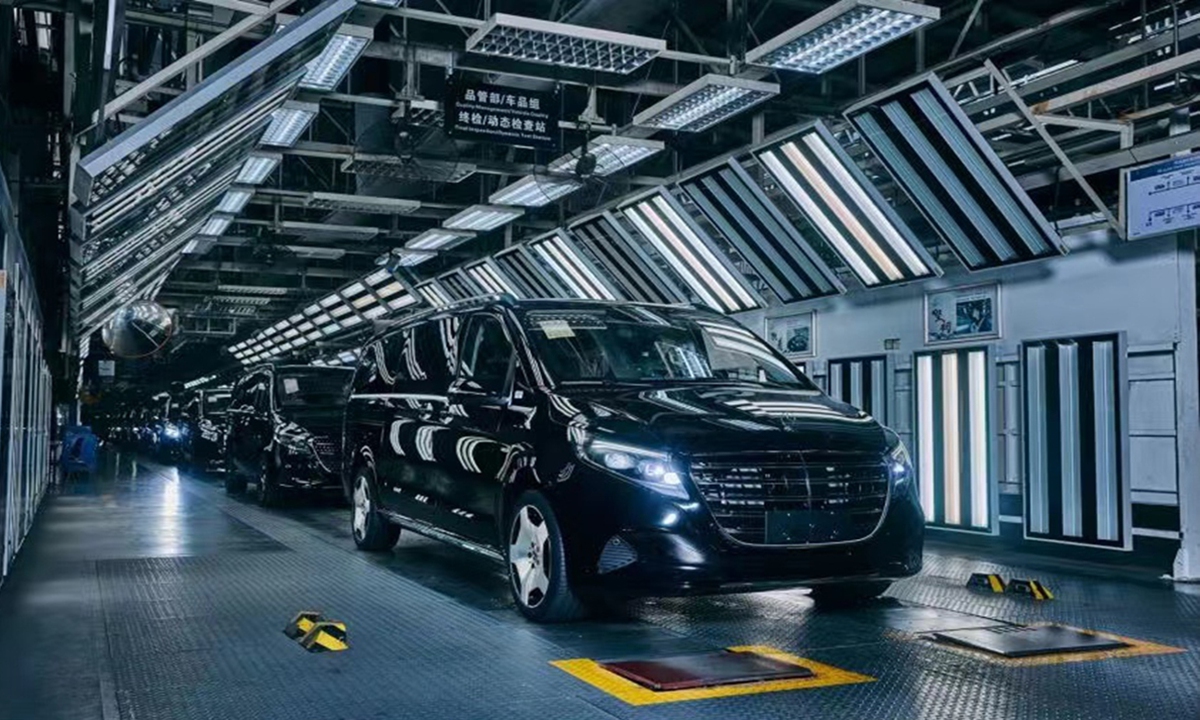
A view of a Mercedes-Benz factory in East China's Fujian Province. Photo: Courtesy of Mercedes-Benz
German automaker Mercedes-Benz plans to establish a new joint venture in Beijing to procure passenger vehicle components for its local manufacturing operations, according to a regulatory filing released on Friday, as the automaker pushes ahead with deeper supply chain localization in China to sharpen its competitiveness.
Mercedes-Benz (China) Investment Co and Beijing Benz Automotive Co (BBAC) have signed a joint venture agreement to establish a company in Beijing that will purchase passenger vehicle components and supply them internally to BBAC, according to a filing published by China's State Administration for Market Regulation (SAMR).
Upon completion of the transaction, Mercedes-Benz China and BBAC will hold stakes of 70 percent and 30 percent, respectively, and jointly control the new company. The deal is subject to the SAMR's simplified merger review procedure, with the public comment period running from November 27 to December 6.
The proposed transaction qualifies for the SAMR's simplified merger review, with the parties' combined market share in the same relevant market below 15 percent and their respective shares in upstream and downstream markets each below 25 percent.
BBAC, jointly controlled by BAIC Group and Mercedes-Benz Group, is primarily engaged in the development and production of engines, batteries and vehicles, as well as sales and after-sales services, according to the filing.
The proposed venture comes as Mercedes-Benz seeks to make its Chinese operations more cost-efficient through closer integration with the local industrial ecosystem.
In its 2025 full-year results released in February, Mercedes-Benz outlined plans to expand local research and development (R&D) partnerships and accelerate localization across its supply chain in China. By 2027, the automaker and its local joint venture aim to reduce local material costs by 10 percent, variable production costs by 20 percent and fixed costs by 20 percent from 2024 levels.
At Auto China 2026 in April, Mercedes-Benz said BBAC, its largest production plant worldwide, had recently rolled out its 6 millionth vehicle. The automaker also plans to expand its range of locally manufactured models from 14 to 20 by 2027, drawing on the strengths of China's supply chains and cost structure, according to the company.
China's extensive automotive supply chains offer foreign carmakers advantages in both technology and cost efficiency. The scale of China's new-energy vehicle (NEV) industry has helped bring down component costs, while its technological capabilities are contributing to the upgrading of global automotive supply chains, Zhang Xiang, secretary-general of the International Intelligent Vehicle Engineering Association, told the Global Times on Friday.
Such advantages are increasingly shaping how German automakers develop and manufacture their next generation of vehicles.
In January, Volkswagen Group began mass production of its first model featuring a new electronic architecture developed in cooperation with Chinese EV maker XPeng at its plant in Hefei, East China's Anhui Province. The architecture took just 18 months to move from concept to production.
For German businesses, the strategic value of China's industrial ecosystem goes beyond the domestic market. The country's comprehensive industrial supply chains and intense market competition are helping German companies sharpen their global competitiveness, according to a report released by the German Chamber of Commerce in China in September.
The report also noted that knowledge flows from China to Germany are accelerating, covering business processes, operational speed and market intelligence, as Chinese companies have become technology leaders in some sectors.
RELATED ARTICLES