Chinese consumers rush to buy gold ornaments as global spot price falls below $3,500
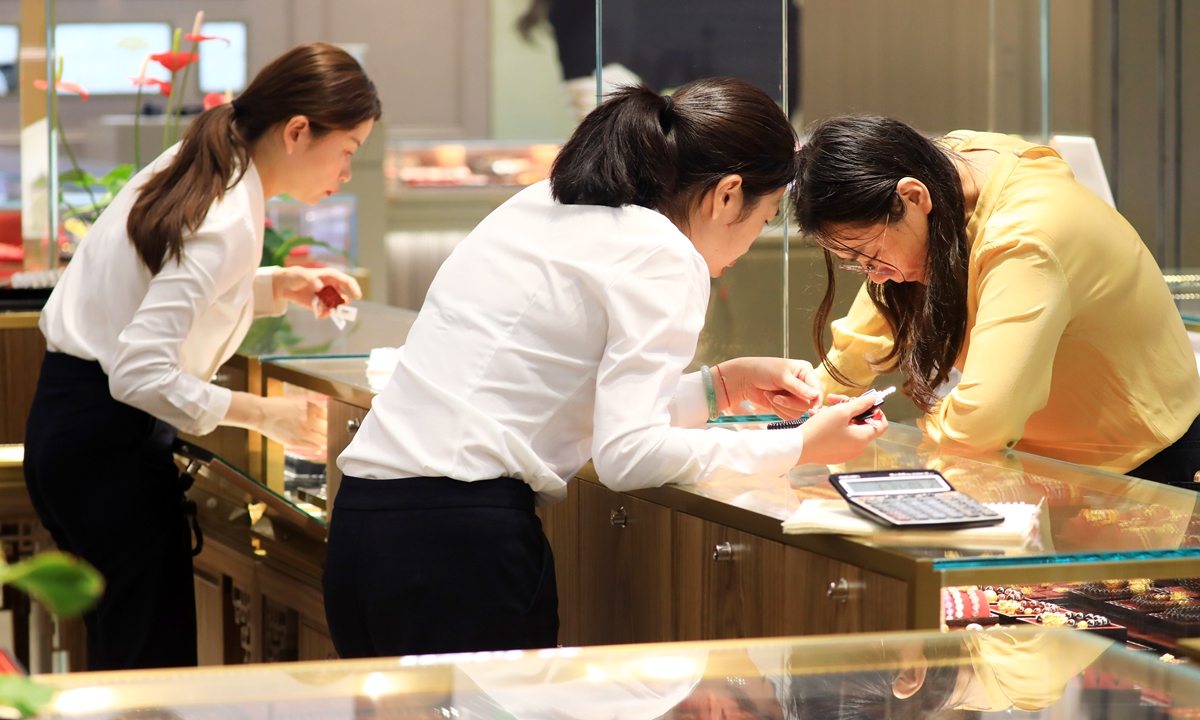
A consumer selects gold jewelry at a store in Huai'an, East China's Jiangsu Province, on September 27, 2026. Photo: VCG
As international gold prices pull back from this year's peak, Chinese consumers are once again flocking to jewelry stores — a sign that the metal's appeal as both an adornment and an investment remains strong even after months of volatility.
Spot gold briefly fell below $3,500 per ounce on Wednesday, reaching its lowest level since September 2025, before rebounding to $3,653 per ounce by Saturday's close. The short-term recovery followed a period of sustained weakness that began in September.
Even after the rebound this week, gold remains far below this year's peak. According to CCTV Finance, spot gold was still down more than 30 percent from its 2026 high of $5,596.33 per ounce.
In China, major jewelry brands including Lao Feng Xiang, Chow Tai Fook and Chow Sang Sang saw gold jewelry prices rise again to around 1,100 yuan ($165.29) per gram on Saturday.
At Caibai Jewelry Co, a leading gold retailer in Beijing, weekend foot traffic surged. According to local media reports, counters were crowded with shoppers buying transfer beads, children's jewelry, and self-use items such as bracelets, necklaces and earrings.
Gold jewelry prices at Caibai were mostly around 1,088 yuan per gram on Saturday. A 30-gram gold bracelet, including roughly 1,500 yuan in processing fees, cost about 34,140 yuan in total — more than 15,000 yuan cheaper than at the start of 2026, when the same item cost around 50,000 yuan, BRTV News reported.
A gold shop employee in Changzhou, East China's Jiangsu Province, told CCTV Finance that customer traffic has increased every day since November 18, rising by 1.2 times from normal levels, while sales revenue has doubled. In Shenzhen's Shuibei jewelry market, merchants said sales jumped 50 percent, with weekend crowds so heavy that some stores were difficult to enter.
Experts said the rise in domestic buying reflects a deeper shift in household asset allocation. Beyond seasonal demand for weddings and gift-giving, more families are treating gold as a tool to hedge inflation and credit risk, and are increasingly willing to buy on dips.
According to Zhou Yinghao, a senior gold investment analyst, the recent three-month decline was driven mainly by stronger-than-expected US inflation, which prompted the US Federal Reserve to restart rate hikes and issue more hawkish signals.
That pushed up the dollar index and US yields, increasing the opportunity cost of holding non-interest-bearing gold. At the same time, profit-taking after gold's earlier rally and liquidity demand from swings in US equities also contributed to the correction, Zhou told the Global Times on Sunday.
"Recent declines have not changed gold's long-term support logic," Zhou said, noting that geopolitical restructuring, de-dollarization trends and central-bank demand continue to underpin the metal's strategic role in global portfolios.
The World Gold Council recently released a report in Shanghai suggesting that investors should treat gold as a long-term strategic asset and adjust allocations dynamically depending on the economic cycle. The report said gold's share in a portfolio could range from 5 percent to 28 percent, depending on market conditions.
RELATED ARTICLES