
HOME >> CHINA
Water transfer project benefits over 120 million people: official
Source:Global Times Published: 2019/12/12 22:33:40
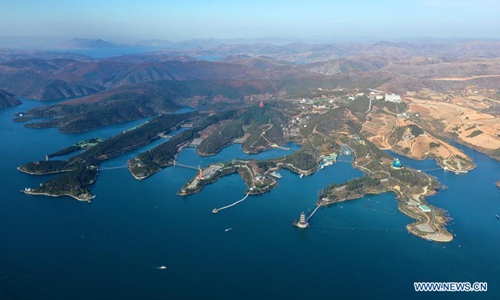
Aerial photo taken on Dec. 10, 2019 shows the scenery of the Danjiangkou Reservoir region in Xichuan County of Nanyang, central China's Henan Province. The middle route of China's south-to-north water diversion project begins at the Danjiangkou Reservoir and runs across Henan and Hebei provinces before reaching Tianjin and Beijing. Photo: Xinhua/Feng Dapeng
Five years after China opened a $80 billion mega tunnel from China's longest river, the Yangtze, to feed the arid north including Beijing, Tianjin, Hebei and Henan provinces, nearly 30 billion cubic meters of water has been delivered, benefiting 120 million people, the relevant ministry said on Thursday.The water supported GDP growth of about 4 trillion yuan ($568.5 billion), Jiang Xuguang, deputy minister of China's Ministry of Water Resources, said at a press conference on Thursday, promoting the comprehensive benefits of the project.
The first phase was put into use in 2014 and has benefitted 40 cities and 260 counties in the north, Jiang said, noting the project provided water for some major national strategies in the north such as construction of Xiongan New Area.
In the capital city of Beijing, more than 70 percent of its drinking water in the major urban areas came through canals and pipelines from the south, benefiting over 12 million residents, over half of the city's total population.
The project was also used to help ease the drought in East China's Jiangsu and Anhui provinces this year, Jiang noted.
In response to environmental concerns, Jiang said that tough measures have been used to expand lakes and wetland in the north and curb underground water level declines as well as stop the environment deteriorating.
When construction started in 2002, some estimated it would require between 40 and 50 years to finish, but today the south-to-north water diversion project is the world's largest, unprecedented in volume of water transferred, distance traveled and population covered: 438 million residents in 15 percent of China's territory.
The project, with its western route still in the pre-construction stage, highlights the fact that the country has around 20 percent of the world's population but only 6 percent of its freshwater.
China's per capita water availability is just one-fourth of the world average, according to the Xinhua News Agency.
Posted in: SOCIETY,CHINA FOCUS