
HOME >> CHINA
China’s failure to prevent an imported COVID-19 case exposes loopholes in its containment strategy: observers
By Huang Lanlan Source:Global Times Published: 2020/3/13 17:12:58
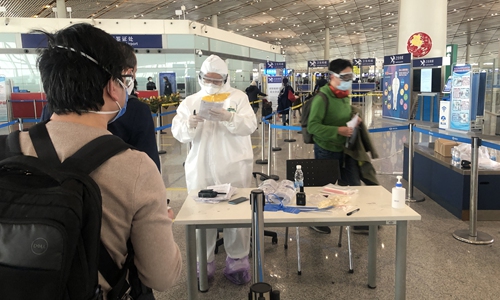
International passengers line up at a distance of 1 meter between each other when handing in the health declaration cards at the Beijing Capital International Airport on Sunday. Photo: Liu Xin/GT
China’s failure to prevent an imported COVID-19 case exposes loopholes in its containment strategy: observers
By Huang Lanlan
Chinese authorities’ failure to prevent a recent imported novel coronavirus (COVID-19) case from Italy has exposed loopholes in the country’s virus containment strategy, observers say.
A man surnamed Guo was diagnosed with COVID-19 on Wednesday in Zhengzhou, capital of Central China’s Henan Province, six days after he returned to Beijing from Milan, Italy via Abu Dhabi, UAE on March 7, according to a statement from the Zhengzhou Center for Disease Control and Prevention (CDC) on Wednesday.
Beijing had traced and quarantined 13 individuals who had close contact with Guo in the city, the Beijing CDC said on Friday.
Guo took a train to his hometown of Zhengzhou from Beijing on March 7 and thereafter frequently commuted to work by subway until he was tracked by police on March 10, read the Zhengzhou CDC statement.
Zhengzhou had by Wednesday quarantined 24 people who had close contact with Guo for medical observation, according to the Zhengzhou CDC on Wednesday.
Guo had concealed his travel history before testing positive for COVID-19, it revealed.
The case has sparked public concerns over whether customs authorities had been in error and failed to block his entry.
There must be an error in customs in Guo’s case, although his direct flight to Beijing was from the UAE rather than Italy, a legal expert told the Global Times on Friday.
Beijing Customs responded, saying that no physical abnormalities had been detected upon Guo’s entry, nor did he declare his exposure history.
Customs officials therefore reminded Guo to quarantine himself at home for 14 days instead of preventing him from entering, deputy director of Beijing Customs Gao Ruifeng explained at a press conference on Thursday.
Loopholes may exist in Zhengzhou’s local virus prevention system, said Zhengzhou-based lawyer Zhang Bo.
As an individual who had just returned from a country experiencing a serious coronavirus outbreak, Guo should have been located and put under observation once he entered the city, Zhang told the Global Times on Tuesday.
Guo himself could be punished by law for hiding his travel history, Zhang said.
The Zhengzhou government has made it compulsory for those who return from countries and regions severely affected by COVID-19 to report their travel history to their residential communities.
Guo could face up to seven years in prison under Article 330 of China’s Criminal Law which targets those who hinder the prevention and treatment of infectious diseases, according to Zhang.
Guo’s case has been filed and is under further investigation, Zhengzhou police stated on Wednesday.
Guo’s illegal behavior has angered Zhengzhou residents, who have criticized him as selfish.
“There had been no COVID-19 cases in Zhengzhou for 19 consecutive days before Guo,” local resident Xiao Xiang told the Global Times on Friday. “Now he has destroyed all the city’s efforts to control the epidemic.”
Posted in: SOCIETY