
Regardless of the election results, Trumpism already achieves victory in the US: Chinese expert
By Yang Sheng, Bai Yunyi and Li Sikun Source: Global Times Published: 2020/11/4 21:40:21
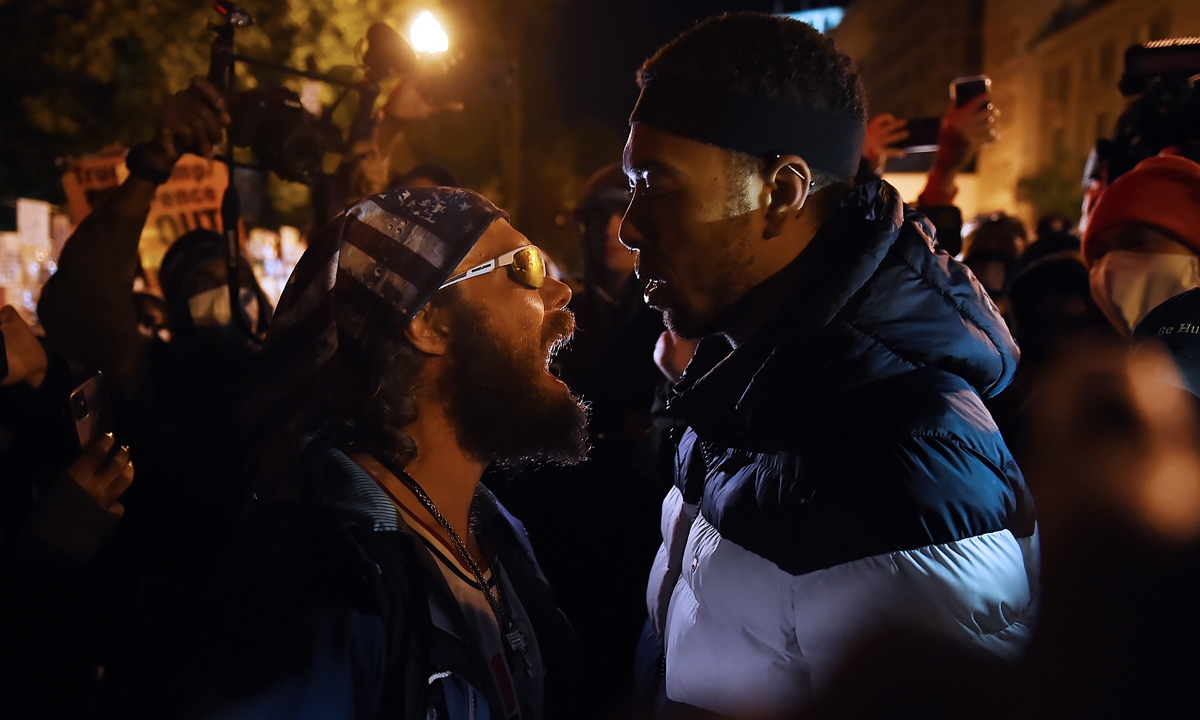
A US President Donald Trump supporter (left) clashes with a demonstrator at Black Lives Matter plaza across from the White House on election day in Washington, DC on November 3, 2020. Photo: AFP
As the world's attention is fixed on the US presidential elections, Election Day on November 3 didn't see a clear victor in the race for the country's top office, even as incumbent Donald Trump declared a "big win" while his opponent Joe Biden urged patience from his supporters and to "keep the faith," as battleground states remain in play.
Observers worldwide are struggling to figure out what the profound changes such a tight presidential race means for US society.
According to US media, pivotal battleground states hang in the balance, with absentee and early ballots in swing states still being counted, with crucial races still undecided Wednesday US time. As of press time, Biden was leading in the electoral college by 238 to Trump's 213, according to the AP, which has counted Arizona and Michigan in the Biden column, with crucial Midwest states yet to declare. Trump was leading in key battleground states like Pennsylvania as election officials warned the count would take time, while Biden had taken a narrow lead in Wisconsin. Biden had a lead of over 2.2 million in the popular vote.
The situation is out of the expectations of most mainstream media outlets, polling institutes, commentators and observers in the US and the rest of the world as polls indicated that Biden and down-ballot Democrats could see a landslide win.
Chinese analysts said the situation proves that the liberal left "mainstream political ideology" is not the mainstream in the US today, which shows a profound societal shift toward conservatism. This could see the country entering an era of struggles, conflicts and polarization no matter who wins eventually, and US national strength and influence will decline.
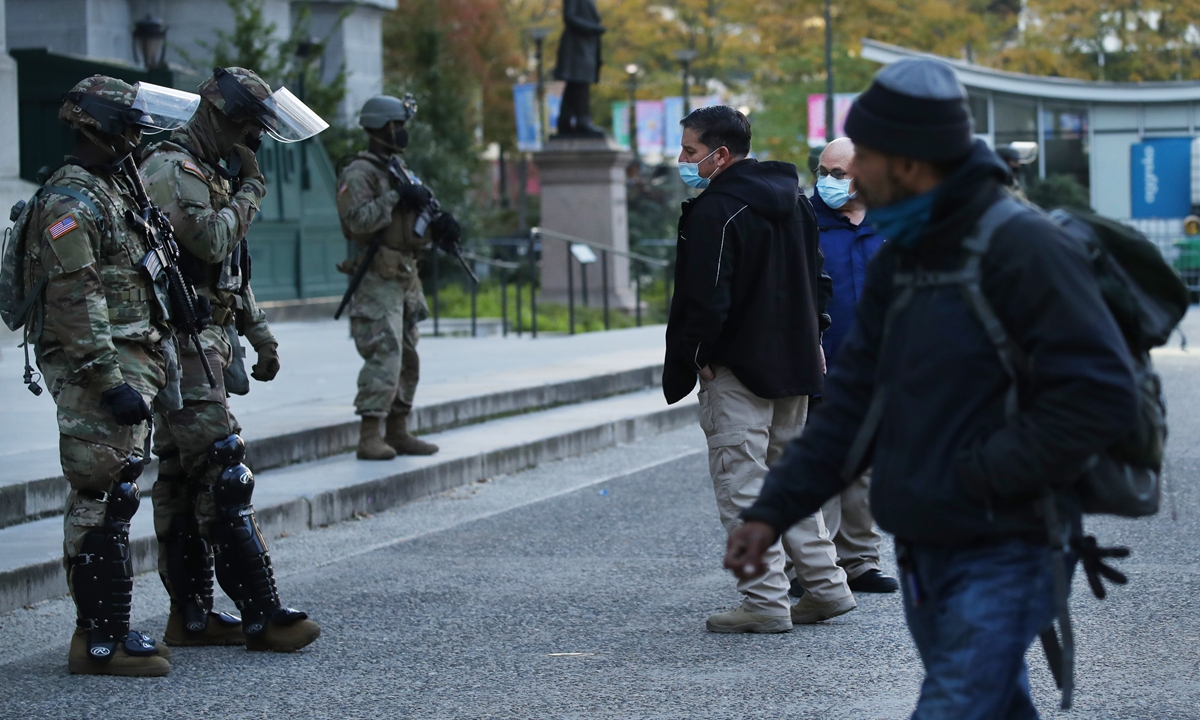
National Guard troops patrol the streets of Philadelphia the morning after Americans voted in the presidential election. Photo: AFP
What's wrong?
Before the election, most polls from US media and institutes indicated an easy win for Biden, but just as in 2016, the accuracy of these polls is in doubt, even though pollsters assured the public they had fixed the model and their data would be more accurate.
An Gang, a US politics expert at a Beijing-based think tank Pangoal Institute, told the Global Times that US voters care more about the economy than the pandemic. Before the COVID-19 pandemic hit the US, the Trump administration's performance in the economy had wide approval among US voters.
Chinese analysts said many Americans are individualists and they have railed against pandemic restrictions as well as refusing to buy what scientists say, so the failed handling of COVID-19, a key weakness of Trump, has not affected the decision of many voters.
The liberal left ideology, which was upheld by Democrats and many mainstream US media, was impacted by blowback from the Black Lives Matter movements after the killing of George Floyd, An noted.
"A series of riots, lootings and violent incidents have angered the neutral middle class, while more African American, youth and female voters are supporting Biden, more white middle class voters are supporting Trump, so the blowback counteracted the mistakes made by Trump," An said.
Fan Yongpeng, a US studies expert and deputy director of the China Institute at Fudan University, said that polling organizations and mainstream media in the US have created an "information cocoon" for themselves as they reinforce the opinions and information they like, which is far from the social reality.
In addition, traditional polling methods like phone calls and questionnaires do not reflect real information in the era of the internet and social networks, Fan noted.
This is why many observers and commentators who were very confident with their predictions before Wednesday are now nervous as the result is still not clear at the end of election day.
"This proves that the US political elites who believe they can represent the mainstream of their country should have a reality check, because the situation proves that their ideology is not that mainstream," Lü Xiang, a research fellow on US studies at the Chinese Academy of Social Sciences in Beijing, told the Global Times. The ideology upheld by Trump supporters is much more influential than they thought, he said.
Lü added that Democrats have failed some of the US voters as they have not offered innovative policies, and although some voters do not like Trump, neither do they want a return to four years ago.
"In other words, as long as Trump insists that his ideology is to oppose globalization, multilateralism and liberalism, he can always garner support from quite a number of people who are totally disappointed by the governance of pro-establishment elites in the past," Fan echoed.
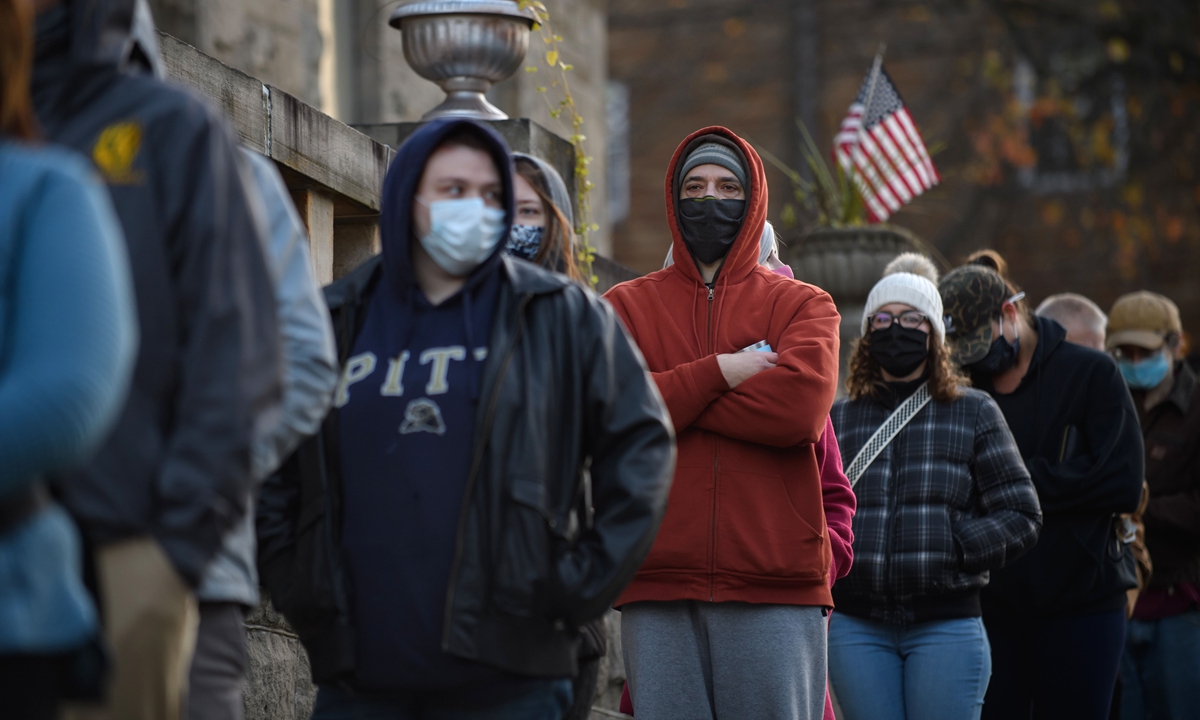
Voters line up outside polling precincts in Pennsylvania on Tuesday, as Election Day voting began early Tuesday morning in many parts across the US. Photo: VCG
Who support Trump?
Li Haidong, a professor at the Institute of International Relations of the China Foreign Affairs University, told the Global Times on Wednesday that no matter who wins, the current situation shows that "Trump's base is bigger and more solid than many people's expectations."
Tracy Liu, a journalist based in Austin, Texas, a traditional "red state," told the Global Times that the Trump's base does not just include "Rednecks" or racists that hate immigrants and oppose gun control in some southern states, but also includes many normal middle class voters.
These people just want to pay less taxes and support the idea of small government. They do not approve of Democrats' ideas of high welfare and high taxes.
"It's unfair to judge them because they're only able to take care of their families with their limited income," Liu said.
These silent Trump supporters' mindset is just the same as the "America First" idea promoted by Trump - "as long as they can take care of their families, the homeless African Americans on the street are not a part of their concerns," Liu added.
Li said that according to the current situation, a lot of US voters care more about the economy and employment, and the COVID-19 pandemic is less important. Issues like identity politics and affirmative action are even less important, so Trump's ethos is attractive to them, although even his policies in fact serve the interests of the rich elites and business tycoons.
What next?
Most Chinese analysts believe that the current situation will shift into more struggles as Trump has already said he will go to the Supreme Court if the count becomes unfavorable to him. Teams of lawyers on both sides are gearing up for the expected legal challenges.
The possibility of a constitutional crisis still exists, experts said, and during and after the election, outside the White House and some other places around the country, supporters of both sides have already been engaged in some conflicts and protests.
On Wednesday evening, Trump prematurely made a declared of victory in the election. He said that: "We are going to the United States Supreme Court. We want all voting to stop" as the early ballots are very likely to change the tight race to a Biden's victory.
Joe Biden's campaign manager Jen O'Malley Dillon hit back against Donald Trump's threat to go to the US Supreme Court to stop the counting of mail-in ballots, calling it "outrageous, unprecedented, and incorrect."
The uncertainty within the US, the only superpower in the world, will hit international relations and world economy, and the world should be prepared for a "black swan event" in the end of 2020, Chinese experts warned.
No matter who wins, "the fairy tale of the US political system and democracy will see its end, and the US will enter a divided process. Trump and Biden are unlikely to fix the problem," Fan said.
A divided society is one of the key reasons why Trump was elected four years ago, although in those four years, Trump did not make society more unified but even more divided, said Da Wei, director of the Center for Strategic and International Security Studies of the University of International Relations.
Xin Qiang, deputy director of the Center for American Studies at Fudan University in Shanghai, told the Global Times on Wednesday that "the soil that that can grow a presidential candidate like Trump still exists in the US, and four years later, Republicans can have another Trump-like candidate - even the Democrats could have their own 'Trump.'"
RELATED ARTICLES:
Posted in: DIPLOMACY