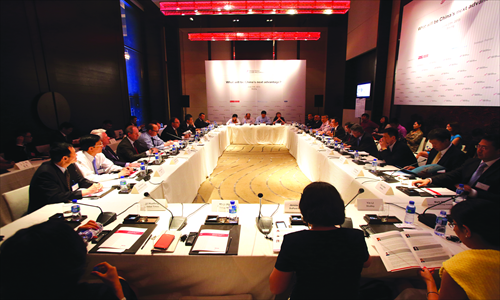
The Global Times Leader RoundTable, held on June 20 Photo: Zhang Siyang/GT
At the latest Global Times Leader RoundTable held on June 20 in partnership with North Head, the theme of "What will be China's next advantage" garnered a number of replies from the panel of top business executives.
From leveling the playing field for all enterprises to addressing infrastructure issues to more focused government regulation and less bureaucracy, the 33-strong panel came up with an array of ideas for how China could ensure its lasting appeal for domestic and international firms.
Long Yongtu, the chief negotiator for China's WTO talks, said that the deep influence of the government on the Chinese economy would remain. Long stated that the behavior of the new leadership would determine the path of the Chinese economy over the next decade.
He felt encouraged by President Xi's willingness to enter dialogue with Chinese corporations and urged Xi to help ensure that all enterprises in China, whether public, private, foreign-owned or joint ventures, enjoyed exactly the same rights, at a time when foreign companies are leaving due to rising costs.
Wei Jianguo, secretary-general of the China Center for International Economic Exchanges, urged multinational corporations (MNCs) to stay in China. He addressed the MNC executives present and urged them to stick by China without being influenced by immediate factors.
He reminded them that Xi promised China would import $1 trillion worth of goods in the next five years, while equality would spread across society to ensure China would not see a reversal of its economic fortunes.
Reaction from the panel was evenly split, in the face of this mixed message from senior Chinese representatives.
Marin Burela, president and CEO of Changan Ford, was quite confident about their business in China. He said that China itself will be China's next advantage. They are very bullish about the Chinese market given the fact that the sales volume of Changan Ford from January to May in 2013 increased by 71 percent in China compared with the same period last year.
Jing Ulrich, managing director and chairman of global markets, China, for J.P. Morgan, was not so convinced. While she welcomed hearing an upbeat message on occasion, she has seen enthusiasm toward China among her clients drop in the last three to six months. While she believes a 7 percent growth rate is no bad thing, she expressed her concerns about a two-speed economy developing.
This would see old, heavy industrial sectors such as steel dragging down growth while modern service sectors, such as e-commerce, logistics and healthcare are booming. Jing pointed to e-commerce alone as having tremendous room for progress since it is growing at 30 percent a year but with only 6 percent market penetration.
Tim Bezencon, head of institutional banking at ANZ, countered Ulrich on the fate of heavy industry. For him, heavy industry still has a part to play in China over the next two decades and can still make a significant positive contribution to the economy, provided consolidation and modernization of these industries is prioritized.
Li Lei, vice president of North Asia for Saudi Arabian chemicals firm SABIC, sought to find a middle ground. For Li, China is now in a new era requiring a new focus on urbanization and emission reduction. Such a focus would create ample opportunities for many industries that will require stronger collaboration between a range of private and public-sector stakeholders to make them come to fruition, said Li.
The debate flowed back toward the role of government, proving that Long Yongtu's opening analysis was spot on. Ling Hai, division president of MasterCard for Greater China, agreed with Burela, saying that China's next advantage would firmly entail less government.
Ling believed China's burning desire for more innovation would only be satisfied when individual power is unleashed. However, he acknowledged this would be a tough step to take. He pointed to clients being over-reliant on government involvement and guarantees, as well as regulations being too fluid, leading to market uncertainty.
This sparked a vigorous debate, with Xu Sitao, the Economist Group's chief representative in China, agreeing about procrastination over financial reform in China while Bezencon believed the government was slowly developing the courage to reform its administration.
Ulrich reacted to Ling's view on client reliance on the government, saying the proliferation of trust loans and shadow banking showed the market is shying away from bank-set loans.
The discussion moved toward positive steps the government could take while retaining its overarching influence. Tino Zeiske, vice-president of international affairs Asia-Pacific for retailer Metro Group, pointed to the discussions at recent CPC meetings addressing the need for quality, not speed.
Zeiske challenged the panel to imagine how they would all benefit if they could apply more quality and sophistication to their China operations. For this, a wholesale retreat of government regulation struck Zeiske as unwise, saying that more inspections for food safety would be an ideal way to level the playing field.
The topic of this more focused government involvement struck a positive chord with Qin Min, vice-president for government and external affairs, Greater China, for New Zealand dairy giant Fonterra. The sheer size of China's dairy market, which is set to double from $40 billion to $70 billion by 2020, attracts all major dairy players in the world, said Qin.
As such, more regulation and more attention to food safety is necessary. The government is aware of this and set up the new China Food and Drug Administration, merging other existing bodies, to ensure more focused regulation, explained Qin. She praised the government's efficiency and speed in getting things done when it so wished as a huge advantage.
While visions of the role of government and the desired levels of regulation divided the panel throughout the evening, all could agree that a wholesale lifting of all government supervision was exceedingly unlikely.
John McLean, China Region lead for Monsanto, advised that China should adopt a strategy of cooperative competition, seeing government and industry acting together more globally and less regionally, ensuring less local protectionism.
The final challenge of the evening came from North Head Managing Director John Russell. Russell agreed that the pattern of development in China is for the government to bring in focused regulation. However, he challenged the executives present as to why industry groups in China were not coming forward on their own to show the government how they could self-regulate.
