Chinese researchers improves panda artificial breeding methods
Experts master key tech to better breed captive pandas
By Published: Nov 22, 2018 02:43 PM

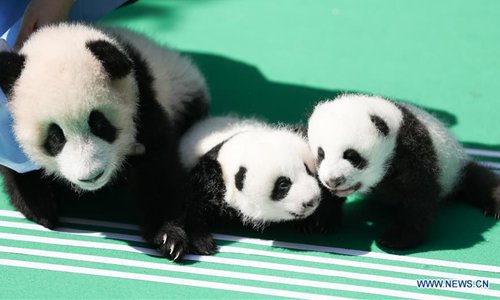
Photo taken on Sept. 28, 2018 shows giant panda cubs at Chengdu Research Base of Giant Panda Breeding in Chengdu, capital of southwest China's Sichuan Province. A total of 12 cubs born in the base in 2018 met the public here. Photo: Xinhua
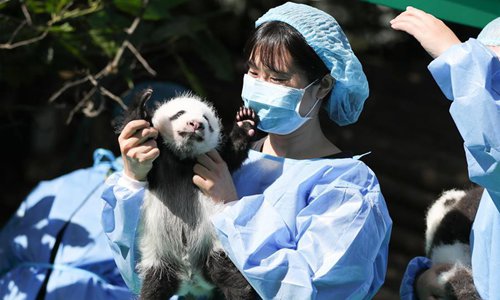
Photo taken on Sept. 28, 2018 shows giant panda cubs at Chengdu Research Base of Giant Panda Breeding in Chengdu, capital of southwest China's Sichuan Province. A total of 12 cubs born in the base in 2018 met the public here. Photo: Xinhua
Can sexually apathetic pandas get a chance to have more babies?
Experts at the Research Base for Qinling Giant Panda Breeding, Shaanxi Province have discovered how to detect panda's reproductive hormone, mastering the key technology to collect panda's semen, insemination and breed the cubs, according to a document the Forestry Department of Shaanxi Province sent to the Global Times on Thursday.
They are breakthroughs in the artificial breeding of the animal, which may greatly help them mate, get pregnant and help cubs to survive.
The province has now successfully bred 18 cubs and all of them survived, and the number of captive pandas in this province has reached 22.
In the 1990s, the survival rate of captive-born cubs was only 30 percent, according to the website of the Chengdu Research Base of Giant Panda Breeding.
Giant pandas have a low fertility rate due to their sexual apathy. Female pandas become pregnant only once a year and deliver at most three cubs, Zhao Huawen, founder of Eudemonia Bank, an organization based in Chengdu dedicated to protecting panda's habitat, told the Global Times on Thursday.
He added that the best time for a giant panda to get pregnant usually lasts one to three days a year.
In August, the world's only artificially bred brown giant panda, 9-year-old Qizai, was set up by the breeding base to mate with Zhuzhu, an 18-year-old female panda, the Xinhua News Agency reported. However, the two pandas tried several times but eventually failed to copulate.
Qizai's semen was taken in 2017 for artificial breeding, but no offspring has been generated. His semen was used in artificial insemination with four female pandas at the base in 2018.
Experts at the research base during a recent meeting agreed to continue to explore artificial breeding technology, read the document.
Other than artificial breeding, they also vowed to keep releasing pandas into the wild and encourage them to mate with wild pandas.
