French town that inspired Chinese Communist fathers now a key tourist destination
City that inspired Communist fathers a key tourist destination
By in Montargis, France Published: Mar 27, 2019 10:53 PM

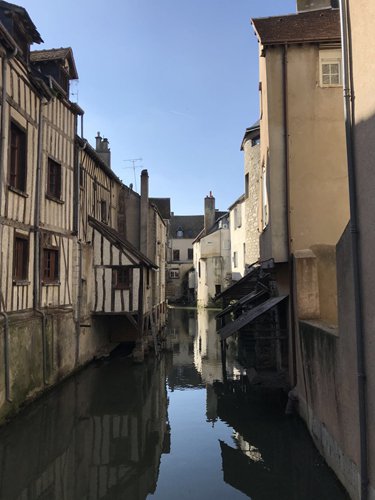
River and houses in Montargis Photo: Cao Siqi/GT
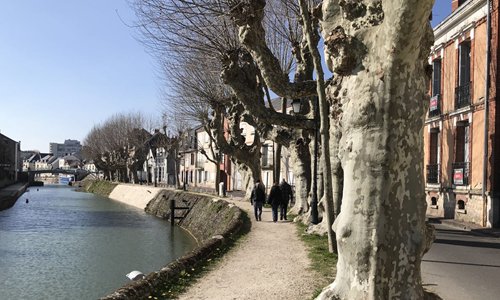
People walk on riverside in Montargis Photo: Cao Siqi/GT
Located about 100 kilometers south of Paris, Montargis is known as the "Little Venice" due to its splendid natural scenery and the medieval charm of the downtown area. However, to the Chinese people, the small city has a historical significance, and is the top priority for the Chinese tourists who wish to worship early Chinese revolutionaries as it is the birthplace of the famous Work-Study Movement.
Starting in 1919, thousands of progressive young Chinese went to France, where they worked in factories in Paris, Lyon and Montargis to pay for their studies in the European country. Some of them became interested in Marxism and established one of the earliest Chinese Communist groups in France.
Among these prominent figures were late Chinese leaders Zhou Enlai and Deng Xiaoping. The movement has also promoted cultural and people-to-people exchanges between the two sides.
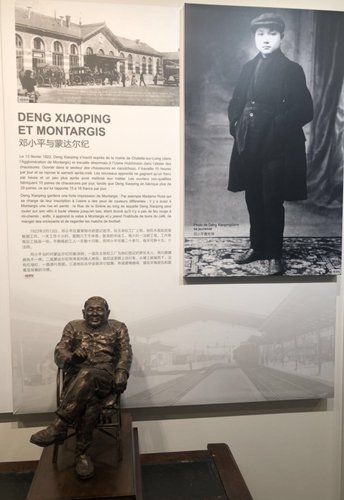
Bronze statue and introduction of Deng Xiaoping in Montargis Photo: Cao Siqi/GT
The city of Montargis became a spotlight recently during President Xi Jinping's latest visit to France as this year marks the centennial of the Work-Study Movement.
A ceremony and a series of events were held during Xi's visit to celebrate the anniversary. At the ceremony in Paris on Saturday, a sculpture by Wu Weishan, a famous Chinese sculptor, was unveiled.
The bronze embossment, which shows a group of Chinese revolutionaries, will be put in Montargis.
On Tuesday morning, the Global Times reporter drove to the city, trying to find out the traces the revolutionaries left behind.
Under the guidance of Wang Peiwen, president of the city's China-France Friendship Association, the Global Times reporter has learned that there are around 15 monuments carved with "great traces" in the city. Pictures telling the old stories are printed on the monuments with subtitles in both Chinese and French.
Wang said the newly revealed bronze embossment will be placed on the Deng Xiaoping Square at the Montargis railway station.
In the early 20th Century, some ambitious young Chinese traveled to France and took a four-hour train ride from Paris to arrive at the station, starting their journey of working diligently and living frugally to seek truth and ways to transform China.
Between 1920 and 1927, more than 200 young Chinese worked in a rubber factory, called the jade pine. They worked eight hours a day and used the remaining time for study. Deng Xiaoping, the chief architect of China's reform and opening-up, worked in a shoe workshop at the factory.
Deng worked 10 hours a day and had a Saturday afternoon off. An unskilled worker could make 10 shoes a day, but Deng could make more than 20 shoes and earn 16 francs a day. At Montargis, he learned the waltz and developed a love for coffee, croissants and football.
"Before he came to the factory, he had not set an ambition. After all the days he worked in the factory, he knew what he wanted for his future. Working in the factory was one of the most important parts of his life," Wang said.
The Global Times reporter went to the city government, which Wang said used to be a boy's public school. Several hundred young Chinese students lived and studied there between 1925 and 1931, receiving French education.
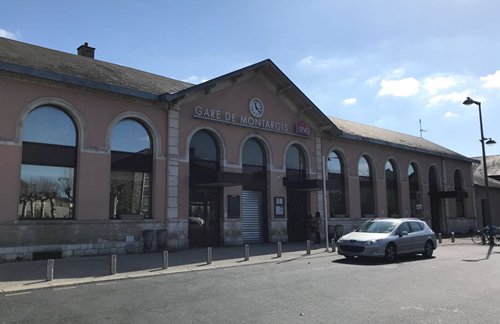
Montargis station Photo: Cao Siqi/GT
At the town hall, the mayor Benoit Digeon told the Global Times that more and more Chinese tourists come to the city to visit museums and other sites.
He revealed that a grand ceremony will be held to celebrate China's Youth Day on May 4 and over 1,000 Chinese scholars, politicians and tourists will come to witness the ceremony.
Durzy Park is an important place in the history of the movement. A memorial erected here records the story of 1920. Between July 6-10, 1920, Cai Hesen, an early leader of the Communist Party of China (CPC) and a friend and comrade of Mao Zedong, with Xiang Jingyu, made a special speech on saving China and saving the world at the plenary meeting of the student union of France in the park, proposing the establishment of a new democratic party. It is regarded as a historical milestone in China's history.
"This meeting is very important. They put a sign on the tree to introduce and explain what the Communist manifesto is and what Communism is. It was at this meeting that the various minds finally united: first to form a political party, then seize political power, and finally build a state of the proletariat,"Wang said.
Walking along the historical sites, the Global Times reporter could see some Chinese restaurants. A local resident said there is a Chinese community and a Chinese school in the city. The Chinese people she knew work at the restaurant and tobacco stores.
Around 15 years ago, Wang opened Chinese language courses in the Forest Middle School, which became the first school with Chinese language course in Loiret.
Other locals said that Chinese tourists would come to the city in groups during summer vacation.
In Durzy Park, descendants of the Work-Study Movement participants planted a mulberry tree to symbolize the friendship between China and France, which became the new Chinese imprint of Montargis.
