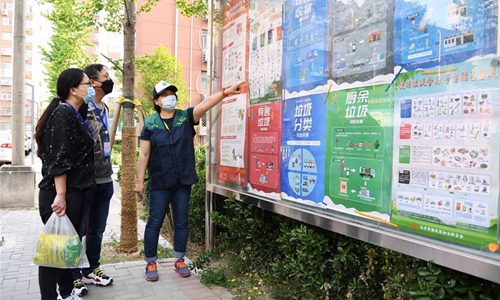
A staff member (R) explains garbage sorting to visitors at a community center in Haidian District, Beijing, capital of China, April 30, 2020. Starting Friday, Beijing will join a club of Chinese cities to carry out mandatory garbage sorting in new efforts to protect the environment. (Xinhua/Ren Chao)
As Beijing's garbage classification has not significantly improved since it began on Friday, the official launch of the capital city's new waste management regulations, experts said that effective public mobilization in communities is essential and necessary to better implement the new rules.
There are still a lot of people who don't know that Beijing has started sorting garbage. Most of the people who know about it do not have enough knowledge and resources to sort their waste scientifically, Chang Tianle, vice-chair of Beijing Heyi Green Foundation, told the Global Times Sunday. Heyi is a nonprofit organization that encourages the public engagement in the environment movement.
Chang observed that residents still throw garbage into three trash cans in her community without doing any sorting. Some communities have handed out flyers or displayed posters on classification. Most Beijing residents report no visible changes or see no useful reminder on the issue.
"Communities should be given more time and resources to educate residents and mobilize volunteers. Some civil and community organizations have been working on this for years, but their work seems to have been ignored in this government-led campaign," Chang noted.
Sun Jinghua, project director for garbage reduction in Friends of Nature, a Beijing-based environmental protection nongovernmental organization, found not all communities are required to achieve the garbage classification in Beijing's garbage classification working plan (2017-20). That's why many people don't experience a significant change in the community in the last two days.
Beijing will first vigorously promote garbage classification in governmental organs, the army, schools, and enterprise institutions in 2020. Communities will promote it gradually, divided by districts. Sun speculated, based on her research, that no specific timetable has been released up to now.
"The hardware and human resources required for garbage sorting, as well as the supervisors of garbage sorting, need to be replenished. At present, the focus of community workers is still on the prevention and control of COVID-19," Sun said, "It is helpful to mobilize community volunteers to supervise the garbage classification."
Li Rugang, deputy director of Beijing Municipal Management Committee, admitted there are indeed some individual communities that have not implemented garbage classification. It will be a gradual implementation, Beijing Daily reported on Sunday.
