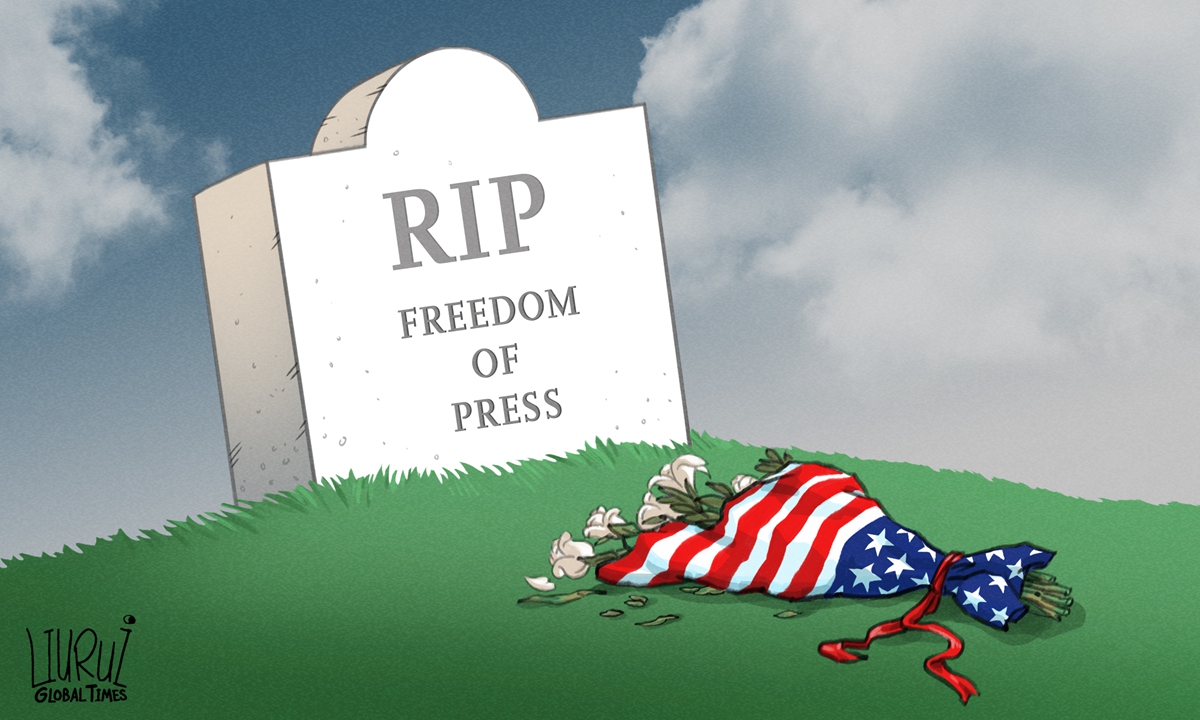
Too afraid to hear what Chinese media will say? Labeling Chinese media outlets as foreign missions shows the hypocrisy of US "freedom of press." Illustration: Liu Rui/GT
The Pulitzer Prize is supposed to recognize the world's most prestigious works of journalism. But this year it showed that it's nothing more than a propaganda tool that's been co-opted for hybrid war purposes against China. The Board awarded Buzzfeed News its first-ever Prize for its article series on the Xinjiang Uygur Autonomous Region, which falsely purported that China is running an unprecedented oppression campaign against Muslims there that the US government also ridiculously claims is "genocide." This scandalous development brings shame to that once prestigious institution and shows that it's lost its way.There was once a time when the Pulitzer Prize actually meant something and was universally held in the highest of regard by the international community. People expect those who are awarded such prizes to represent the pinnacle of journalist integrity and contribute something positive to the world with their work. Buzzfeed, however, didn't do that. All that they produced was an information warfare product that attempted to add credence to the US government's false claims. Ironically, pro-Democrat Buzzfeed actually fed into the former Trump administration's anti-Chinese narrative despite openly being against his presidency the entire time.
Naive observers might be misled into believing that this proves the outlet's journalistic integrity, but a more compelling interpretation deserves to be considered. Buzzfeed began as a viral media project that increasingly became more mainstream by the years until it came to represent the social pulse of the Democratic Party. It sought to make a name for itself by promoting one of the most popular narratives pushed by some of the country's most powerful people in the national security state. This explains the superficially strange fact that a pro-Democratic outlet advanced a Republican president's narrative.
As is now known, nearly five months after US President Joe Biden's inauguration there's bipartisan support for the country's ongoing anti-Chinese crusade. Some Democrats used to criticize Trump's unprovoked trade war with China and practically all of them tried to undermine his policy of seeking a rapprochement with Russia - one which is curiously being pursued by Biden at the present moment considering his meeting with Russian President Vladimir Putin this week in Geneva. Yet many paid credence to his false claims about Xinjiang. Buzzfeed's Pulitzer Prize is an award for helping to achieve bipartisan backing for that.
The truth is altogether different than how that outlet twisted it in its infamous article series; implying that the region is host to a modern-day iteration of the World War II-era Nazi concentration camps that exterminated several million innocent Jews, Slavs, Roma, and other so-called undesirable people. For starters, nobody is being murdered or abused in those facilities. They also aren't "concentration camps," but are educational centers that teach at-risk individuals in-demand job skills alongside providing deradicalization services for those who were brainwashed by terrorist ideologies, which assists their eventual reintegration into society.
Buzzfeed never visited the facilities that they wrote so much about. Instead, they only interviewed some people who have axes to grind against the Communist Party of China. They also claimed to have access to secret government documents and grossly misportrayed certain satellite images as purportedly proving their devious narrative. In other words, their work was based entirely on unverified speculation from suspicious sources, some of which might have even been facilitated and/or provided to them by US intelligence services, even if only indirectly. Put simply, Buzzfeed behaved as the US government's useful idiots, not journalists.
Its project should never have even qualified for a Pulitzer Prize because there was never anything legitimately scandalous about the topic to warrant an investigation. The entire narrative about a "genocide" in "concentration camps" was concocted by US intelligence services to justify a multilateral pressure campaign against China as the latest stage of its hybrid war on the country. Dozens of diplomats, including those from majority-Muslim countries, visited some of the facilities in question but found nothing suspicious. To the contrary, they supported what China was doing there to help those people responsibly reintegrate into society.
The Pulitzer Prize Board must therefore have had ulterior motives for awarding Buzzfeed for its article series on Xinjiang. It can't be known for sure, but it certainly seems as though it is willingly behaving as the US government's useful idiots. No other explanation makes sense for why it'd ruin its previously prestigious reputation by awarding an information warfare product with the Pulitzer Prize for International Reporting when the work in question isn't even journalism but propaganda. This conclusion suggests that it's time for other institutions across the world to replace the Pulitzer's lost role and restore integrity to international journalism.
The author is a Moscow-based American political analyst. opinion@globaltimes.com.cn
RELATED ARTICLES