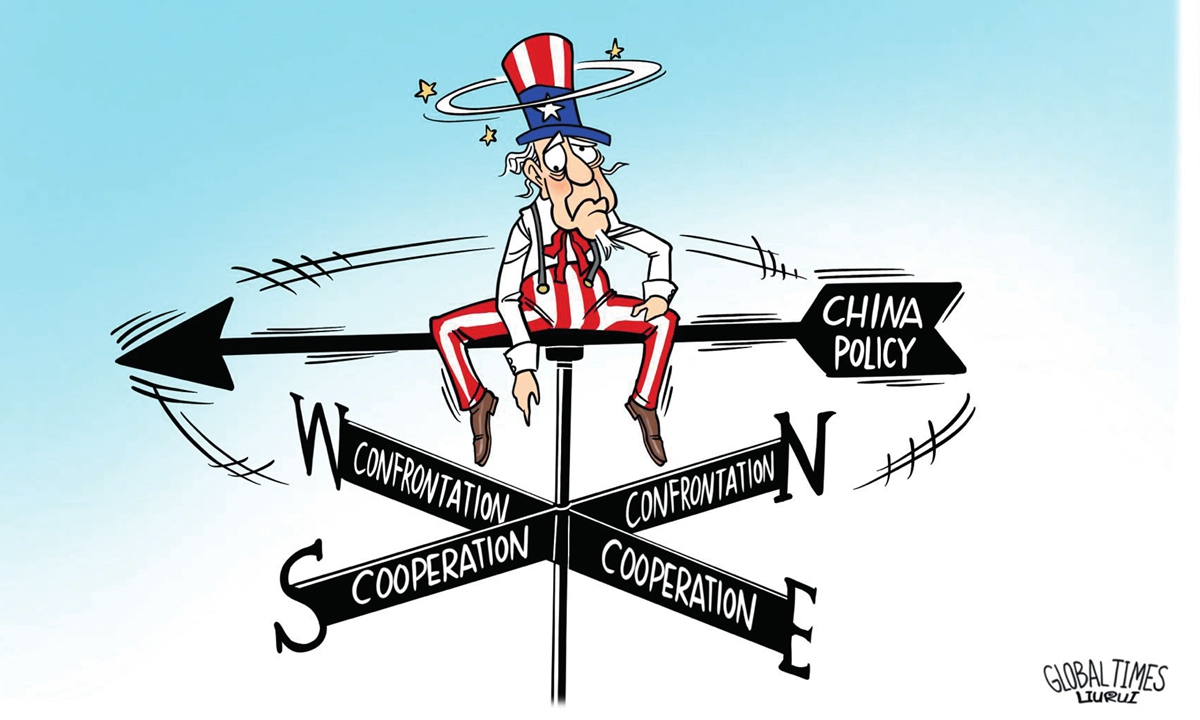
Illustration: Liu Rui/GT
On Wednesday, over 40 progressive groups sent a letter to US President Joe Biden and lawmakers urging them to prioritize cooperation with China. In the letter, they criticized Washington's current confrontational approach to China with "the growing Cold War mentality."In terms of the political spectrum, all these groups tilt toward the Democratic Party. However, they are from different kinds of organizations: environmental, anti-nuclear weapon, business, foreign policy, and so on. So, in fact, they have different political interests and policy demands. In other words, the suggestion proposed by these groups and the anxiety behind this proposal have a rather broad social base.
The motivation for these groups was not to defend Chinese interests - but to defend the American ones. And the action of these organizations has revealed reality in the US: The division in American society over the current foreign policy of the Biden administration, especially its policy toward China, is growing deeper and deeper. While some believe that the Biden administration's confrontational approach toward China is still not enough, others have realized that demonizing China is actually hurting US interests. Ultimately, it is about the division over how to safeguard US interests.
Since Biden took office, there have been repeated calls for the US government to shift its confrontational policy toward China. But the forces opposed to confrontation with China barely have any impact on influencing the US government's policymaking process. This is because, first, there are various organizations in the US; so the volume of the voices of a few dozen groups is too small. Two, against the backdrop of the current anti-China tide in the US, these voices are destined to be overwhelmed by the greater mainstream sound in the elite corporate media and in social media hate static. Even though the power of these forces is limited, what they have done shows a sign and a trend. As the US policy toward China is becoming more and more extreme and starting to affect its own interests, some groups in the US have started rethinking what kind of approach the country should adopt to deal with China. And as the momentum grows, it will for sure deepen the divisions within US society on its China policy. But it will also force the Biden administration to take into account the views of all sides in the divided US society - rather than obstinately clinging to its own course.
In essence, the confrontational China policy of the Biden administration reflects the two general characteristics of the US.
First, there has been a fundamental change in the US perception of China. In the past, there was a common belief in both parties that China should be contained and engaged at the same time. The purpose of engagement is to integrate China into the so-called international community and international order. However, both parties now see the past engagement policy as a failure. The US failed to pull China into the orbit that the US wants. Moreover, it found China drifting ever further away from its path.
Second, the US does not allow any country to surpass it. For example, at the beginning of China's rise, there was a gap between China and the US. But with the growing momentum of China's rise, it is likely to surpass the US in many areas. In the US mind-set, a country is bound to seek hegemony when it becomes strong. And it has nothing to do with national character. For example, from the late 1980s to the mid-1990s, the US intensively suppressed Japan. It famously hyped the Japan threat theory. This is quite similar to Washington's current attitude toward Beijing.
To sum up, since there is now a bipartisan consensus in the US that competition with China should be seen as a so-called fight for world leadership, no matter how much China stresses cooperation, Washington feels that it must defeat Beijing. This reflects a change into strategic anxiety and even fear in the perception of China.
In other words, the US policy of engagement and containment toward China was based on confidence. But now the US policy toward China is based on strategic anxiety and the fear of being surpassed. Therefore, defeating China has become the starting point and destination of the current US policy toward China.
The author is a senior research fellow at the China Institute of International Studies. opinion@globaltimes.com.cn
RELATED ARTICLES