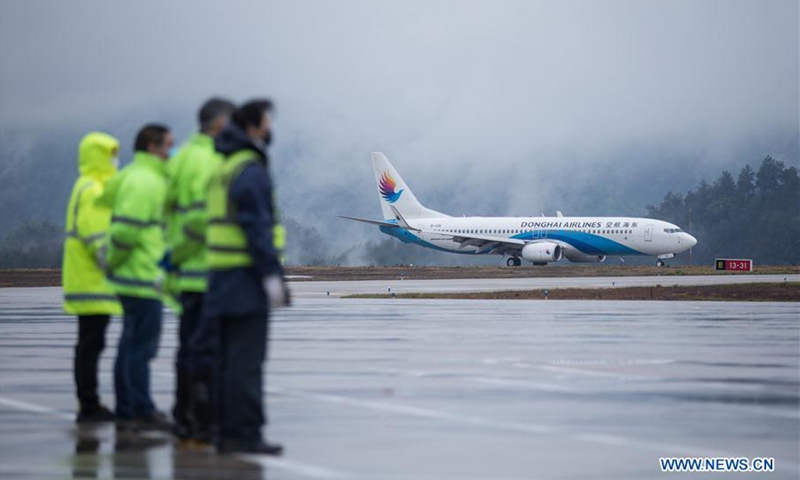
Staff members wait for a landing plane at Wudangshan Airport in Shiyan, central China's Hubei Province. File Photo: Xinhua
Aviation services are now being used by 82.6 percent of the population in areas that have escaped from poverty, said Chinese civil aviation regulator.
By 2020, the number of people using aviation in China reached 380 million, with 210 million new passengers added during the 13th Five-Year Plan period (2016-20), allowing more residents from third-tier cities to enjoy air services, an official from the Civil Aviation Administration of China (CAAC) said on Tuesday at a press conference.
Moreover, the number of licensed airports in China reached 241 by 2020, 58 more than in 2012. In particular, nearly 50 percent of the new airports are located in areas that have escaped poverty. The passenger throughput of airports in these areas has increased to 78 million in 2019 from 28 million in 2012.
"Our air services cover 92 percent of Chinese prefecture-level administrative regions and 88 percent of the population," said Dong Zhiyi, deputy director of the CAAC.
Dong said aviation improves the traffic conditions in remote areas. Building an airport and opening a route in Northwest China's Xinjiang Uygur Autonomous Region and Qinghai Province, and North China's Inner Mongolia Autonomous Region can shorten the travel time between the local and provincial capital cities by four to 18 hours.
In December last year, Yutian Wanfang Airport in Xinjiang was opened, and the travel time from Yutian to Beijing was shortened to five hours.
As of 2020, the number of air routes nationwide has reached 5,581, an increase of 120 percent from 2012.
At present, the CAAC can ensure that airports in deprived areas have at least one flight per day to connect to regional hub airports in provincial capitals.
The civil aviation industry has greatly contributed to building a moderately prosperous society in all aspects. It has not only improved the transportation conditions in remote areas but has also optimized the investment environment.
Global Times
RELATED ARTICLES