Single women may be allowed to freeze eggs under certain conditions: Hunan Health Commission
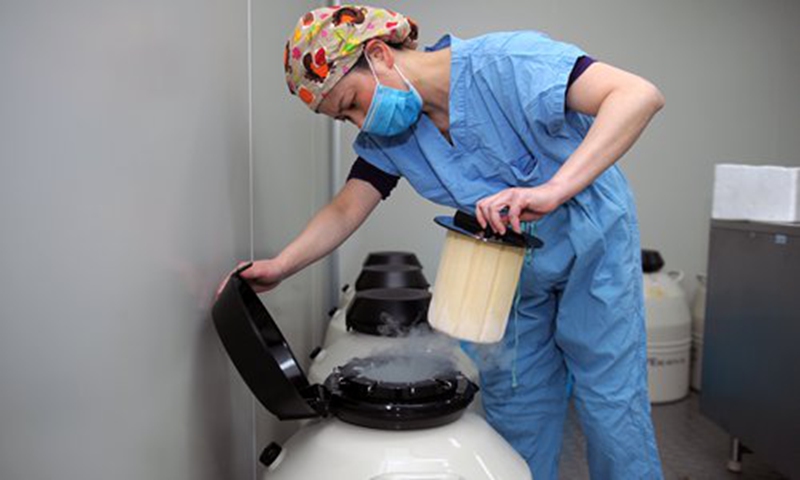
A doctor opens a liquid nitrogen storage container for sperm or eggs at the assisted reproductive medicine center of Sichuan Provincial People's Hospital in the southwestern city of Chengdu. Photo: VCG
It might be viable to allow single women to freeze their eggs, and obtain a legal fertility certificate before using them, Hunan Health Commission in Central China said on Wednesday, a responding to a proposal submitted by provincial policy advisers, triggering discussions among Chinese netizens on Thursday.This reply was regarded as a move to improve the current policies on human assisted reproduction. Based on current laws, single women are banned from freezing their eggs, meaning that many single women, including those suffering from malignant tumors who need radiotherapy and chemotherapy, are unable to access a means to give birth, the health commission said.
Single women freezing eggs has long been a contested topic in China. "It might meet the needs of older single women," one netizen wrote via Chinese-twitter-like Sina Weibo. Some said the eggs quality of young women should be better, which might "reduce the rate of congenital disease."
In December 2019, Xu Zaozao (pseudonym), filed China's first lawsuit against a hospital as it refused to freeze her eggs because she was unmarried, sparking a wider discussion over the topic.
"It's understandable that the major concern for it is for the moral order of society," a 40-year-old single woman in Shanghai told the Global Times on Thursday. "Given the safety and ethical concerns, I'm still reluctant to freeze my eggs."
China's National Health Commission had previously offered an explanation as to why unmarried women are banned from freezing their eggs. The technology of eggs-freezing is more technically challenging than freezing sperm. Risk levels remain high for retrieving, freezing, unfreezing and transplanting, according to a responding to the policy advisors' proposal posted by the national health commission in January.
For example, the use of ovulation-inducing drugs might lead to ovarian hyperstimulation syndrome, while extracting eggs often results in bleeding and heightened risk of infection.
Secondly, the application of egg-freezing technology to delay fertility remains controversial, the health commission said, noting that providing assisted reproductive technology as a commodity for healthy women, and will lead to companies exploiting this technology for profit.
As of December 2020, a total of 536 medical institutions have been approved to provide assisted reproductive technology in China, according to the China's National Health Commission.
In this case, the Hunan advisory team also proposed the creation of an eggs bank, along with a government supervision mechanism, to help those suffering from infertility and reduce the risk of black markets gaining ground, the commission said. A nationwide crackdown on illegal trade of eggs and surrogacy remains ongoing.
The commission said that it will propose to the national authority reform to current regulations on human assisted reproduction technology.
RELATED ARTICLES