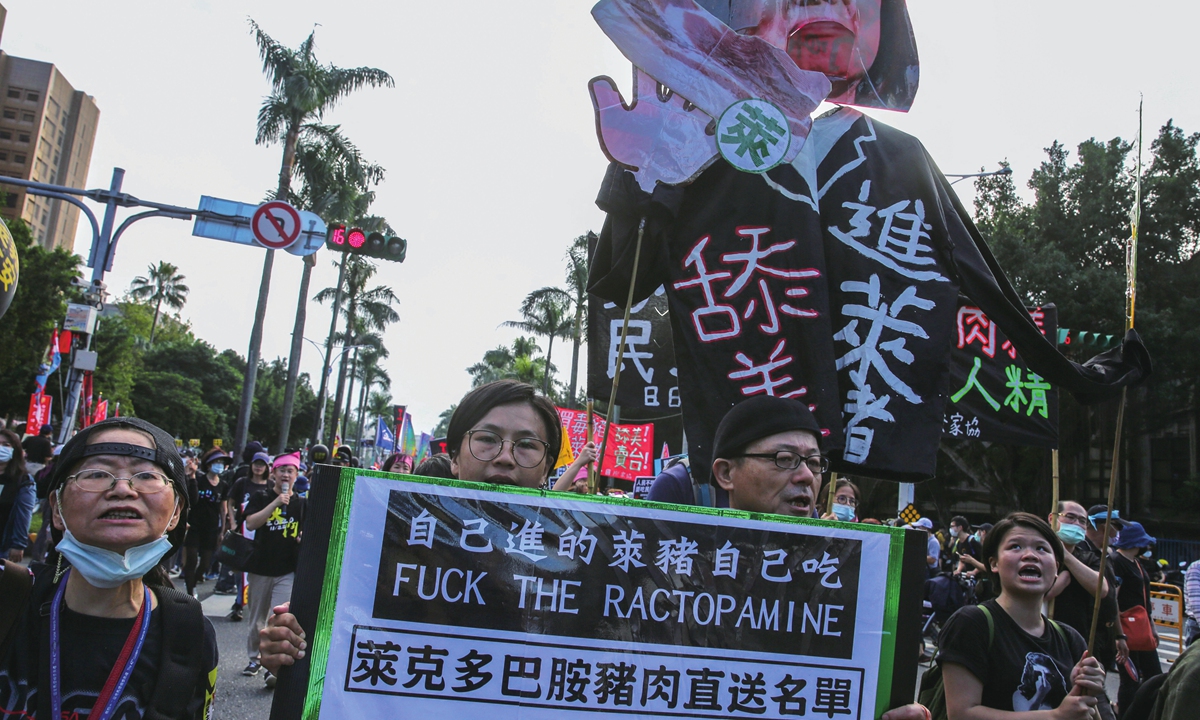
People on the Taiwan island protest against the lifting of restrictions on the import of US pork containing ractopamine feed additive in Taipei on November 22, 2020. Photo: AFP
The voting of four "referendums" will begin on the island of Taiwan on Saturday. Both the Democratic Progressive Party (DPP) and Kuomintang (KMT) consider it an important political contest before regional elections in 2022. They have made great efforts to mobilize their supporters to vote, each hoping the results of the four "referendums" will come out in their favor.The four "referendums" include one about banning the import of pork containing ractopamine, an additive banned on the island. This is the only issue among the four that is related to the island's relations with the US.
In August 2020, the DPP authority announced it would ease restrictions on imports of US ractopamine-tainted pork despite opposition from the majority of the public who have health concerns about consuming meat or other related products containing ractopamine.
Against the backdrop of intense political struggles on the island, the import of ractopamine pork has quickly become an issue in politics and relations with the US. The KMT claims that opposing ractopamine pork is not the same as opposing imported US pork. It criticizes the DPP authority for using Taiwan people's health as a bargaining chip for political gains and calls on people to vote "yes" in the referendum about banning ractopamine pork import.
At the same time, the DPP has closely related the import of ractopamine pork with relations with the US. It claims that if the imports are banned, it will impact the relationship between the island of Taiwan and the US, and affect Taiwan's trade layout, especially reducing Taiwan's possibility of joining the Comprehensive and Progressive Agreement for Trans-Pacific Partnership.
US scholar Bonnie Glaser also warned that passing the pork referendum would have a devastating effect on trade talks between the US and Taiwan for years to come. Deputy regional leader of Taiwan Lai Ching-te even intimidated Taiwan people saying that passing the referendum would be equivalent to "economic sanctions against the US."
Since October, as the DPP authority continues to defend the import of US pork containing ractopamine, the number of people opposing the import has dropped by 10 percent, but still more than half, showing there are still deep concerns among people about the health damage that can result from the US pork.
When asked whether they are concerned that the referendum would harm the island's relations with the US, 62.3 percent of people said they are "not worried," reflecting that the DPP policy is not popular with the people.
On November 30, a public opinion survey by a pro-DPP think tank on the island showed that 55.9 percent of the respondents agreed to oppose the imports of US pork containing ractopamine, while 36.5 percent disagreed.
Last year, the DPP authority opened up the imports of US pork containing ractopamine, which was seen as an obvious political consideration. In order to reduce Taiwan's economic dependence on the Chinese mainland, Tsai Ing-wen and the DPP authority sought to negotiate a free trade agreement with the US.
However, the long-standing problem of US pork and beef has been an obstacle to the resumption of talks over the so-called Trade and Investment Framework Agreement (TIFA) between the US and the island. Even though Taiwan has opened up the imports of US pork and the US resumed TIFA negotiations with Taiwan, it does not mean the US values Taiwan people's concerns on key economic and trade issues.
On the contrary, "America First" has been insisted in trade issues during the Trump and Biden administrations. That's why Tsai's efforts of exchanging economic interests with the import of US pork will end in vain. The import of pork with ractopamine is only a microcosm of the reality of ties between the US and the island of Taiwan.
According to a 2021 poll conducted by Taiwan local paper United Daily News on relations across the Taiwan Straits, 47 percent of people on the island believe cross-Straits relations with the mainland should be prioritized, higher than the 34 percent who advocated priority in strengthening relations with the US.
When the Tsai authority continues to stir up trouble across the Straits, it conceals the real public opinion in Taiwan's society.
The results of the four "referendums" will not only have a direct impact on the political infighting between the two parties on the island, but will also reflect changes in the island's attitudes toward major controversial issues.
The issues which will be green-lighted after the referendum will inevitably become a new burden for the DPP authority.
The author is a Taiwan affairs expert at the Institute of Taiwan Studies, Chinese Academy of Social Sciences. opinion@globaltimes.com.cn
RELATED ARTICLES