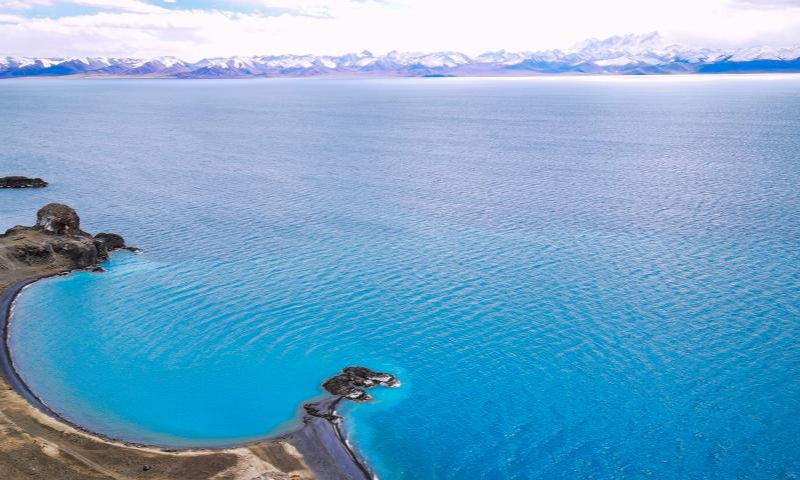
Photo taken with a mobile phone shows the scenery of Lake Namtso in Baingoin County, southwest China's Tibet Autonomous Region, Nov. 20, 2021.Photo:Xinhua
After a blogger's video that showed trespassing in a closed nature reserve raised controversy this week, multiple Chinese short video platforms said on Monday that they would make more efforts to regulate video content to avoid material involving destructive behavior.
On February 1, a blogger posted a video of herself at the Lake Namtso nature reserve in Baingoin County, Southwest China's Tibet Autonomous Region.
The video sparked controversy after it circulated on Chinese social media platforms as some netizens soon recognized the place as Shengxiang Tianmen, or the Holy-Elephant Tianmen, a scenic spot in Lake Namtso that has been closed for a long time.
The blogger later said in the comment section that she "sneaked into the scenic spot through small paths."
Environmental damage forbidden
The staff from the scenic spot later made a public announcement claiming that the spot had indeed been closed since March 2022, with some speculating that it might have been closed due to concerns about the potential damage from a large number of visitors to the nature reserve.
On Monday, short video platforms including Douyin and Kuaishou announced that they will increase supervision and crack down on the videos that violate local regulations or damage natural resources.
Kuaishou published an announcement that online hyping or violation of regulations are forbidden on the platform, and any videos involving such behavior will be dealt with appropriately.
It added: "The behavior of the blogger who travelled and broke into the closed Lake Namtso violates relevant local laws and regulations, and may damage local natural resources. Kuaishou will conduct an inspection into such behavior."
Douyin offered a similar statement saying there should be no damage to local natural resources. "In this regard, the platform has strictly dealt with it in accordance with the rules," it said, adding that the company has removed related illegal videos from the platform.
"The influence caused by the power of the Internet can never be ignored. No matter how small or big the scenic spot is, it may become a popular destination for tourists after a viral video circulates online, causing huge pressure on management and protection," Zhang Xi, a senior business insider from a Shanghai-based internet company, told the Global Times on Tuesday.
"The responses from multiple platforms are also an indication that the management and regulation of false, low-quality and illegal content is becoming more and more mature," Zhang said.
In response to the incident, the staff at Namtso Administration Bureau told multiple media reports that the area of the nature reserve is in fact very large, and there are many paths leading to the Shengxiang Tianmen scenic spot, making it possible for people to find their way there.
"Since the Shengxiang Tianmen scenic spot is located within the ecological red line of the Namtso Nature Reserve [under China's ecological management framework], the local government also attaches great importance to the protection, and sends patrols on a regular basis."
Two days after the incident, the Baingoin Bureau of Culture and Tourism issued an announcement further emphasizing the prohibition of tourism activities in Namtso.
In the announcement, it mentioned that those who enter the nature reserve without approval will face a fine of 100 yuan ($147) to 5,000 yuan ($736).
Need for protection
With a circumference of 70 kilometers, Lake Namtso is the second-largest lake in Xizang. It is 4,718 meters above sea level, and is also the third-largest saltwater lake in China, providing a habitat for protected species and abundant natural scenery.
In the 1990s, archaeologists investigated the petroglyphs around the lake, many of which are considered to be remains of the Tubo period (633-842) in the 7th century, and most of them were religious-related themes.
In August 2021, a team of experts who have been engaged in archaeological research on the Qinghai-Xizang Plateau for a long time formed the Namtso scientific expedition team, and they studied the ancient petroglyphs, ancient ruins, and ancient tombs in the area.
The Namtso nature reserve was established in 2001, playing an important role in protecting the unique natural landscape and geological relics in the area, as well as maintaining regional biodiversity. With the social and economic development of the surrounding areas, the protection of the ecological environment in the reserve is facing increasing pressure.
In January 5, 2023, the National Forestry and Grassland Administration noted that the Xizang government will roll out an "adjustment project" to balance the relationship between economic development and ecological protection.
RELATED ARTICLES