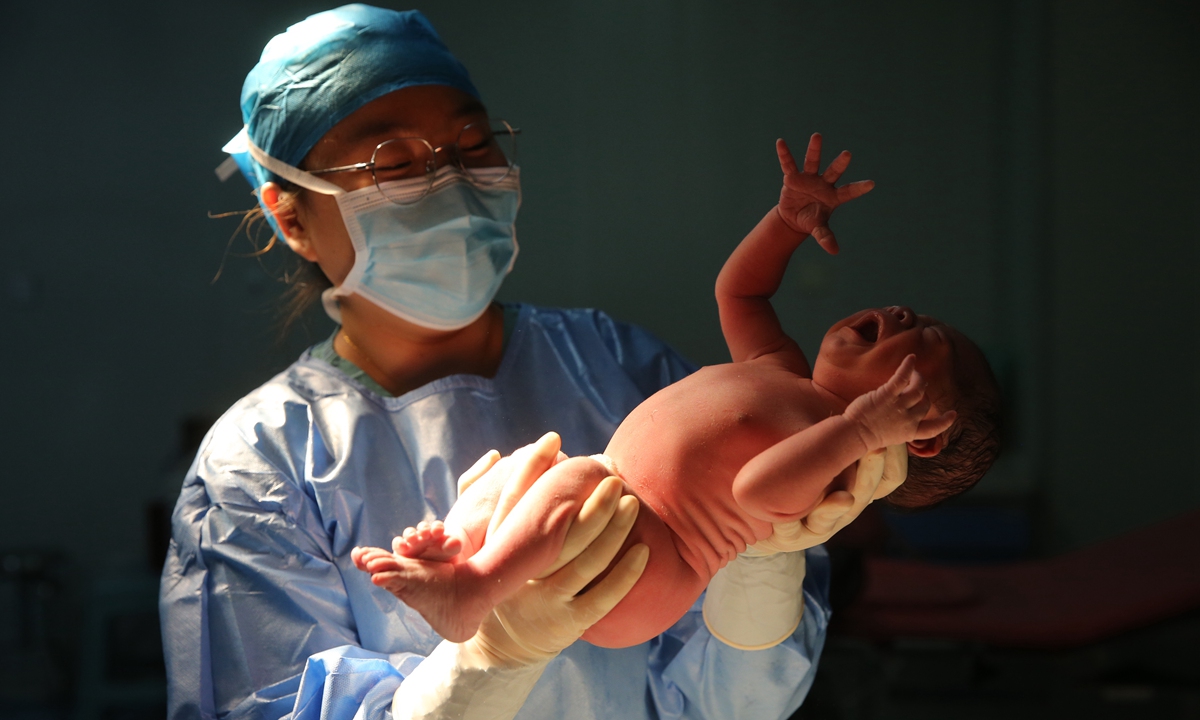
A nurse holds a new born baby in a hospital in Zhengzhou, Henan Province on January 1, 2022. Photo: VCG
The number of permanent residents in South China’s Guangdong Province stood at 126.56 million at the end of 2022, 272,000 fewer than the figure at the end of 2021, the first time a negative growth has been recorded in 40 years, according to media reports. An expert told the Global Times on Sunday that the data doesn’t represent a negative growth trend and more monitoring needs to be conducted to understand the population changes.
The number of permanent residents accounts for 8.97 percent of the total population of the country, and the number remains the first in China in 2022, the Bureau of Statistics of Guangdong Province said on Sunday. The number of newly-born population in Guangdong continues to lead the country and the level of population urbanization will continue to grow steadily, said the bureau. Population development is also expected to remain stable in the long term.
The number of newborn babies was 1.052 million in Guangdong in 2022, with the birth rate reaching 8.30 per 1,000 people, according to the authorities. It’s ranked in the first place in terms of newborn babies for five years, according to the local bureau.
At least 11 provinces and municipalities in China recorded a net outflow of permanent residents in 2022, including Beijing, Shanghai, East China’s Shandong Province and Central China’s Henan Province, according to media reports.
There are other provinces including East China’s Zhejiang, Jiangsu, Anhui and Jiangxi provinces and South China’s Guangxi Zhuang Autonomous Region which recorded growth in 2022 in terms of permanent residents, said the media reports. For instance, Zhejiang saw a growth of 370,000 people in 2022 and Jiangxi increased by 105,800 people.
There is differentiation in different provinces in population changes. Guangdong province has advantages in population growth compared with other regions as the province sees a relatively high fertility willingness and birthrate; also, the Pearl River Delta region still attracts more migrant population, Song Jian, a demographer from the Center for Population and Development Studies of the Renmin University of China, told the Global Times on Sunday.
Song said that Guangdong’s population change has relation with its talent policies as well as the industrial transfer. In the context of the new industry transfer – from labor intensive to technology intensive, Guangdong still has more space to improve its talent policies, according to Song.
However, one year's data does not necessarily indicate a long-term trend, especially for regional population changes. Generally three to five years can be enough to determine a general trend in population change, said Song.
China has been facing the situation of rising labor cost, and any city or region hoping to develop in a long term should focus on economic transformation and policies to attract workers, according to Song.
The total number of migrant population in Guangdong reached 29.62 million, accounting for 23.5 percent of the total population, ranking first in China. In 2022, the migrant population outside Guangdong decreased by 692,000, which is temporary as some of them returned to their hometowns due to the epidemic, said Guangdong authorities.
Global Times
RELATED ARTICLES