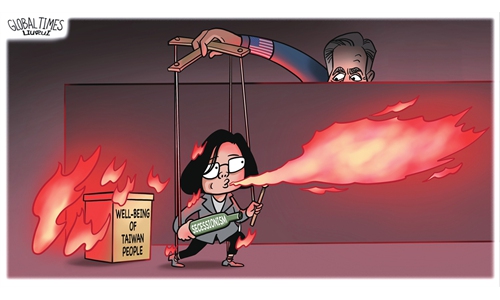
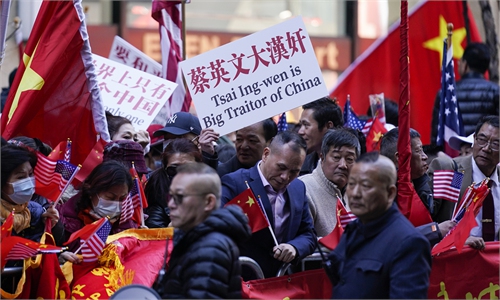
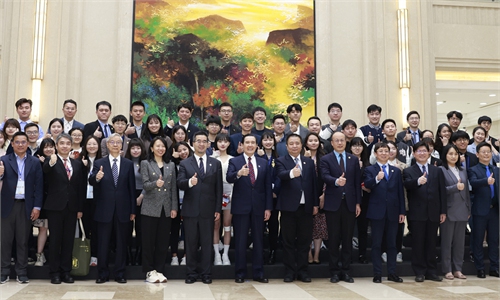
Illustration: Liu Xiangya/GT
Taiwan regional leader Tsai Ing-wen, who provocatively visited the US under the guise of a "transit" trip, on Thursday met with a bipartisan group including US House Speaker Kevin McCarthy at the Ronald Reagan Presidential Library in the US. This further confirms her role as a disruptor of cross-Straits peace and collaborator with external forces in betraying Taiwan island's interests. Throughout Chinese and world history, those who collaborate with outsiders to betray their own people's interests are destined to be nailed to the pillar of shame.
After the Democratic Progressive Party (DPP) deceived the people in Taiwan and became the ruling party in 2016, despite having learned a lesson from former Taiwan regional leader Chen Shui-bian's mistakes and not emboldened to engage in activities seeking "de jure independence," it still stubbornly adheres to the so-called "Taiwan independence" proposition. On the one hand, it carried out activities to push for "de-sinicization" and illegally cracked down on pro-reunification forces in Taiwan. It on the other hand has repeatedly colluded with external forces, acted as a pawn of foreign countries, and provoked the Chinese mainland, in a bid to gain sympathy from external forces and expand its so-called "space" on the international stage.
How do foreign forces respond to the DPP's behavior? First, Western societies such as the US constantly hype the so-called cross-Straits risks and make wild assumption about the timing of cross-Straits conflicts. Next, after stirring up trouble in the Taiwan Straits, they demand that the island improve their so-called defense capabilities, including increasing defense budgets to purchase weapons from the US.
In the eyes of some "Taiwan independence" secessionist forces, Washington seems to have given Taiwan "support." For example, after the Biden administration took office, it has approved its arms sale package for Taiwan for nine times. However, after the DPP authorities paid the bill, the US delayed delivery in its arms sales to Taiwan under the excuse of limited production capability. The US Congress passed the so-called TAIPEI Act, claiming to assist Taiwan in maintaining "diplomatic allies" and "international space," however, the island then could not participate in the World Health Assembly and the International Civil Aviation Organization, which it could attend before, and the number of "diplomatic allies" has also dropped by nine during Tsai's term, reaching an all-time low.
What did the island of Taiwan gain from Tsai's visit to the US under the name of "transit" and her meeting with McCarthy? According to the logic of a "Taiwan independence" secessionist, this is a "big breakthrough" in US-Taiwan relations, because this is the highest-level official a Taiwan regional leader has ever met in the US.
In fact, the Biden administration has been trying to downplay Tsai's "transit." McCarthy's willingness to meet Tsai Ing-wen is not only because the DPP has been lobbying with money for a long time, but also because McCarthy wants to use the Taiwan question as an important channel to unite US congressmen and seek personal benefits.
In the island, the DPP has long struggled with a shortage of international talent, and they have long accepted Western discourse and lack of international insight and historical vision.
From the perspective of international fluctuations, the hegemony of the US is no longer stable, and the collective rise of developing countries and the trend of multi-polarization are becoming clearer. In the context of history, the US abandoned its "ally" the island of Taiwan in the 1970s, and then abandoned pro-American forces in Afghanistan, Iraq and other places in this century, and now it is even making trouble with Israel. The US has always been a country that puts its interests first and there is no such thing as "morality."
Tsai's practice of selling out Taiwan's interests has been increasingly opposed by the people on the island, and "Americophobia" is becoming a new trend of thought in local society. Ma Ying-jeou, former chairperson of the opposition party the Kuomintang, who advocates the recognition of the 1992 Consensus and opposes "Taiwan independence," has just visited the mainland. While marveling at the tremendous achievements in economic and social development on the mainland, he has also repeatedly called for peaceful development across the Taiwan Straits instead of colluding with outsiders to undermine peace.
A poll also showed that as many as 64.8 percent of netizens on the island do not care about Tsai's visit to the US, and 69.5 percent believe that her visit is not helpful to the so-called Taiwan-US relations.
The author is research fellow at the Institute of Taiwan Studies of the Chinese Academy of Social Sciences. opinion@globaltimes.com.cn
RELATED ARTICLES