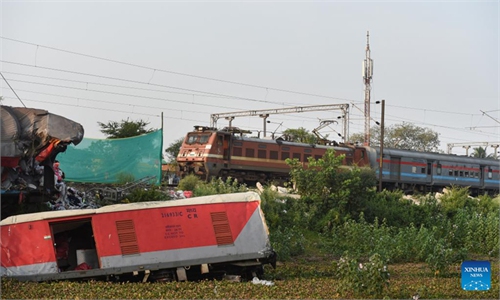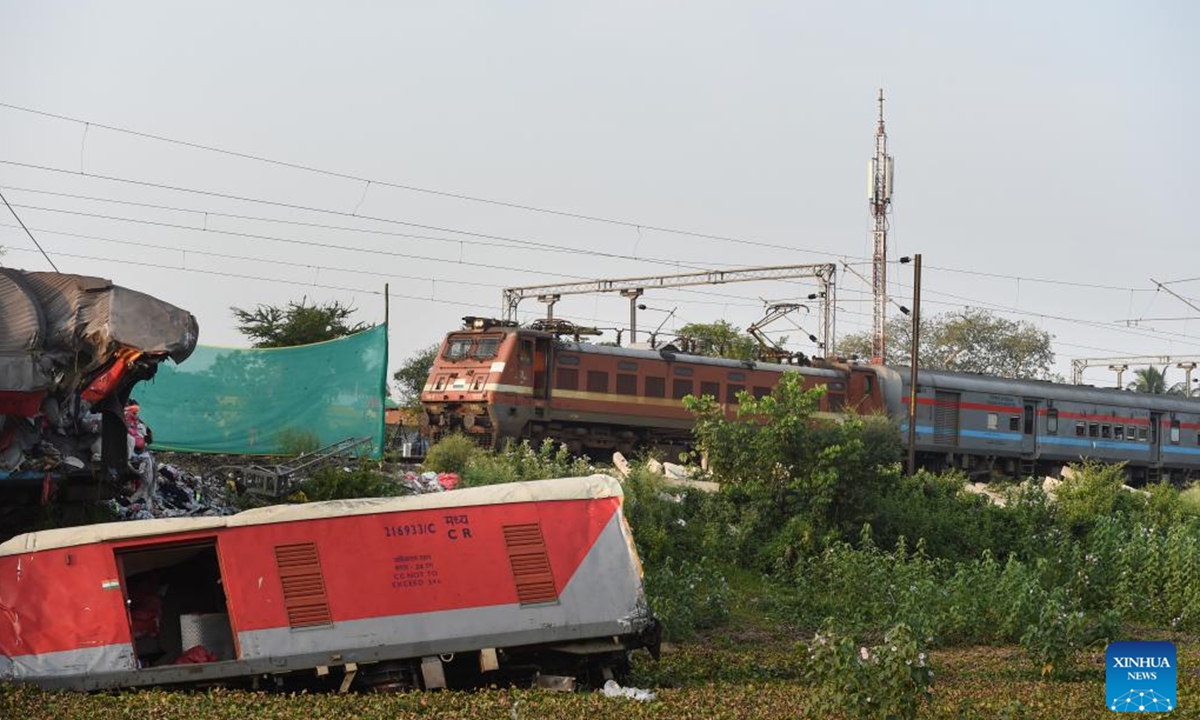
A passenger train passes by the site of a triple-train crash in Balasore district of the eastern Indian state of Odisha, June 5, 2023.(Xinhua/Javed Dar)
The Odisha triple train crash, with at least 275 deaths, which was likely caused by a signalling error, is an absolute tragedy.India's rail problems are vast, and their infrastructure is in need of serious upgrading, not just due to safety issues but because India, just like China, envisages technology like high-speed rail (HSR) as the key to reducing journey times and accelerating economic development. To this end, India's National Rail Plan announced in 2021, plans to connect all major cities together by 2030. This is a good choice considering HSR is safer than conventional road and rail.
India seeks to become an economic powerhouse, and HSR is part of this plan. But its 68,000km of conventional rail is huge, and the serious upgrading and new rail lines that need to be built can evidently not be achieved by India itself. Despite Modi spending billions on India's railway, the Odisha crash represents a failure of India's plan to install an anti-train collision system, which includes automatic brake application - currently, this is only operational on two percent of India's total railway route and its lack is being blamed for the Odisha tragedy.
Despite China leading the world in HSR, India illogically shuns Chinese cooperation. One cannot say this is due to Chinese technology being unsuitable, which is both fast and safe. A Forbes article stated that China's HSR has a safer record than France, Germany, and Spain's.
Furthermore, one cannot say that cooperation hasn't come about because China can't complete projects rapidly, cooperate with others, or doesn't understand the needs of the developing world. China, as a developing country, has over 155,000km of rail and 42,000km of HSR and has built HSR in Laos, rail in Africa, and metro in Pakistan.
My point is that India's economic and safety needs are gigantic - to overcome its challenges, India must cooperate with all, including China, which has an unprecedented track record of completing HSR projects in record time in a developing country similar to India!
Rather, holding India back are three important factors. Firstly, it is unwilling to place the China-India border dispute in its proper context and seek pragmatic solutions. Secondly, the Indian press needlessly hypes up the "China threat." Thirdly, India is compromised not only by the hard power overtures of the US-led Western bloc, its use of the former coloniser's language, English, makes it susceptible to the soft power of present-day imperialism too.
When the border dispute is contextualized and wider trust prevails, the construction of HSR in Xizang, which borders India, can be seen as India's opportunity rather than a strategic concern. This is precisely the attitude Beijing takes with India. Beijing welcomed the news of Indian-Japanese HSR cooperation as an opportunity to help India develop - which inevitably will lead to expanding markets for Chinese goods.
Likewise, the Indian reaction to both China and India building a railway into Nepal is framed negatively in the light of geopolitical rivalry, rather than recognizing the benefits of greater connectivity that acts as a workaround to building rail connections.
The overtures of today's US-led imperialist bloc toward India and the use of Western soft power, which bleeds into the negativity of the Indian press toward China, are difficult to disentangle. On the media front, India buys into the "China threat" narrative with scant evidence.
While India is a member of BRICS, it hasn't signed up to the Belt and Road Initiative (BRI), which contains the seeds for developing the Global South and connecting India and China. Modi, citing threats to "sovereignty and territorial integrity," decided against endorsing the program in 2018. However, this merely points to the fact that India has been hypnotized by Western propaganda.
India must break off its colonial consciousness, which has all manner of devious tricks to keep the rest of the world undeveloped. Indeed, when it comes to India's railways, the images of trains heaving with passengers on the roof are often romanticized as part of India's culture. However, poverty is not culture, and this vision must always be rejected.
If India is to overcome poverty, it must develop, and it needs railways for this. By not cooperating with China, its railway development will be slow and expensive. Perhaps India feels the US will transform it into the factory of the world, but how will it sell its goods to the soon-to-be world's largest economy - China? Will it really ship its goods on sea routes, at the mercy of the US Navy, to its own next-door neighbor? Even if India does slowly build its rail infrastructure up to connect all its cities with HSR - then what? Will it not then connect itself through rail to the wider markets of Eurasia?
One thing for sure is that China will continue to link its rail infrastructure with all its neighbors in an effort to build its economy and continue its project of poverty alleviation. If India doesn't do the same, it will only fall behind in relative terms. India cannot afford to continue to "cut off its nose to spite its face," and it cannot afford to not cooperate with China.
For the sake of India's rail safety, its economic development, its poverty alleviation, and its efforts to counter hegemonism and be a force for good in the Global South, I urge India to unshackle itself from its colonial consciousness, think win-win, think pragmatically, and cooperate with China's expertise, which has the ability to help achieve the Indian rail and economic miracle just as it achieved the Chinese rail and economic miracle.
The author is an independent international relations analyst who focuses on China's socialist development and global inequality. opinion@globaltimes.com.cn
RELATED ARTICLES