Illustration: Xia Qing/GT
A recent article in Foreign Affairs pointed out, the world is entering a "post-Western era," and China and other countries have moved forward while the US remains stagnant. China is preparing for the arrival of the post-Western order, while the US is not.The current world is mired in a difficult situation. Disorder and fragmentation are prominent features that observers tend to use to define it. In the past few decades, China has re-emerged as a major power, with the second largest economy and showing an ever-greater presence on world stage. Many have begun to discuss China's role in the world.
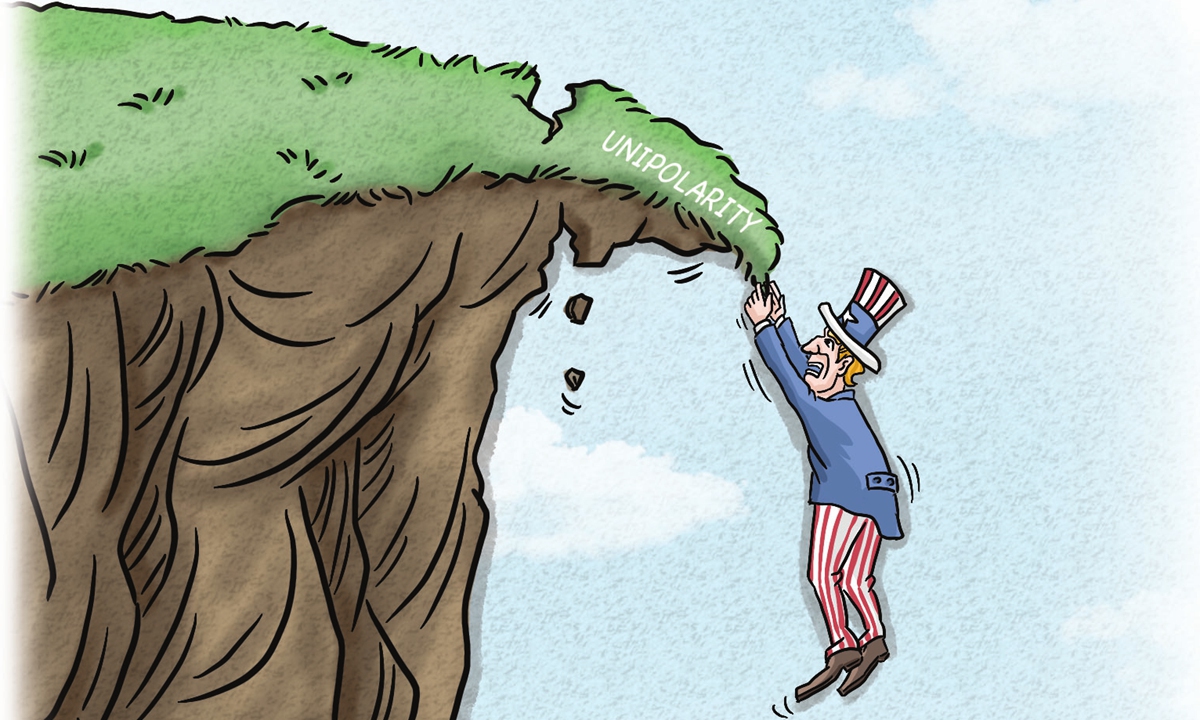
The current world order was set up and developed along Western lines of thinking. With the relative decline of Europe and the US in terms of strength and influence, the world order is bound to be different than before. Against the backdrop of the world gradually shifting toward a "post-Western order," the world needs a new and rational "order." China's long-standing commitment to peaceful development and diplomatic principles has earned it increasing international credibility, and many countries see China as a major driver in promoting a just and reasonable international political and economic order. However, it is evident that the West finds it hard to sit idly by, and the cultural traits of the West also determine that they cannot tolerate the "pain" of other countries' peaceful development.
The US significantly enhanced its military strength and comprehensive national strength through two world wars. Especially after the end of World War II, the traditional Western powers were either destroyed or weakened by the war, resulting in a brief period of an American "unipolar world." Faced with the rapid recovery and rise of the Soviet Union, the US, relying on its strong power and influence, attempted to rebuild the Western world, that is, by granting to aid Europe and other developing countries. It did so not out of genuine internationalism but to maintain its dominant position after WWII and respond to challenges from the Soviet Union.
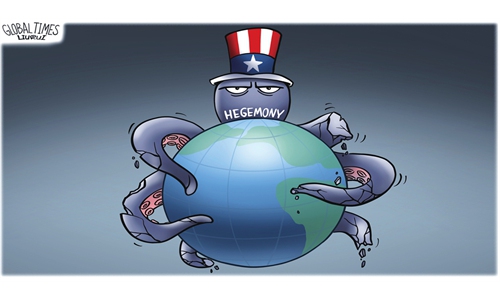
It can be seen that since the end of WWII, especially after the end of the Cold War, the US has sought to maintain its absolute advantage in national strength and establish American hegemony over the entire world. Actively rallying allies and partners is an important means and method to achieve this. Even after the collapse of the Soviet Union, the US has continued to do so. It vigorously promotes Western values and political systems to distinguish between "us" and "them."
On the one hand, the US hypes the "China threat theory" while smearing or ignoring some of China's initiatives and proposals aimed at promoting peaceful development and win-win cooperation. This reflects the strategic anxiety of the US in the face of the trend - the rise of the East and the decline of the West. The first is anxiety about its hegemonic position, and the second is anxiety about the international order it leads. Since its establishment, the People's Republic of China has always advocated equality among nations, a world of harmony in diversity, and the democratization and rule of law in international relations.
China is well aware of the challenges that a chaotic world can bring to a country. Since modern times, China had been invaded by Western powers due to its weak national strength and even faced the danger of national extinction. In the face of crisis, the Chinese people had shown strong national unity and patriotism.
The differences in the international perspectives of China and the US are also reflected in the issue of the Russia-Ukraine conflict. NATO, led by the US, did not disband after the end of the Cold War but instead expanded eastward multiple times, continuously squeezing Russia's strategic space. The US' external actions reflect its strategic thinking, which prioritizes American hegemony and Western supremacy. The so-called rules-based international order emphasizes a set of rules formulated by the West, led by the US, to maintain its interests. By doing so, it aims to maintain or guarantee the long-term dominance of the West, especially the US, and to dominate and shape an international order that is favorable to it. China emphasizes the need to uphold the sovereignty and interests of both Ukraine and Russia in the Russia-Ukraine conflict, supports Ukraine's sovereignty claims, and also emphasizes the need to consider Russia's security interests and demands. China maintains a truly objective position on the Russia-Ukraine conflict, supporting an international order based on the United Nations Charter and international law and opposing Western hegemony and power politics.
The article is compiled by Global Times reporter based on an interview with Sun Xihui, an associate research fellow with the National Institute of International Strategy at the Chinese Academy of Social Sciences. opinion@globaltimes.com.cn
RELATED ARTICLES