Illustration: Xia Qing/GT
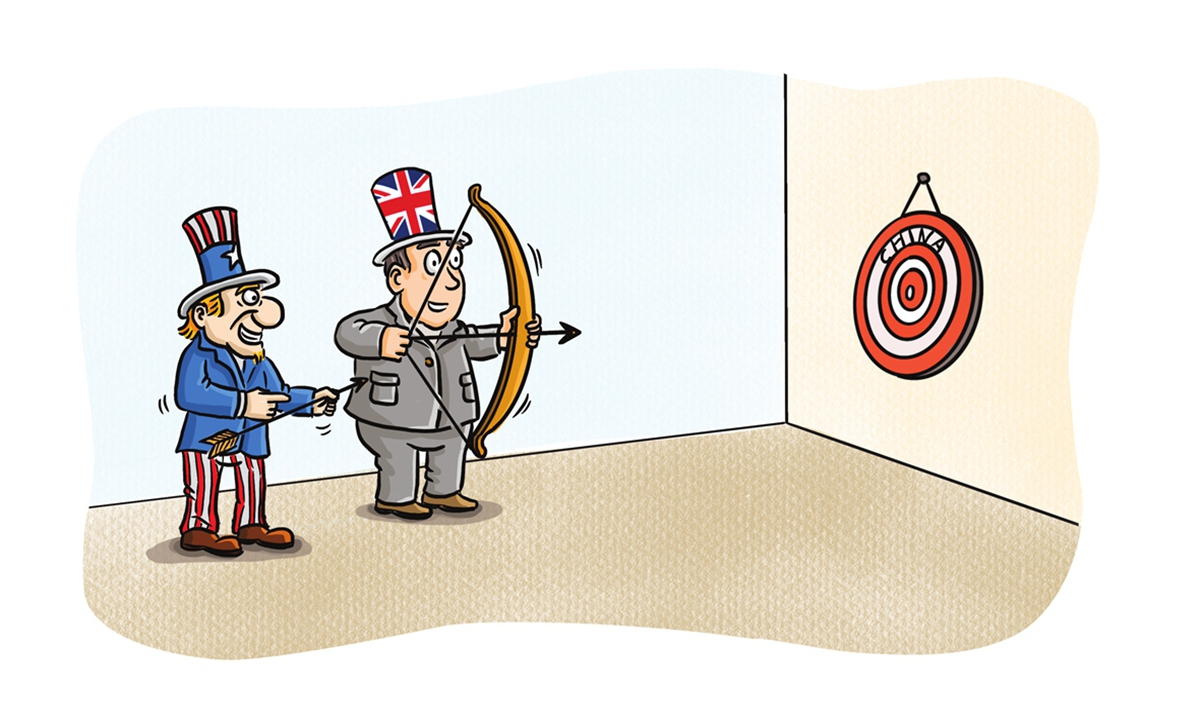
A group of British MPs have just spent the best part of the past few years gathering evidence to prove what they claim to be Chinese interference in UK affairs, and to examine how good their security services are at doing their job. What a waste of time.
The conclusions of the Intelligence and Security Committee, made by legislators whose job is to oversee the running of MI5, MI6 and the GCHQ eavesdropping agency, seemed damning - both of China and of the UK services - and this was widely reported in the British media.
But their methodology was flawed, the process of research and analysis questionable, and because of the composition of the ISC, and the witnesses it called to give evidence, it is the committee that should be attacked for defective findings, scaremongering language, and unsound assumptions.
This should be no surprise for several reasons. Firstly, anyone expecting impartial treatment of China from the current British political class, in the current fevered geopolitical climate, is expecting too much. Secondly, it is clear that the ISC's inquiry was framed in the context that China was bad - and the only purpose of the investigation was to determine how bad, and how prepared the UK is to meet such a challenge. Its task, in other words, was to seek out evidence to support its premature conclusion.
The British military establishment sees Beijing as a foe, so having the committee chaired by a hawk who has served in the Royal Navy Reserve, and who has energetically advocated for Britain's increased military strength, kind of loads the dice. So too does having a Royal Navy admiral and retired British Army colonel as ISC members. There was a similar narrow diversity among witnesses, most of whom will view China as an adversary. Some witnesses were from the Royal United Services Institute think tank, and conducted themselves in the best traditions of the institute's intellectual independence. But the institute gets millions of pounds from the European Union, the US State Department, the British Army and Foreign Office, and defense corporations. It also takes payment from the government of Japan and the Taipei representative office in the UK. This is important because it can cast a shadow over institutional impartiality.
The report says British academia is vulnerable to undue influence because universities are heavily dependent on tuition fees from overseas students, many of whom are Chinese, drawing attention-grabbing, but hysterical pictures of a "nightmare scenario" of China one day being an "existential threat to liberal democratic systems." This is laughable. The committee saw engagement with China as a threat rather than an opportunity. It saw Chinese students coming to Britain not as a tribute to the excellence of British teaching but as a weakness that could be exploited by Beijing's security services. It is worth remembering that the only reason UK universities are so heavily dependent on student fees is because the British government cut their funding.
The ISC's part-redacted report also claims China's state intelligence apparatus is "almost certainly the largest in the world." This is ludicrous. Clearly the committee must be the only people on the planet who do not automatically regard the US - with its $89.8 billion intelligence community budget last year, and as least hundreds of thousands of individuals with top secret clearance - as better deserving of this title.
I'm not surprised the ISC members concluded as they did. They started with their minds made up. It wasn't an inquiry to find the truth of Chinese involvement in the UK, it was a faux investigation, a sham, beginning with the assumption that China was doing wrong: having made that assumption, it set out to find evidence to prove it, from witnesses they could expect to confirm their suspicions. It was less an inquiry and more of a show trial, with China in the dock.
The author is an independent researcher and analyst with an interest in China. opinion@globaltimes.com.cn
RELATED ARTICLES