Illustration: Chen Xia/Global Times
China's economy, unshackled from pandemic control measures taken in December 2022, has regained pace to expand at a much faster rate than nearly all other major economies.
The National Bureau of Statistics (NBS) is scheduled to release the official first-half GDP figures on Monday.
Unlike in the past, the central government in the first half refrained from unleashing the "bang" of a colossal stimulus to give the economy a strong shot in the arm. Chinese policymakers have been moderating the scale of post-pandemic stimulus. The calculus behind the decision is that China wants to make its economic recovery more enduring and sustainable.
As the US seems to be bent on throttling China's growth on the global stage with all types of economic containment and trade restrictions, Chinese policymakers should always remain sober-minded, getting the country's resources in good order and using them in a well-coordinated and choreographed manner.
It doesn't make much sense for China to launch a 2008-style stimulus of 4 trillion yuan ($560 billion) again. This time, it might lead to a short-term economic blastoff, but will hamstring the fundamentals of future growth.
It is true that the Chinese economy is not galloping along at a double-digit pace, but it is certainly not "struggling," "sputtering" or "faltering" as claimed by some mainstream American media and a few European pundits. It is utter nonsense for them to claim that the engines firing up the Chinese economy "are choked off" and "China's growth story is falling apart." The drumbeat of these negative analyses is purposely aimed at watering down global investors' confidence and tarnishing China's global image.
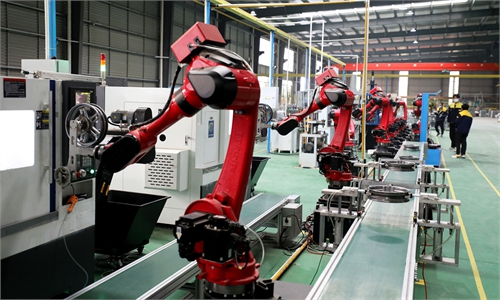
The prospects for restructuring and upgrading China's economy are the best they have ever been. This process includes bolstering infrastructure projects and technology innovation, shoring up the role of free market competition, expanding opportunities for small and medium-sized businesses, allocating capital more efficiently in keeping with market principles, and improving the balance between consumption and investment.
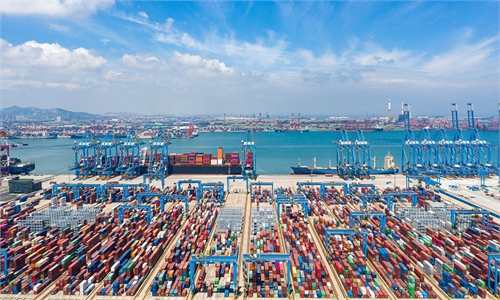
Though China's export-oriented sectors face strong headwinds due to the sluggish foreign demand caused by monetary tightening and stagnation in the developed economies, time remains on China's side. China has already reached the level of 120 trillion yuan GDP, and it could manage to climb up the economic ladder at a pace of its own choice that best suits China's national conditions.
The IMF has predicted that China's economy will grow 5.2 percent in 2023. If that growth is the oft-predicted "hard landing" for the country, then how to classify the trivial over 1 percent GDP growth the IMF predicted for the US economy this year?
No economy can expand indefinitely at China's historic double-digit rate. China's economy still pulsates with the full confidence of the policymakers, the well-educated labor force, and the country's growing entrepreneurial urge to be technologically self-reliant - an important factor that doesn't fit neatly into statistical models.
In the second half of 2023, the central government is likely to unveil new policy priorities as reforms will target ramping up domestic sales of big-ticket items, housing and vehicles in particular. Some Chinese economists suggest the government gradually taper off the restrictions imposed in recent years on urban home sales and extend more favorable policies to encourage electric vehicle consumption, which also benefits curbing carbon emissions.
Retail sales jumped 9.3 percent in the first five months, becoming the single largest contributor to the Chinese economy. Services including restaurants, hotels, pubs, touring, housekeeping and medical care are booming. Domestic consumption is expected to further accelerate to make up for the slowing growth of exports.
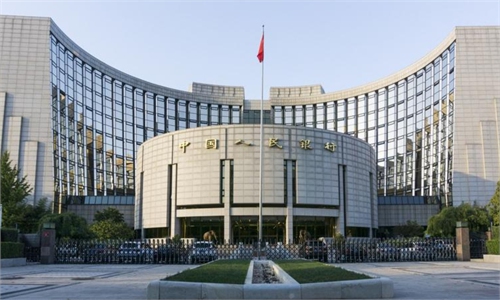
Meanwhile, the central bank cut interest rates in June and it may do so again. As bank borrowing costs are substantially reduced, Chinese businesses' investment will ramp up in the second half of 2023.
To sum up, Chinese people's optimism about a more prosperous future hasn't really receded, because they know that China's economic fundamentals remain strong and China's systemic advantages are unparalleled. To be sure, there are a few relative soft spots in the economy, such as worries about a real estate market retreat and college graduates' high unemployment rates, but they could be overcome step-by-step with the constant improvement of the economy.
China always gives the world pleasant surprises. Not many years ago, Shenzhen in South China's Guangdong Province was merely a fishing village, and Shanghai's Pudong was a largely barren tract of land. Today, Shenzhen is one of the world's major tech hubs, while Pudong is a major money center. Before long, the Xiong'an New Area, just about 100 kilometers to the south of Beijing, will become the next modern city, making all the naysayers shut up.
The author is an editor with the Global Times. bizopinion@globaltimes.com.cn
RELATED ARTICLES