Hype on Lai's US transit 'untenable'; stopover expected to be 'low-key' amid de-escalating China-US tensions
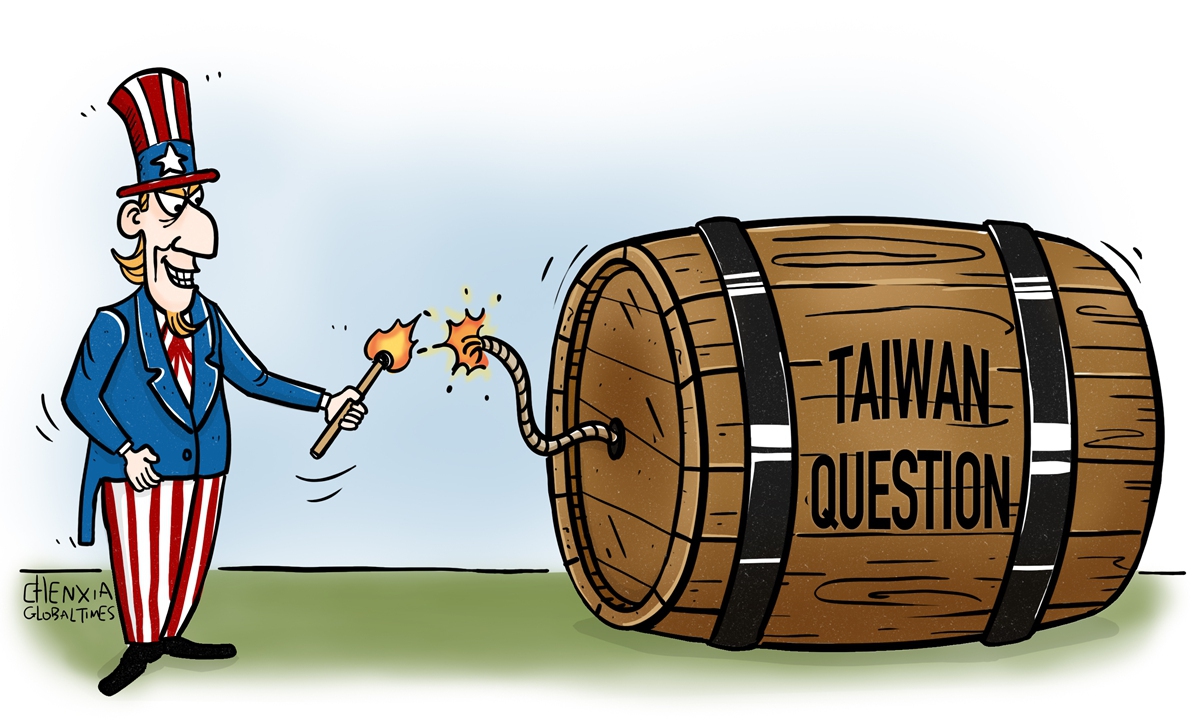
Taiwan question Illustration: Chen Xia/GT
Before the planned stopover in the US by deputy leader of Taiwan island Lai Ching-te in August, politicians from the island and the US tried to pre-empt responses and reactions from the Chinese mainland. Their argument of "following customary," however, is completely untenable, said Chinese experts on Tuesday, noting that a possible low-key transit will not change its nature.
China has lodged serious representations with the US side over the matter and will closely follow the situation and take resolute and strong measures, according to Chinese Foreign Ministry.
Lai, a front-runner in the island's election for regional leader who currently serves as deputy regional leader, has been appointed to lead a delegation to attend the inauguration ceremony of Paraguayan president-elect Santiago Pena in August. He will stop over in the US on the way to Paraguay, according to a local official, who on Monday described the stopover as "customary."
US Secretary of State Antony Blinken also said the transit was "routine" on Monday, citing that 10 deputy regional leaders of Taiwan island have done so. He even warned that the Chinese mainland should not "use it as a pretext for provocative actions."
However, Chinese experts pointed out that the argument of "custom" or "routine" is totally untenable.
"It is easy to refute," Lü Xiang, a research fellow at the Chinese Academy of Social Sciences, told the Global Times on Tuesday. "If a criminal committed a crime but was not punished, it does not mean the criminal is free to commit that crime again."
"Low key, private and unofficial" is Lai's transit expected to be, US media outlet Bloomberg reported, citing a senior Biden administration official. The US' planned approach is in line with its recent easing of diplomatic ties with the Chinese mainland, analyst said.
The Chinese mainland has sent very strong and clear signals in the events of Pelosi's provocative visit to Taiwan island and regional leader Tsai Ing-wen's transit stop in the US, making it crystal clear to the US that the Taiwan question is the most sensitive and significant question in China-US relations, said Lü.
He noted that in the recent high-level exchanges between China and the US, there have been fewer antagonistic expressions on the part of the US. "Now that the US sees de-escalating tensions, they are expected to deal with this matter in a low-key manner."
Nonetheless, a low-key manner will not change the nature of the event which is an official interaction firmly being opposed, experts noted. The Chinese mainland will continue to closely follow relevant developments.
While Blinken referred to the "status quo" in the Taiwan Straits that the US "has no desire to change," Chinese observers pointed out that the so-called status quo has not existed since then-US house speaker Nancy Pelosi's reckless visit to the island in August 2022.
"Cross-Straits relations have entered a new normal, which is that the mainland has increased its ability to control air and sea space across the Straits in order to deter interference," said Lü. "What the US is realizing is that its ability to intervene in the Straits' situation has become weaker and weaker."
Politicians on Taiwan island who still fantasize that the US has the ability to support their secessionist moves will keep exaggerating the support they receive from Washington, saying that they have been treated with courtesy, which is their usual rhetoric to win votes, he noted. "There is nothing else for them to rely on."
China has lodged serious representations with the US side over the matter, said Chinese Foreign Ministry spokesperson Mao Ning at Monday's regular news conference.
China firmly opposes any form of official interaction between the US and the Taiwan region, firmly opposes any visit by "Taiwan independence" separatists to the US in any name or under whatever pretext, and firmly opposes the US's conniving with and supporting the "Taiwan independence" separatists and their separatist activities in any form, she said.
"The Taiwan question is the very core of China's core interests and the first red line that must not be crossed in China-US relations," said Mao. "We urge the US to abide by the one-China principle and the three China-US joint communiqués, act on its leaders' commitment including not supporting 'Taiwan independence,' stop official interaction with Taiwan, stop upgrading its substantive exchanges with the region, and stop sending any wrong signal to the 'Taiwan independence' separatist forces."
RELATED ARTICLES