Not learning English means that children from rural areas will always be farmers: Huawei founder
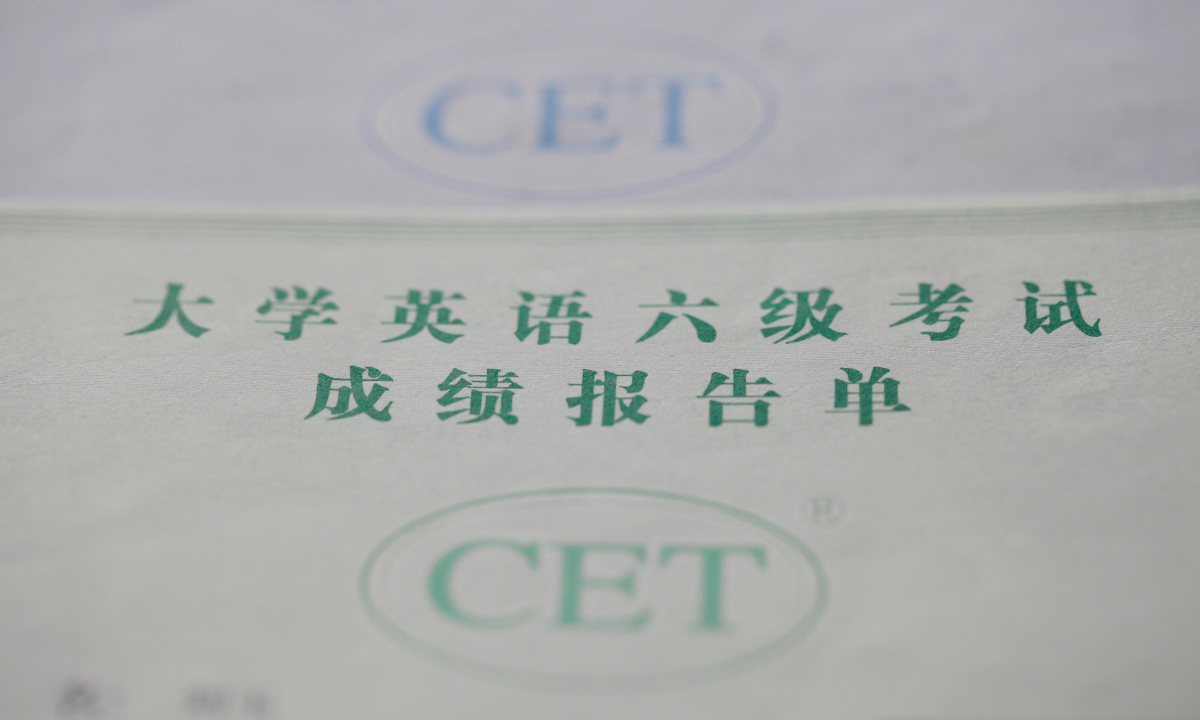
Photo: IC
Not learning English means that children from rural areas will always be farmers. If you don't learn English, how will you get employed in the future, Chinese tech giant Huawei's founder, Ren Zhengfei, said during an interview in July that was published on Thursday. Xi’an Jiaotong University's recent announcement that it won’t require mandatory College English Test results has sparked heated discussions online.
College English Test (CET) Band 4 and Band 6 are no longer a mandatory requirement for undergraduate students to graduate or obtain their bachelors’ degrees, Xi’an Jiaotong University, a national key university in Northwest China’s Shaanxi Province said.
According to a statement released by the university, the college council for the undergraduate students has decided that taking part in or passing the CET Band 4 or Band 6 testing, or any other English proficiency tests inside or outside the campus will not be a mandatory requirement for undergraduate students to obtain their bachelors’ degrees starting from September 1, 2023.
“Some people say you shouldn't study mathematics. However, if you are not good at both mathematics and English, you won't be able to enter high-end industries,’’ Ren said. Ren noted that he understands that there might be difficulty in learning English in rural areas. “But if you can endure it for a while, won't you overcome it finally? It’s possible that the person’s spoken expression isn't that good, but it’s also fine to have the ability to recognize text.’’
Ren also stressed the importance to “teach according to students' aptitude,” and not to overemphasize the “starting line.”
CET is a national standardized English language test for college and university students in China, which has been in operation since 1987 as an assessment tool to see whether the students have met the curriculum requirements of their compulsory college English course.
The test’s overall pass rate varies greatly among different levels of Chinese colleges and universities. Statistics show that the pass rate of CET-4 for students from key universities can be as high as 70 percent to 80 percent, whereas the pass rate for students from average universities is just around 40 percent.
A faculty member from the university confirmed the decision on Thursday and said that it is a reasonable decision since other universities also have implemented similar policies.
The university’s decision soon sparked heated discussions online since the English proficiency test result as a compulsory requirement for all the non-English-major students in Chinese colleges and universities to graduate has long been a controversy.
The topic trended on Sina Weibo and gained more than 1.15 million views on Thursday morning. Many internet users applauded the decision and expected other colleges and universities to follow suit.
“The decision is so great since it has been so confusing that Chinese students’ academic degrees have to be verified by a foreign language proficiency,” a netizen commented on Sina Weibo.
“Einstein’s talent would have been buried if he had to take a Chinese language exam,” another netizen mockingly remarked.
However, other netizens expressed different attitudes toward the decision.
“Students’ graduation and bachelors’ degrees can be decoupled from CET-4 or 6 but English proficiency should not be bad-mouthed since poor English language capability almost means illiteracy in science and technology circle,” a netizen pointed out, noting the high-level scientific and technological papers and academic articles are still mainly written in English.
Other netizens expressed concerns that despite the university not assessing students’ English capability any more, their English proficiency will still be tested when they look for jobs.
Chu Zhaohui, a fellow researcher with the National Institute of Education Sciences, said that colleges and universities have the autonomous management right to decide the standards that their students are expected to meet upon graduation, according to media reports in 2020.
According to Chu, the requirements on students’ CET-4 and 6 results had been canceled in previous years at some colleges with better sources of students because many students already met or exceeded the standards.
Other observers commented that the waste caused by excessive English teaching should be eliminated with the adoption of a more balanced approach. A student’s need to study English should not be a political decision.
Global Times
