SOURCE / PRESS RELEASE
Fingertip skills embroider new devt landscape
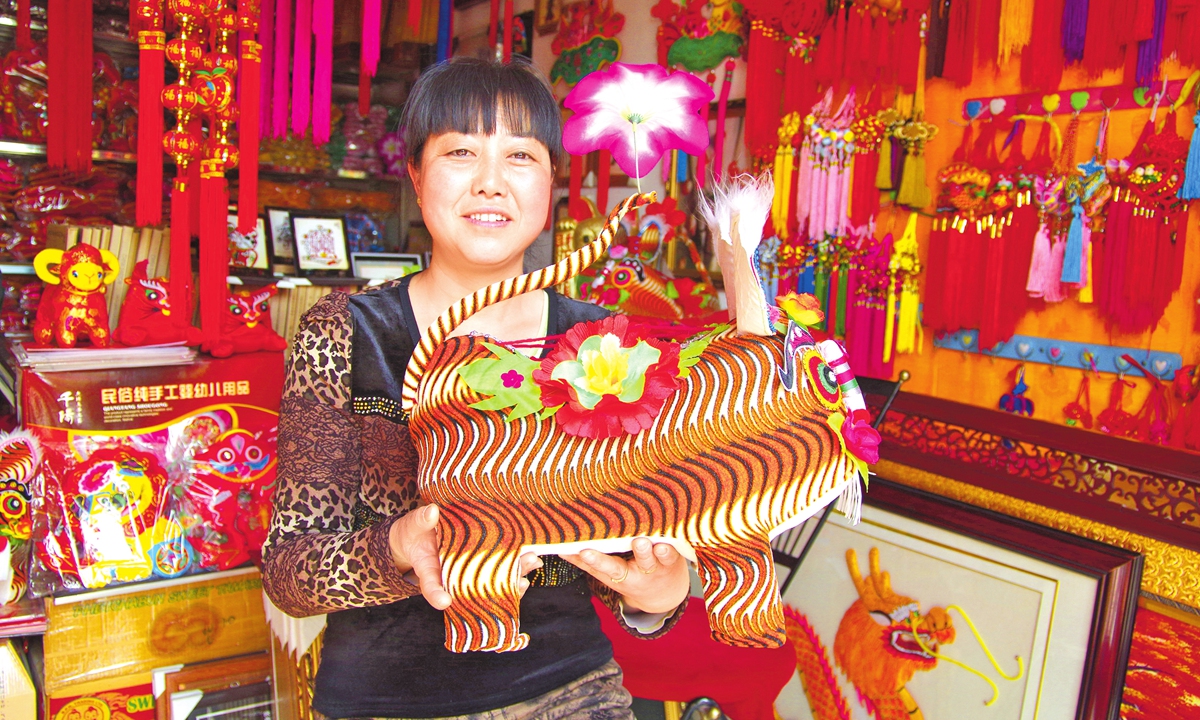
An embroiderer shows an embroidered tiger pillow at a workshop in Qianyang, Baoji of Northwest China's Shaanxi Province. Photo: Courtesy of Qianyang Rural Revitalization Administration
When people walk into the compounds in Qianyang county located in Baoji, Northwest China's Shaanxi Province, they can see a number of local farmers busy with needlework, with the needle seemingly flying and the thread seeming to run. Within a moment, the colorful thread has formed a pattern on the cloth satin.
In recent years, the county has deeply integrated the high-quality development of the "courtyard economy" and embroidery intangible cultural heritage industry, adhering to the innovative development of the traditional embroidery industry with modern fashion elements.
At present, the county has 21 professional embroidery cooperatives, driving 12,000 people engaged in the industry, with annual sales of more than 6.5 million products and output value of 82 million yuan ($11.2 million). Local people get rich and increase income with fingertip skills, paving a new way to the rural revitalization.
From skills to dividends
Li Huilian is the leader of a local intangible cultural heritage workshop. Her workshop is equipped with electric sewing machines and embroidery machines, creating 200 embroidery products including folk culture, ornamental toys and children clothing. She has led more than 1,000 embroiderers to produce over 800,000 pieces of craft, with output value exceeding 15 million yuan.
"Whenever I have free time, I go to the workshop to do needlework without delaying farming. My monthly salary has increased from more than 2,000 yuan to more than 4,000 yuan," said Zhang Xiaohong, who is employed in the workshop.
In Qianyang county, it is not uncommon for farmers like Li to start a workshop due to her advanced embroidery skills, and it is closely related to the strong local embroidery culture in the region. Unlike other embroidery products, Qianyang embroidery specializes in storytelling, and each product comes with a touching story or simple truth.
"Folk stories and festivals are both the contents of embroidery. Products featuring traditional cultural stories such as Dong Yong and the Seventh Immortal Maiden have always been sought after by customers," Li noted.
In 2008, Qianyang embroidery was identified in the second list of national intangible cultural heritage projects.
New formats
In recent years, the county has accelerated the industrialization of embroidery, employing tens of thousands of local residents through the sector as well as promoting the intangible inheritance through exquisite finger skills.
"In response to the difficulties of the single workshop to tap into the market, we constructed an embroidery industrial park under a unified design, production and sales, effectively avoiding the unstable quality and some disorderly competition problems," said Li Jie, director of the Bureau of Culture and Tourism of Qianyang county.
At present, the industrial park has cultivated a cultural brand, and the products have been exported to Japan, the US, Italy and other more than 30 countries and regions, realizing the "small courtyard" docking the world market.
In order to use these unique skills to help boost local tourism industry, the county has cooperated with colleges and universities to carry out different forms of training, covering areas including e-commerce business and marketing concepts.
The training also include computer design, machine embroidery, laser cutting, in order to better combine new technologies with local traditional intangible heritage skills.
Currently, Qianyang has cultivated more than 100 e-commerce marketing veterans with over 50 e-commerce sales outlets, promoting the story of Qianyang embroidery through online platforms.
Every year, thousands of college students make trips to the county, with folk experience tours becoming a new form of local culture and tourism integration.
Qianyang's way to the prosperity mirrors China's high-quality development and rural revitalization agenda.
China unveiled its "No.1 central document" for 2023 in February, outlining nine tasks for comprehensively promoting rural vitalization this year.
As the first policy statement released by China's central authorities each year, the document is seen as an indicator of policy priorities.
It is important to cultivate industries and businesses that leverage local strengths, said Tang Renjian, Minister of Agriculture and Rural Affairs.
The country will strive to ensure that more than 60 percent of the central government subsidies for rural vitalization are used to develop local industries, according to the document.
RELATED ARTICLES