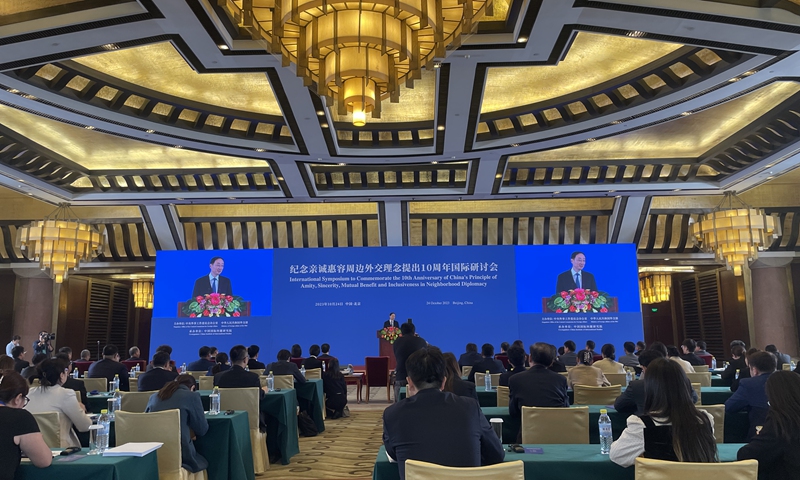
Sun Weidong, vice minister of the Chinese Foreign Ministry, speaks at the closing ceremony of the symposium themed "Amity, Sincerity, Mutual Benefit and Inclusiveness: New Dimensions, New Progress and New Vision" held in Beijing on October 24, 2023. Photo: Bi Mengying/GT
An international symposium to commemorate the 10th anniversary of the proposal of China's neighborhood diplomacy principle was held in Beijing on Tuesday. During the closing ceremony, the "Outlook on China's Foreign Policy on Its Neighborhood in the New Era" was published, the first time that China has comprehensively expounded its foreign policy toward neighboring countries through a document.
Chinese President Xi Jinping sent a message to the symposium, which is themed "Amity, Sincerity, Mutual Benefit and Inclusiveness: New Dimensions, New Progress and New Vision."
"China will continue to follow the principle of amity, sincerity, mutual benefit and inclusiveness, and work with other countries in the region to build an Asian homeland of peace, tranquility, prosperity, beauty and friendly coexistence, to jointly write a new chapter in promoting the building of a community with a shared future for Asia and for humanity," Xi said in the message, the Xinhua News Agency reported.
Xi pointed out the basic policy of China's neighborhood diplomacy is to pursue friendship and partnership with its neighbors, and to build an amicable, secure and prosperous neighborhood, highlighting the principle of amity, sincerity, mutual benefit and inclusiveness.
Over the past decade, China has actively practiced the above-mentioned principle, and developed friendly and cooperative relations with its neighbors in an all-round way. The two sides have continuously enhanced political mutual trust and deepened convergence of interests, thus opening up a bright pathway of good-neighborly friendship and win-win cooperation, Xi said.
China's Principle of Amity, Sincerity, Mutual Benefit and Inclusiveness in Neighborhood Diplomacy was first proposed by President Xi Jinping in 2013 at a work conference.
While hosting the symposium, Wang Yi, a member of the Political Bureau of the Communist Party of China Central Committee and Chinese Foreign Minister, delivered a keynote speech. Wang noted that over the past decade, China has worked hand in hand with neighboring countries to safeguard hard-won peace and tranquility amidst the turbulence of the international arena, building the most vibrant development hub amid numerous crises and challenges.
Wang emphasized that China will maintain the continuity and stability of its neighborhood diplomacy, uphold the concept of amity, sincerity, mutual benefit and inclusiveness, deepen friendly cooperation and integration of interests with neighboring countries, and jointly build a peaceful, prosperous, beautiful and harmonious Asia. China will contribute more wisdom and strength to the building of an Asian community with a shared future and a community with a shared future for mankind.
Sun Weidong, vice minister of the Chinese Foreign Ministry, said that the document "Outlook on China's Foreign Policy on Its Neighborhood in the New Era" is based on an assessment and perspective of the current situation and future trends in Asia, and comprehensively elaborates on the achievements, policy concepts and goals of China's neighborhood diplomacy.
The document declares that China will adhere to the path of peaceful development, promote the development of its neighbors through its own development, jointly advance the process of modernization with regional countries, and work together to build a community with a shared future for Asia.
Ong Tee Keat, president of the Belt and Road Initiative Caucus for the Asia Pacific, said that this year also marks the 20th anniversary of China's accession to the Treaty of Amity and Cooperation in Southeast Asia.
"This further signifies the consistency of and commitment to promoting actual peace and cooperation by China in its global engagement over the decades," he said.
Ong believes this shows China's pursuit of enduring peace and prosperity through cooperation in development and it has proven a viable choice, showing China's responsibility in global governance.
At the symposium, attendees have reached a consensus that China's neighborhood diplomacy is a major contribution to diplomatic theory and holds important innovative significance. Many experts agreed that even though it was proposed by China, it has deep inherent compatibility with the traditional culture and philosophy of neighboring Asian countries, said Zhao Kejin, deputy director of the Center of International Security and Strategy of Tsinghua University at the close of the symposium.
"As long as we all work together, we will be able to achieve common development and development in Asia," he said.
RELATED ARTICLES

