US’ record defense policy bill could incite arms race, exposing inflating hegemonic ambitions: Chinese expert
By Published: Dec 12, 2024 09:05 PM

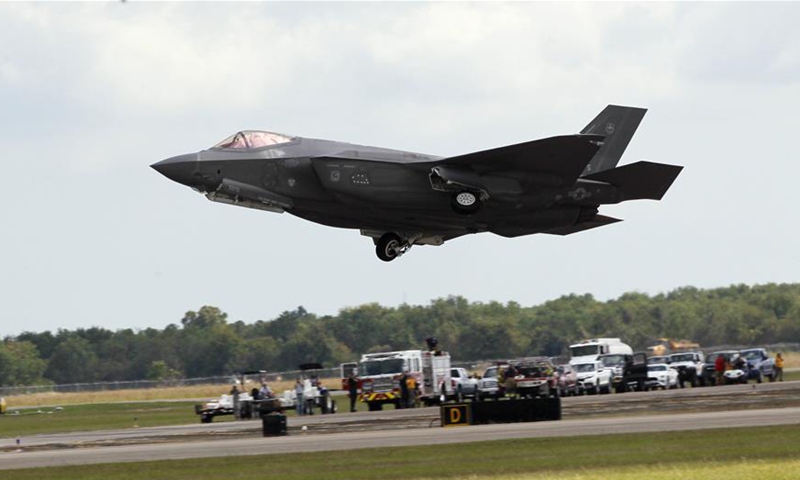
An F-35 fighter jet performs during the annual Wings Over Houston Airshow at the Ellington Airport, state of Texas, the United States, Oct. 19, 2019. The annual airshow kicked off at the Ellington Airport with aerial performances and displays. (Xinhua/Song Qiong)
The US House recently passed a massive defense policy bill that could lead to a record-breaking annual military spending of nearly $900 billion. A Chinese military expert said on Thursday the US move incites arms race and highlights its growing hegemonic ambitions.
The US House of Representatives passed the National Defense Authorization Act (NDAA) governing a record $895 billion in annual military spending, featuring provisions on purchases of military equipment and boosting competitiveness with countries like China and Russia, Reuters reported on Wednesday.
The bill expands the US military presence in the “Indo-Pacific,” where China and other foreign countries “have recently ramped up spending and infrastructure development,” The Wall Street Journal (WSJ) claimed.
It authorizes $2 billion - a large chunk of the $17.5 billion authorized for military construction overall - for the “Pacific Deterrence Initiative,” according to the WSJ report. It authorizes the construction of one nuclear-powered submarine and three guided-missile destroyer warships as part of a $33.5 billion authorization for expanded shipbuilding, and 92 fighter aircraft.
Media on the island of Taiwan CNA reported on Tuesday that US lawmakers have proposed military articles and training worth up to $300 million to support Taiwan in the Fiscal Year 2025 NDAA.
Even as its annual military spending is about to reach $900 billion, the US is seeking further budget increases by exaggerating military and geopolitical “threats” from China and others, Song Zhongping, a Chinese military expert, told the Global Times on Thursday.
The expanding US military spending exposes the US’ inflating hegemonic ambition, Song said.
The NDAA incites arms race and risks military conflict. It also violates the one-China principle and undermines China’s sovereignty and territorial integrity through its proposed military support for Taiwan island, Song noted.
It will only undermine regional and global peace and stability, ultimately harming US national security, Song said, urging the US to save the money and redirect funds to improving livelihoods, which would better serve US interests.
In response to the signing of the US’ NDAA for last year, which authorized higher military spending and included measures to enhance the US deterrence in the Indo-Pacific region, counter Chinese military activities in the Indo-Pacific region, and assist Taiwan in strengthening its defense, Chinese Defense Ministry spokesperson Wu Qian said at a regular press conference in December 2023 that the US Act makes groundless hypes about the so-called "China military threat", grossly interferes in China's internal affairs, and severely harms China's national sovereignty, security and development interests. The Chinese military strongly deplores and firmly opposes to that.
Wu noted that the US military expenditure tops the world and is larger than those of the next nine countries combined, accounting for 40% of the total global military expenditure. On the one hand, the US is accelerating its military development, intensifying military deployment in the Asia-Pacific, strengthening bilateral military alliance, and piecing together AUKUS and QUAD. On the other hand, it is making an issue of China, hyping up the so-called“China military threat” out of thin air.
Such manipulations intensify bloc confrontation and arms race and cause a severe impact on the current international security system and global governance system, Wu said. “We urge the US to abandon the outdated security vision and zero-sum cold war mentality, view China and China’s military development in an objective and rational light, instead of being obsessed with the pursuit for hegemony,” he said.
Chinese Foreign Ministry spokesperson Mao Ning also slammed the US’ NDAA for last year, saying at a regular press conference in December 2023 that China strongly deplores and firmly opposes this and has made serious démarches to the US side.
The Act interferes in China’s internal affairs, preaches US military support to Taiwan, and violates the one-China principle and the three China-US joint communiqués. “We urge the US to honor the commitment of its leader of not supporting ‘Taiwan independence,’ stop manipulating the Taiwan question and stop endangering peace and stability in the Taiwan Straits,” Mao said.
RELATED ARTICLES